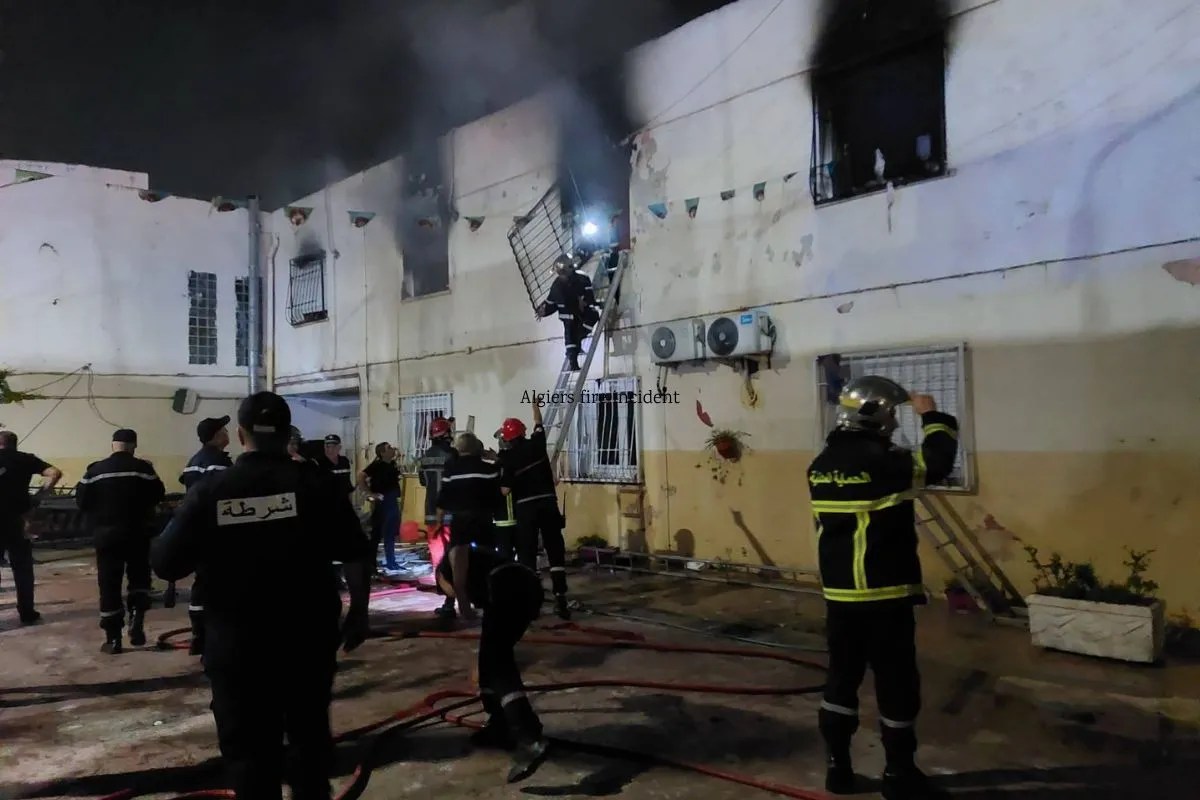
Eleven dead. Nineteen injured. Five disabled residents pulled from the ash.
When the news broke of the devastating fire at an Algerian care facility, the media quickly fell into its comfortable, well-rehearsed routine. They printed the death tolls. They praised the emergency responders who dragged five disabled survivors to safety. They published solemn statements from local bureaucrats promising "full investigations."
This is the lazy consensus of tragedy reporting. It frames the horror as an act of God, an unpredictable failure of materials, or a stroke of terrible luck.
It is none of those things.
Calling this fire an accident is a lie. It is systemic manslaughter. When we focus on the heroism of saving five people instead of asking why dozens of vulnerable individuals were trapped in a centralized tinderbox in the first place, we become complicit in the next disaster.
The Inspiration Porn Distraction
The competitor headlines rushed to highlight the rescue of five disabled residents. This is a classic media diversion tactic known as inspiration porn. It shifts the reader's emotional state from righteous anger to cheap relief.
We are supposed to feel good that five people survived. We are supposed to applaud the bravery of the rescue teams. But as someone who has audited municipal infrastructure and safety protocols in high-risk zones, this framing disgusts me.
Why were five highly vulnerable, non-ambulatory people housed in a facility where they required external rescue to survive a standard building fire?
In modern safety design, we talk about defend-in-place strategies and horizontal evacuation. If a facility housing disabled individuals relies on firefighters physically carrying people down stairs or out of windows while a building burns, that facility has already failed its most basic design requirement.
The survival of those five individuals was luck, not a victory of the system. Relying on luck is a criminal strategy when you are responsible for human lives.
The Paper Safety Illusion
Every time a tragedy like this occurs, the public demands "stricter regulations" and "more inspections." This is a fundamental misunderstanding of how institutional safety works in developing and highly bureaucratic states.
The issue is rarely a lack of regulations. Most countries have codes heavily borrowed from European or international standards. The problem is the paper safety illusion.
Municipal inspectors do not look at wiring. They look at clipboards. They check boxes, collect their fees—or bribes—and sign off on compliance certificates. The building owners display these certificates as shields against liability.
- The Certificate Myth: A piece of paper signed by a local inspector does not magically make substandard, non-flame-retardant wiring safe.
- The Extinguisher Theater: Hanging a cheap, unserviced dry-chemical fire extinguisher every fifty feet does not constitute a fire suppression strategy.
- The Locked-Door Dilemma: In orphanages and group homes, staff regularly lock exit doors to prevent residents from wandering off or to manage security with minimal staff. A locked fire exit is not an exit; it is a dead end.
I have walked through facilities where the fire exits were chained shut because the night shift only had two workers who could not monitor all access points. When a fire breaks out, those two workers cannot find the keys in the dark and smoke. The result is what we saw in Algeria: people burning alive inside a structure designed to protect them.
The Real Culprit is the Warehouse Model
We must challenge the core premise of how we care for the vulnerable. The global North and South alike remain obsessed with the warehouse model of care. We pack orphans, the elderly, and the disabled into large, centralized institutions because it is cheap and convenient for the state.
This model is a relic of the nineteenth century, and it is inherently lethal.
Warehouse Model (High Risk)             Decentralized Care (Low Risk)
----------------------------            ------------------------------
Centrally housed populations            Small-scale, community-integrated homes
Understaffed night shifts               High staff-to-resident ratios
Locked exits for "security"             Accessible, open-plan ground floor layouts
High-density, multi-story hazards       Single-story, easily evacuated structures
When you crowd dozens of people with varying levels of mobility into a single, multi-story structure, you create a high-density hazard. Add underpaid, poorly trained staff who flee at the first sign of thick black smoke, and you have designed a tragedy.
We do not need better fire drills in orphanages. We need fewer orphanages. We need to transition to decentralized, family-style, community-based care where individuals live in standard, ground-floor residential units that do not require complex evacuation plans.
Dismantling the Ignorant Questions
When public forums discuss these disasters, the conversation is dominated by useless, superficial questions. Let us dismantle them with brutal honesty.
How do we stop orphanage fires?
You do not stop them by buying better fire trucks. You stop them by dismantling the mega-orphanage system entirely. As long as you warehouse children in low-budget, institutional settings, they will remain at risk of neglect, abuse, and environmental hazards. True safety lies in family-reunification programs, foster care networks, and small group homes.
Why do fire alarms fail to save lives in these institutions?
Because a fire alarm only alerts you to the danger; it does not evacuate you. If you have thirty children and five disabled adults in a building with two staff members on duty at 3:00 AM, a screaming alarm does nothing but soundtrack the panic. Without an active, automated suppression system like quick-response sprinklers, an alarm is just a death siren.
Aren't sprinklers too expensive for developing nations?
This is the ultimate cop-out. Governments find the money for military parades, lavish administrative buildings, and political campaigns. The claim that a state cannot afford basic water-distribution systems for its most vulnerable citizens is a confession of priorities, not resources. If a state cannot afford to make an institution fire-safe, it has no right to operate it.
Stop Donating to the Firetraps
Well-meaning international donors love funding the construction of massive, shiny orphanages. They want their names on the side of a concrete building. They want the photo opportunity with smiling children.
They never want to fund the boring stuff. They do not want to pay for the yearly maintenance of a localized sprinkler system. They do not want to fund the payroll required to have a proper 1:4 staff-to-resident ratio on the night shift.
If you are donating money to build centralized institutions, you are funding future headlines like the one from Algeria. You are financing the construction of structures that lack basic compartmentalization—the architectural practice of using fire-rated walls to contain a fire to its room of origin for at least an hour.
Without compartmentalization, a fire in a laundry room becomes a toxic smoke cloud that suffocates children in their beds three floors up within ninety seconds.
Stop funding the bricks. Start demanding the systemic shift toward community integration. Demand that every dollar spent on care goes toward de-institutionalization.
The tragedy in Algeria was not an accident. It was the predictable, mathematical outcome of institutional neglect, corrupt inspection regimes, and a global preference for cheap, centralized human warehousing. Until we stop praising the rescue of the few and start condemning the system that trapped the many, the ashes will continue to pile up.