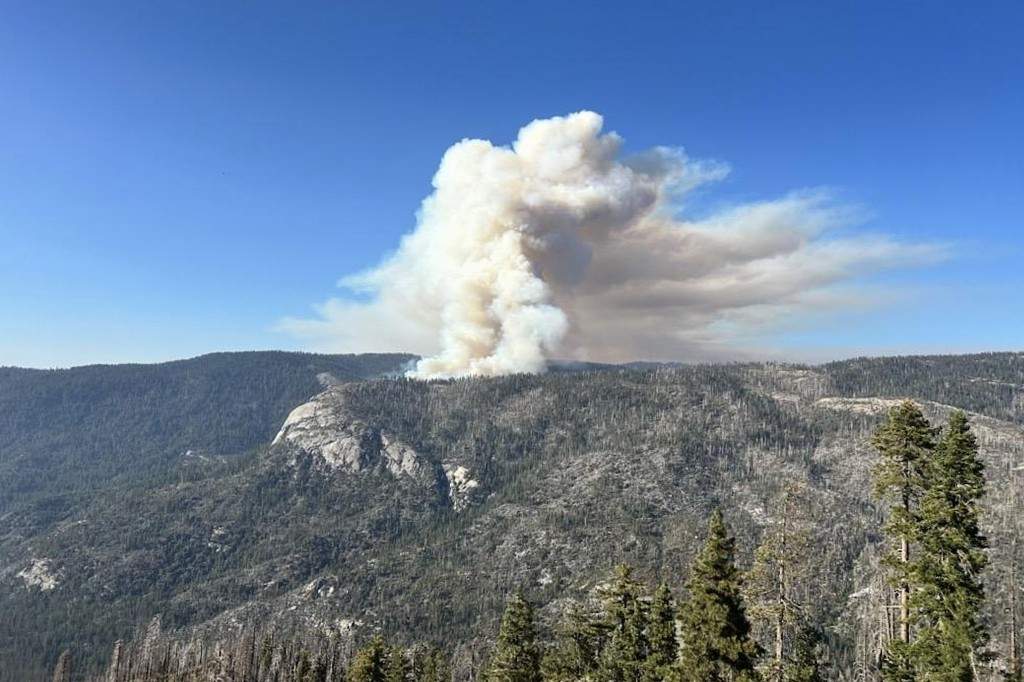
Every single time a utility helicopter drops out of the sky over a burning forest, the ritual repeats itself with nauseating predictability.
Politicians issue solemn statements about brave heroes. News anchors lower their voices to a mournful register and speak of fallen guardians. The official narrative writes itself in real time: a tragic, unavoidable accident caused by erratic winds, choking smoke, and the sheer fury of an unpredictable wildfire.
It is a comforting lie. It absolves the entire apparatus of modern wildland fire management from any accountability.
I have spent years watching the mechanics of aerial firefighting from the inside. I have seen companies flush with emergency cash while their flight crews operate machinery that belongs in a museum. I have watched risk calculations get shredded the moment a county supervisor or a federal dispatcher screams for air support to protect million-dollar vacation homes built in high-risk chaparral.
The crash near Yosemite that killed two pilots was not a freak occurrence of nature. It was the mathematical certainty of a broken system colliding with gravity. When you take obsolete, heavily modified military surplus aircraft, load them past safe performance margins, fly them through thermal updrafts dense with particulate matter, and incentivize private operators based on flight hours and deployment speed, pilots do not die by accident. They die by design.
The Economics of the Aviation Meat Grinder
To understand why pilots keep dying in firefighting helicopters, look at the money.
The commercial market for wildland suppression is dominated by private contractors operating under government tenders. These contracts are structured around perverse incentives. Many operators are paid on a seasonal retainer supplemented by hourly flight rates, or worse, strictly on a call-when-needed basis.
Under a call-when-needed structure, an operator makes zero revenue sitting on the ground. Every dollar earned depends on getting wheels up, regardless of whether visibility is zero, density altitude is off the charts, or the airframe is fatigued beyond its design limits.
This creates an unspoken psychological pressure that no safety manual can override. Pilots know that if they ground themselves due to marginal conditions, a competitor will take the flight. They internalize the risk because the financial penalty for caution is bankruptcy for the operator and unemployment for the crew.
We call them heroes to avoid calling them what they actually are: underinsured independent contractors working in a high-stakes auction house where safety equipment and modern airframes eat into profit margins.
Let us look at the fleet itself. Many of the heavy and medium lift helicopters deployed across the American West are vintage airframes engineered during the Cold War. These machines have been patched, re-wired, and retrofitted with modern avionics, but their structural metal has endured decades of heavy stress, violent vibrations, and corrosive payloads of water mixed with chemical retardants.
Corrosion from ammonium polyphosphate retardant is not a minor maintenance footnote. It is an aggressive chemical agent that eats aluminum and compromises structural integrity. When you combine decades-old airframes with the corrosive nightmare of aerial drop operations and subject them to extreme thermal cycling over an active fire front, you are operating on borrowed time. Yet, private operators continue flying these relics because the capital expenditure required to purchase modern, clean-sheet turbine helicopters is prohibitive when government contracts are short-term and volatile.
Furthermore, the maintenance oversight on private contract aircraft often exists in a regulatory gray area. While the Federal Aviation Administration sets baseline airworthiness standards, the intensity of wildland suppression pushes airframes past normal civil aviation duty cycles. When an aircraft flies ten hours a day in severe turbulence, ash-filled air, and high temperatures, standard inspection intervals become dangerously inadequate. Yet, turning an aircraft around for routine checks in the middle of a major crisis is viewed by operators as lost revenue.
The Expensive Placebo of Water Drops
The most dangerous myth in modern fire management is the belief that helicopters and airtankers are the primary solution to stopping wildfires.
Public sentiment holds that a well-placed bucket drop can extinguish or stall a raging inferno. This is a comforting illusion fed by Hollywood and nightly news broadcasts showing dramatic crimson trails of retardant.
Physics tells a different story.
A standard medium utility helicopter drops roughly three hundred to five hundred gallons of water per run. When that water hits a high-intensity crown fire driven by fifty-mile-per-hour winds, the vast majority of it evaporates before it ever reaches the burning fuel bed on the ground. It is an expensive, high-risk thermal placebo.
We are risking million-dollar machines and the lives of elite aviators to achieve tactical theater. Helicopters excel at specific, narrow tasks: inserting handcrews into remote ridgelines, extracting injured personnel, and conducting targeted precision drops on isolated spot fires before they merge. They are not aerial fire engines capable of beating back a region-scale megafire.
Yet, because the public demands visible action, political leaders exert immense pressure on incident commanders to keep aircraft in the air long past safe operating windows. When a town is threatened, optics dictate that planes and helicopters must be flying, safety limits be damned.
This political theater transforms pilots into disposable chess pieces. When visibility drops below minimums due to smoke inversion layers, or when extreme winds create severe mechanical turbulence over steep canyons, the pressure to launch remains relentless. Dispatchers pass the pressure down to base managers, who pass it down to pilots. By the time the flight crew straps into the cockpit, refusing to fly requires an extraordinary amount of professional courage against an institutional headwind.
The Myth of the Uncontrollable Act of God
Whenever an investigation report drops after a fatal aviation accident in the firefighting sector, the conclusions follow a familiar, sterile template.
Human factor error. Sudden wind shear. Unforeseen micro-meteorological phenomena.
The reports almost never indict the systemic institutional failures that placed the crew in those box canyons of risk. They rarely examine why a helicopter was dispatched into an unescapable canyon at dusk, or why maintenance logs showed recurring hydraulic anomalies that were signed off as within tolerance because the aircraft was needed on the line.
We treat wildfires as sudden acts of divine wrath, impossible to predict and impossible to manage until they break out. This is intellectually dishonest. Megafires are the predictable outcome of a century of aggressive fire suppression, poor zoning policies, irresponsible insurance subsidies in high-risk ignition zones, and a complete refusal to execute broad prescribed burning programs during low-risk windows.
Because our land management policies are paralyzed by bureaucratic inertia and environmental litigation, our forests have accumulated an unprecedented biomass load. When those forests inevitably ignite, the energy release is orders of magnitude beyond what historical suppression tactics can handle.
To compensate for our failure to manage the fuel load on the ground, we rely on a frantic, reactive air war. We demand that pilots compensate for human political cowardice with their lives.
Imagine a scenario where the federal government froze all emergency housing construction in high-risk zones, redirected billions from reactive suppression budgets into aggressive prescribed burning and mechanical thinning, and instituted mandatory, uncompromising safety stand-downs for all aerial firefighting fleets when environmental thresholds are breached.
The outcry would be immediate. Developers would sue. Politicians would panic. But pilots would stop dying in carbon-monoxide-choked canyons.
Rewriting the Rules of Engagement
If we are serious about ending the slaughter of aviation crews, we have to dismantle the current operational model. The half-measures and solemn ceremonies after every crash are nothing more than an emotional tax we pay to keep a broken system running.
First, abolish call-when-needed contracts for heavy and medium rotorcraft. Transition exclusively to dedicated, salaried, year-round federal or state-retained fleets with guaranteed maintenance standards, mandatory rest periods, and transparent safety reporting that carries zero financial penalty for grounding an aircraft. If a pilot refuses to fly because conditions are suicidal, they should be commended, not replaced by the next operator in line who is willing to roll the dice for a payday.
Second, establish an independent safety board specifically for wildland aviation, completely insulated from the political pressures of incident commanders and forestry agencies. Right now, the agencies directing the flights often hold too much influence over how accidents are investigated, creating an inherent conflict of interest that sanitizes systemic flaws.
Third, stop treating water drops as magic bullets. Educate the public and local governments that when a fire reaches extreme behavior thresholds, air operations are not going to save the day. Grounding aircraft when safety margins disappear is not cowardice; it is tactical intelligence.
We do not need another memorial service. We do not need another congressional hearing full of empty rhetoric about fallen heroes. We need an industry-wide refusal to accept that human lives are a renewable resource to be burned up in the name of political optics and outdated tactical doctrines.
Stop blaming the wind. Fix the system.


