New York City just dropped ninety-five million dollars on a shiny new underground flood defense plan, and urban planners are popping champagne. They think burying infrastructure solves extreme rain. They are wrong.
I have watched cities waste billions on subterranean concrete band-aids while the actual physics of the metropolis ignored the engineering reports. Burying more drainage boxes beneath a city built on paved-over swamps does nothing when the real bottleneck sits above ground, blocking every exit route water desperately needs to find.
Let us break down the lazy consensus behind these subterranean megaprojects and why New York is doubling down on a losing bet.
The Concrete Fallacy
The entire premise of the ninety-five million dollar subterranean defense rests on a flawed mental model. Planners look at water pooling in basements and subways, panic, and decide they need a bigger bucket underground.
This ignores a basic physical constraint. You cannot out-pipe a hurricane.
When cloudburst events dump inches of rain per hour onto asphalt, the water hits a saturated surface and runs downhill. Shoving it into deeper underground tunnels assumes those conduits have somewhere to discharge. But when sea levels rise and storm surges push back against coastal outfalls, gravity-fed drainage systems reverse direction. You do not drain the city. You pump harbor water backward into the neighborhoods.
Pumping more water into a system with blocked outlets is not engineering. It is expensive plumbing theater.
We have seen this movie before. Every major urban center that tries to out-tunnel climate change discovers the hard limit of geometry. The soil is already packed with utility lines, subway tubes, and steam pipes. Adding massive subterranean storage chambers requires displacing existing infrastructure, driving up costs, and creating single points of catastrophic failure. If a pump station fails or debris clogs an intake grate during a midnight cloudburst, the underground fortress transforms into an underground swimming pool.
The Surface Is The Real Problem
The mainstream narrative blames the storm intensity. That is a convenient dodge for municipal leaders who refuse to touch the real culprit: the urban surface itself.
New York City is a sealed lid. Over eighty percent of the landmass is impervious surface. Concrete, asphalt, rooftops, and brick reject every single drop of precipitation. When rain hits a natural forest, the soil drinks it, trees filter it, and aquifers recharge. When rain hits Manhattan or Queens, it accelerates, gathering volume and velocity until it turns local streets into raging white-water rapids.
Pouring money into underground tanks while leaving the surface sealed is like trying to bail out a sinking rowboat with a teaspoon while someone keeps drilling holes in the hull.
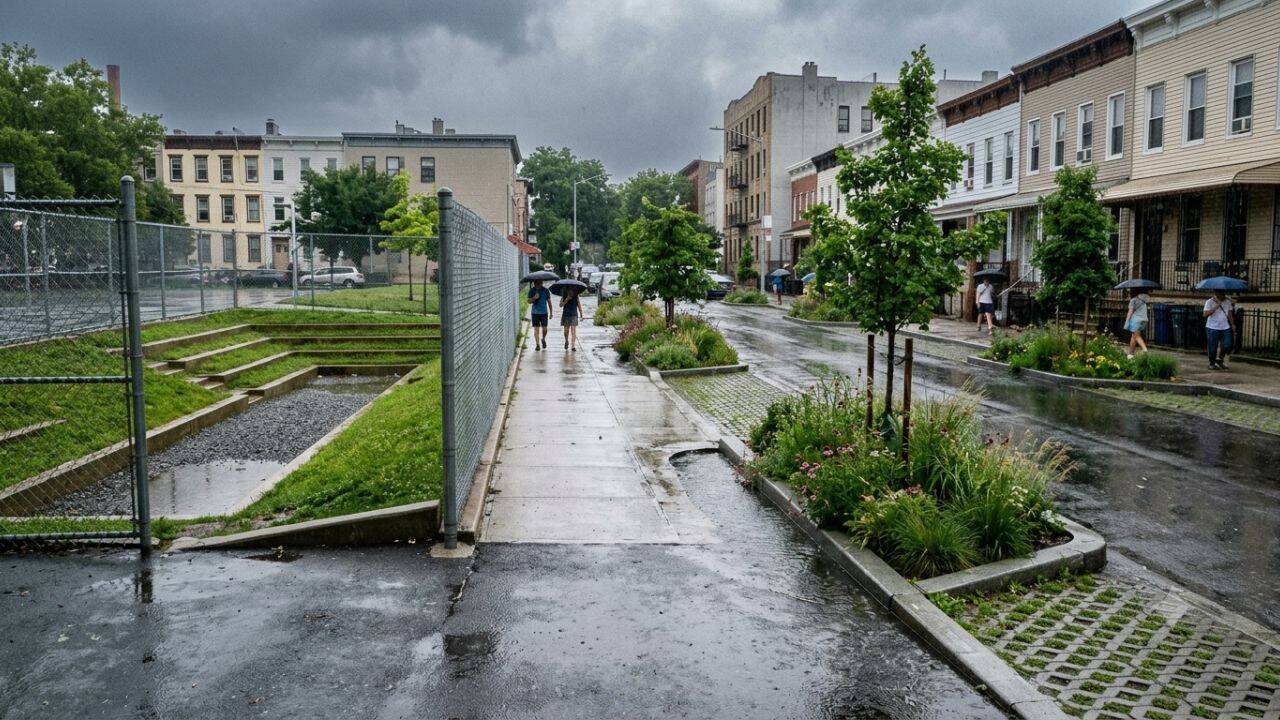
Instead of hiding water beneath the pavement, urban designers should be tearing up redundant asphalt and forcing the streetscape to absorb the blow. We need permeable pavements, sprawling rain gardens, daylighted urban creeks, and bioswales that trap moisture at the point of impact.
Admitting this truth hurts municipal balance sheets. It means fighting property owners, removing parking spots, and disrupting traffic patterns to install green infrastructure. Digging a hole underground lets politicians cut a ribbon without angering drivers.
The Maintenance Trap
Ask any municipal engineer off the record about these high-tech subterranean defenses ten years after installation, and you will hear a different story.
Underground infrastructure decays out of sight and out of mind. Sediment builds up in storage vaults. Tree roots crack hidden drainage pipes. Silt from street run-off chokes fine-mesh filters. Without continuous, aggressive, multi-million-dollar maintenance regimens, these underground structures silt up and lose fifty percent of their capacity within a decade.
Cities love capital expenditures because they look great on campaign brochures. Maintenance expenditures do not win elections. So the subterranean tanks get built, the press conference happens, and five years later, the city quietly cuts the maintenance budget to balance the fiscal year.
Imagine a scenario where a hurricane hits New York five years from now, during a municipal budget crisis, when the fancy underground valves have gone unserviced and rusted shut. The system fails worse than if it had never been built, because citizens trusted the marketing and stayed in harm's way.
What Actually Works
If we want to stop drowning every time the sky opens up, we have to flip the script entirely.
First, decentralize water management. Stop treating stormwater as a waste product that must be whisked away through hidden pipes. Treat it as a localized resource or an immediate threat that must be slowed down right where it falls. Mandate green roofs on every commercial building over three stories. If the water cannot run off the roof, it never reaches the street.
Second, redesign streets as temporary retention basins. Cities like Amsterdam and Copenhagen use public plazas, skate parks, and athletic fields as intentional flood bowls. When normal days roll around, citizens play soccer or drink coffee. When a cloudburst hits, those spaces flood intentionally, keeping water out of residential basements and subway lines. It costs a fraction of deep-tunnel excavation and utilizes open space intelligently.
Third, stop building in the sponge zones. Wetlands and marshes are nature's shock absorbers. Paving over them to construct luxury high-rises and then spending nine-figure sums on underground walls to protect those buildings is economic insanity.
The next time a city announces a massive underground defense project, check who profits. It is rarely the residents whose cellars fill with water. It is the contractors writing the excavation bids.
Stop digging. Start absorbing.