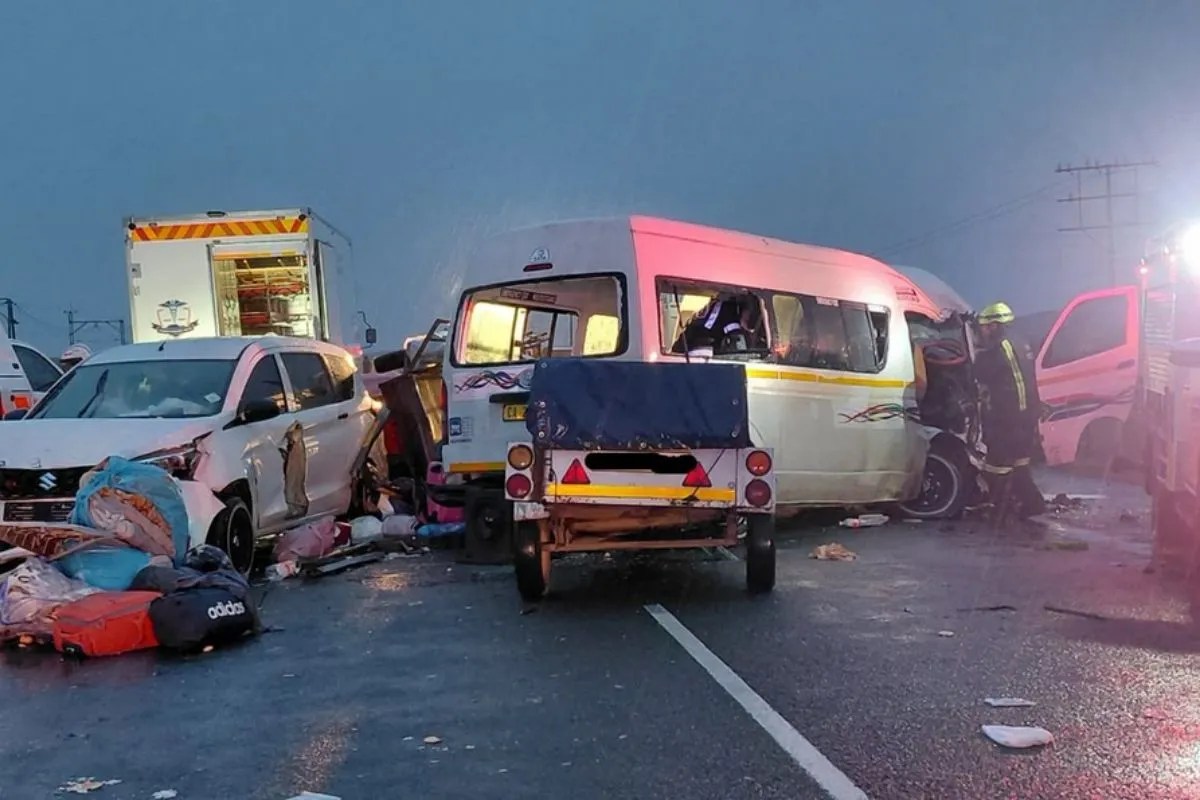
Another headline flashes across the screen. Another twenty-one souls wiped out in a matter of seconds on a stretch of national highway. The ritual follows like clockwork. Politicians issue hollow condolences laden with exhausted clichés about road safety. Pious commentators shake their heads at the moral decay of modern motorists. The police chief steps up to microphones to wag a finger at human error, excessive speed, and fatigue.
It is a convenient, comfortable lie.
It is an institutional alibi designed to protect the architects of a failing state. Every time a catastrophic collision occurs on South African tarmac, the public is spoon-fed a narrative that individual recklessness is the sole author of the tragedy. This framing is lazy, cowardly, and factually bankrupt. The slaughter on these transport corridors is not a series of unfortunate events or isolated driver failures. It is a manufactured outcome. It is the direct consequence of systemic economic rot, logistical collapse, and a deliberate refusal to invest in heavy infrastructure.
When you treat roads as a dumping ground for a broken cargo network and force millions of exhausted workers into deathtrap vehicles over impossible distances, you are not experiencing accidents. You are watching a slow-motion structural execution.
The Comfortable Illusion of Driver Blame
Blaming the driver is the oldest trick in the bureaucratic playbook. If the crash is the driver's fault, the state bears no liability. The Ministry of Transport does not have to answer for crumbling asphalt, missing guardrails, unlit intersections, or the total absence of median barriers. The road maintenance budget can be quietly siphoned away into administrative bloat or corrupt tender loops, because public outrage can always be safely redirected toward a dead or traumatized motorist.
Consider the standard accident report. It almost invariably cites reckless overtaking, speeding, or fatigue. It treats these behaviors as moral choices made in a vacuum. It ignores the environmental pressures that manufacture those choices every single day.
Imagine a long-distance minibus driver staring down a twelve-hour shift across poorly lit, pothole-riddled provincial routes. The vehicle is packed beyond capacity because the operator must turn a profit to survive in an informal economy abandoned by formal credit markets. The driver is not speeding for the thrill of the velocity. They are speeding because their daily wage depends entirely on completing multiple rotations before dark. They are exhausted not because they lack discipline, but because they are trapped in a grinding socioeconomic survival loop where sleep is an unaffordable luxury.
When that driver nods off at the wheel and crosses into oncoming traffic, pointing the finger at them is an act of supreme intellectual dishonesty. The system built the trap. The driver merely sprung it.
The Freight Crisis is the Real Murderer
To understand why South African roads are killing fields, you have to look away from the asphalt and look at the rail lines. Or rather, look at the ghost of the rail lines.
For decades, the country possessed one of the most sophisticated heavy rail networks on the continent. Minerals, manufactured goods, and bulk commodities moved efficiently across the land on steel tracks, safely segregated from everyday passenger traffic. Then came the era of systemic looting, infrastructural sabotage, component theft, and managerial paralysis at the state logistics enterprise. The freight rail network effectively imploded.
Millions of tons of cargo that belonged on trains were overnight dumped onto national highways.
Multiaxle diesel juggernauts now pound two-lane national arteries day and night. These roads were never engineered to bear the continuous thermal and physical weight of heavy freight traffic. The results are visible to anyone with eyes: deep rutting, disintegrating shoulders, and massive craters that can swallow a front tire at one hundred kilometers per hour.
When a passenger vehicle swerves to avoid a crater and collides with an oncoming freight truck, the state calls it a driver error. In reality, it is a infrastructure failure caused by the collapse of rail logistics. By forcing heavy commerce onto narrow public roads, the government created a chaotic battlefield where passenger cars and massive commercial trucks share the exact same narrow lanes at high velocities.
This is not transportation policy. This is institutional negligence on a national scale.
The Licensing Syndicate and Institutional Rot
Let us talk about roadworthiness, or the complete lack thereof.
A functioning state maintains rigorous standards for vehicle maintenance and driver competence. Testing stations are supposed to be fortresses of objectivity. In practice, many provincial and municipal testing centers have transformed into transactional clearinghouses where certificates of roadworthiness are bought and sold like fast food.
Worn-out brake pads, bald tires, compromised steering linkages, and rusted chassis frames receive official stamps of approval every single day in exchange for a bribe slipped across a desk or mobile payment transferred to a clerk. Commercial buses with millions of kilometers on the clock and structural frame fatigue are cleared to carry passengers across provincial borders.
When a braking system fails on a steep mountain pass, sending a bus tumbling into a ravine, the media focuses on the driver's panic. Nobody investigates the testing station inspector who signed off on brake fluid leaks three weeks prior for a cash bribe. Nobody holds accountable the municipal managers who treat licensing departments as revenue collection agencies rather than safety checkpoints.
The rot starts at the top of the administrative ladder and trickles down to the inspectorate, leaving the end user to pay for the corruption with their lives.
Enforcement Theater and the Tax Collector in Uniform
Drive down any major national route in the country, and you will encounter the great enforcement theater.
Traffic authorities love setting up speed traps on long, straight, perfectly safe stretches of open road where drivers naturally drift a few kilometers over the limit. Why? Because it is easy. It requires zero tactical effort, poses no physical danger to the officers, and generates immediate cash through traffic fines.
Meanwhile, actual dangerous driving goes completely unchecked. Reckless overtaking on blind rises, illegal yellow-lane driving, aggressive tailgating by commercial fleets, and blatant disregard for basic right-of-way rules happen right under the noses of traffic police who are too busy negotiating cash bribes at roadblocks or hiding behind bushes with mobile cameras.
Road policing has been outsourced to revenue generation. When the primary performance metric of a traffic department is the number of fines issued rather than the reduction of fatalities, safety becomes secondary to budget balancing. Motorists quickly learn to view traffic officers not as guardians of public safety, but as highway extortionists. This breeds a culture of mutual hostility where drivers try to outsmart enforcement rather than cooperate with safety standards.
When enforcement is viewed as a game of cat-and-mouse rather than a sacred public trust, enforcement loses its deterrent value entirely.
Spatial Apartheid on Asphalt
You cannot separate South African road safety from the geography of the nation. Decades after the formal end of apartheid, the spatial layout of cities remains fundamentally fractured. Working-class populations are pushed to the distant urban peripheries, far away from economic hubs.
This creates a daily mass migration of epic proportions. Millions of workers must commute immense distances every single morning and evening. Because public transport infrastructure is either completely dysfunctional, non-existent, or unaffordable, these commuters are forced into the unregulated minibus taxi industry.
The minibus taxi sector is an extraordinary feat of grassroots entrepreneurship, but it is also a ticking time bomb built on perverse economic incentives. Operators do not make money when vehicles are parked. They make money when vehicles are moving, loaded to maximum capacity, moving as fast as humanly possible, as many times a day as they can manage.
This economic reality forces drivers onto the road while suffering from extreme sleep deprivation. It encourages mechanical neglect because maintenance cuts directly into daily profit margins. It creates an aggressive, hyper-competitive driving culture where drivers fight tooth and nail for every passenger at every roadside stop.
The state watches this unfold and responds with hand-wringing and temporary roadblocks, while refusing to build reliable, high-capacity, electrified commuter rail systems that could transport millions of people safely in bulk. As long as working people are forced to travel hundreds of kilometers every day in poorly maintained, over-packed vans across dangerous roads just to earn a living, the body count will continue to rise.
The Structural Solution Nobody Wants to Fund
Fixing this crisis requires courage, capital, and a complete abandonment of political complacency. It requires measures that do not fit into a quick ministerial press briefing or a catchy social media hashtag.
First, the freight must get off the asphalt. The state must prioritize the absolute restoration and protection of the rail network through private-public partnerships, armed security for copper lines, and aggressive infrastructural overhaul. Every ton of coal, container, and bulk commodity moved off a national road and onto a freight train is an immediate reduction in the probability of a catastrophic multi-vehicle collision.
Second, testing stations must be stripped from corrupt municipal control and placed under independent federal audit with severe mandatory minimum prison sentences for corruption involving roadworthiness certificates. If a vehicle passes inspection illegally and later causes a fatal crash, the inspector who signed off on it should face criminal manslaughter charges. That would clean up the testing system overnight.
Third, national road design must be modernized. Single-lane national corridors carrying heavy freight alongside light commuter traffic are an anachronism from a bygone era. They require physical median barriers, widened shoulders, and dedicated freight lanes that physically separate heavy commercial vehicles from passenger cars.
Fourth, the state must subsidize and secure mass public rail transit for the working class, dismantling the desperate economic pressures that sustain the dangerous edges of the minibus taxi industry.
None of these solutions are cheap. None of them are quick. They require years of disciplined engineering, massive capital expenditure, and uncompromising oversight.
That is precisely why politicians will never prioritize them. It is far easier to blame the driver, shed a tear for the cameras, wait for the public outrage to fade, and then wait for the next twenty-one people to die on the tarmac.
Stop accepting the official lie. The roads are not dangerous by accident. They are lethal by design.