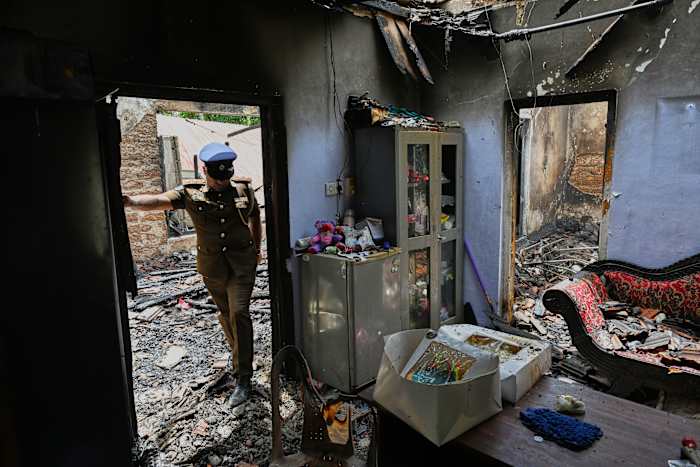
The media coverage surrounding the tragic fire at the Mawpiya Sevana care home in Anguruwatota, Sri Lanka, follows a predictable, lazy script. A fire rips through an overcrowded facility. Twelve vulnerable people lose their lives. The state immediately steps in, arrests the owner for criminal negligence, and the public nods along, satisfied that the villain has been caught.
This reaction misses the entire point.
Arresting a single negligent operator in the Kalutara district feels like justice, but it fixes absolutely nothing. It treats a systemic structural failure as an isolated moral failure. The mainstream narrative wants you to believe that if we just weed out the corrupt or careless actors, our elders will be safe.
They are wrong. The disaster in Anguruwatota is not a story about one bad manager. It is a mathematical certainty born of a massive institutional void in developing economies.
The Illusion of Regulation
According to the National Secretariat for Elders, the facility was entirely unregistered. It was built to hold 15 people but crammed in over 70, including individuals suffering from severe mental illnesses. The state claims it previously visited the site and issued warnings.
Think about that logic for a second.
If a regulatory body knows an illegal, highly flammable facility is packing human beings in at five times its capacity, and its only response is to hand over a piece of paper saying "please stop," the regulation itself is a myth.
I have seen regional authorities across developing markets deploy this exact defense mechanism after a disaster. They point to their stack of unanswered warning letters to wash their hands of blood. It is a bureaucratic shield. When enforcement lacks teeth, a warning is just documentation for the upcoming inquest.
The state did not fail to regulate this home; the state used the home as an unofficial pressure valve.
The Unspoken Economics of Elder Care
The harsh reality that nobody wants to publish is that unregistered, dangerous care homes exist because there is an overwhelming, desperate demand for them.
Sri Lanka possesses one of the fastest-aging populations in South Asia. The traditional family structure—where multiple generations live under one roof and children care for their aging parents—is buckling under severe economic realities. People must work. They cannot provide 24-hour care for a bedridden relative or someone with complex psychiatric needs.
What are the options?
- State-run facilities: Chronically underfunded, with waiting lists that stretch on for years.
- Premium private care: Exorbitantly expensive, completely out of reach for the average citizen.
- The informal gray market: Unregistered homes that charge a fraction of the price by cutting every single corner.
When a family chooses a place like Mawpiya Sevana, they are rarely doing so out of malice or apathy. They do it because the alternative is total financial ruin or leaving a vulnerable relative entirely unmonitored at home.
By shutting down every unregistered facility without creating a viable alternative, you do not protect the elderly. You displace them back into homes that lack even basic medical supplies.
The Overcrowding Paradox
Mainstream articles hyper-focus on the fact that 71 people were crammed into a space meant for 15. They paint a picture of pure greed.
Let us look at the brutal logistics. In low-margin elder care, operational survival depends entirely on scale. If an operator charges a rock-bottom rate to keep the service affordable for poor families, they cannot pay rent, electricity, and staff salaries with 15 residents. The math does not work.
To stay afloat, they add more beds. Then more beds. Then they take in psychiatric patients because nobody else will take them.
[Low Fees] -> [High Capacity Required] -> [Extreme Overcrowding] -> [Systemic Risk]
This creates a vicious cycle where affordability directly correlates with a higher body count when something goes wrong. The tragedy is not that the owner wanted to get rich; it is that the business model of humanitarian care for the impoverished requires hazardous density to break even.
Why Gas Cylinders Are Not The Problem
Initial reports point toward a potential gas cylinder explosion that accelerated the blaze. The immediate public reaction will be to call for stricter inspections of kitchen equipment.
This is a classic misdirection. The ignition source is irrelevant. Whether it was a faulty regulator on a propane tank, a short circuit in ancient wiring, or a discarded cigarette, the result would have been identical.
The real killer was the lack of compartmentalization and egress. When you have dozens of mobility-impaired residents sleeping in a retrofitted residential property without fire doors, external fire escapes, or automated suppression systems, any spark triggers a mass casualty event.
Fixing the gas tanks does not fix the architecture of a death trap.
The Flawed Questions We Keep Asking
Look at the standard inquiries popping up in the wake of this disaster. They are fundamentally broken.
Flawed Question: How do we completely eliminate unregistered care homes?
The Real Answer: You do not. If you ban them by fiat tomorrow, they will simply move further underground, out of sight of even basic local police oversight.
Flawed Question: Why did the neighbors not report the conditions sooner?
The Real Answer: Because the community relied on it. The local residents and police officers who rushed in to save 51 survivors knew exactly what that building was. They tolerated the risk because the facility filled a void the government ignored.
The Dangerous Downside of the Crackdown
Watch what happens next. The government will launch a sweeping, highly publicized crackdown on every unregistered elder care facility in the Western Province. Inspectors will march around, slap padlocks on doors, and generate great headlines.
And where do the thousands of displaced, frail residents go?
In this specific case, 51 survivors were moved temporarily to a local school. A school is not a medical facility. It does not have specialized beds, medication distribution channels, or climate control suited for the infirm. The immediate disruption, stress, and relocation trauma will likely claim more lives over the coming months than the fire itself.
Chasing the optical win of "shutting down illegal homes" creates a secondary humanitarian crisis that happens quietly, in dark rooms, away from television cameras.
The Only Unconventional Path Forward
If we actually care about preventing the next twelve deaths, we have to stop demanding impossible standards from an underfunded sector. Instead of trying to force informal care homes to become pristine, Western-style medical centers overnight, we must legalize and subsidize the gray market.
The state needs to acknowledge that these low-cost, high-density homes are a permanent fixture of the socioeconomic landscape.
Instead of issuing useless warnings, the government should provide basic, non-negotiable safety infrastructure for free. Hand out industrial fire extinguishers. Install battery-powered smoke alarms in every room. Mandate and map out clear, unblocked exit paths.
If an operator cannot afford to fix their wiring, the state should subsidize the electrician, because treating care homes as purely private enterprises while relying on them as public utilities is a fatal contradiction.
Stop looking for a single villain to blame for a tragedy built by structural poverty, demographic shifts, and institutional blindness. The system worked exactly the way it was designed to, and until the underlying economics change, the next fire is already burning.