Medical tech journalists love a binary fight. Either a new therapy is a miracle cure that renders chemotherapy obsolete, or it is overhyped vaporware draining venture capital.
The prevailing consensus around next-generation therapeutic ultrasound falls right into this trap. Critics look at High-Intensity Focused Ultrasound (HIFU) and histotripsy, point out that they have not replaced surgical resection for stage IV solid tumors, and declare that the clinical evidence falls short of the commercial noise.
That take is lazy. It is also completely backwards.
Evaluating therapeutic ultrasound solely as a standalone replacement for the scalpel misses the entire point of acoustic oncology. I have watched medtech startups burn through tens of millions of dollars chasing broad "cure" claims for primary tumor ablation, only to stall out in Phase II trials when microscopic satellite lesions inevitably grew back. Meanwhile, the real clinical revolution is happening in the margins—not by boiling tumors away, but by using sound waves to crack open the biological fortresses that make immunotherapy and chemotherapy fail in the first place.
The Thermal Ablation Trap
To understand why the commercial hype feels disconnected from clinical reality, you have to separate two completely different physical mechanisms that lazy reporting lumps together.
Traditional HIFU relies on thermal ablation. You focus acoustic energy onto a focal point—roughly the size of a grain of rice—and heat the tissue to above 60 degrees Celsius. The cells cook. Coagulative necrosis sets in.
On paper, burning a tumor out of the body without a single incision sounds like peak medicine. In practice, physics fights back.
- The Heat Sink Effect: Tumors do not sit in a vacuum. They sit next to major blood vessels. Flowing blood acts as a radiator, wicking thermal energy away from the target zone faster than the transducer can deposit it. Leave a single millimeter of viable tumor rim along a hepatic vein, and the cancer returns.
- Acoustic Shadowing: Ultrasound waves hate air and bone. Try aiming a high-intensity beam at a pancreatic tumor behind bowel gas, or a liver lesion tucked behind the ribcage. The ribs absorb the energy, risking severe skin and bone burns, while scattering the beam before it ever reaches the target.
- Respiratory Motion: Organs move. A liver shifts up to two centimeters with every breath. Tracking a moving target with a thermal focal point requires gating systems and anesthesia protocols that turn a "simple outpatient procedure" into a multi-hour logistical nightmare.
When companies pitch thermal HIFU as a universal cancer eraser, oncologists rightly roll their eyes. Surgical oncologists like those at Memorial Sloan Kettering and MD Anderson know that if you can safely cut a localized tumor out with clean margins, surgery remains the gold standard. Burning it blindly while fighting blood flow and rib shadows is rarely the smarter bet.
Histotripsy Changed the Physics, Not the Problem
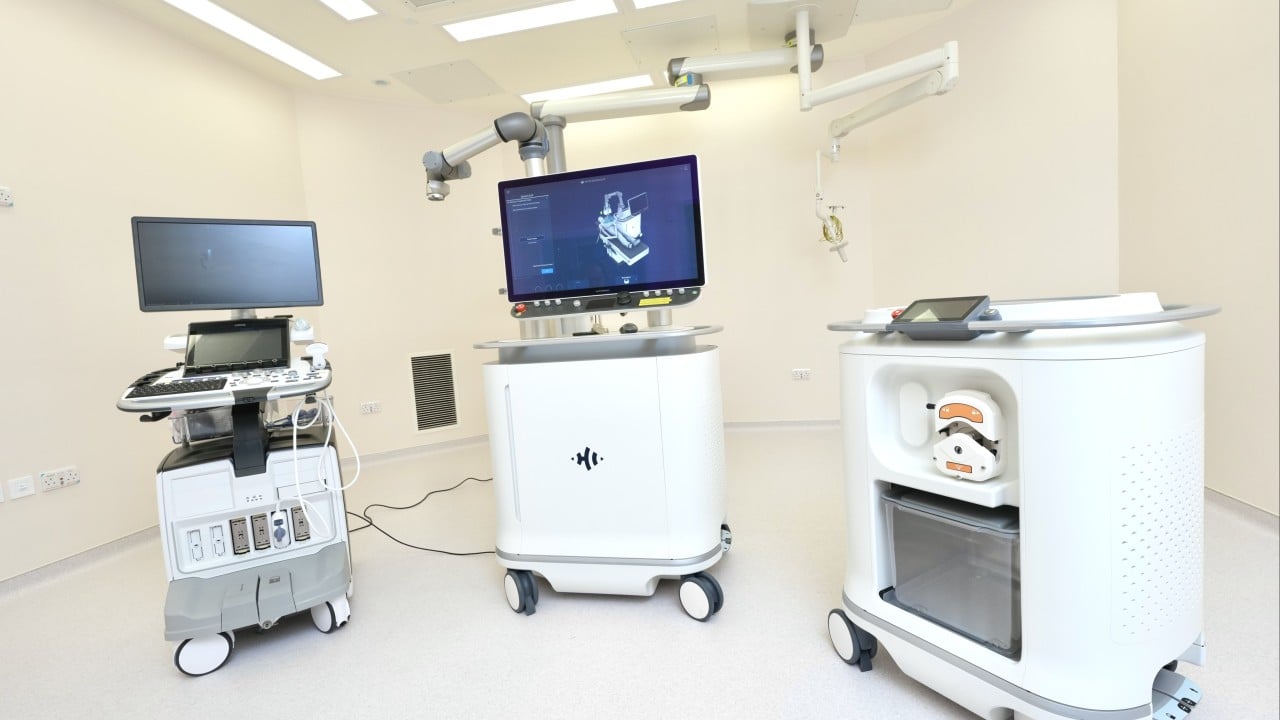
Enter histotripsy. Developed largely out of the University of Michigan and commercialized by HistoSonics with their Edison system, histotripsy ditches heat entirely.
Instead of cooking tissue with continuous waves, histotripsy fires microsecond-long, high-pressure acoustic pulses. These pulses generate localized cavitation—microscopic bubble clouds that form, expand, and violently collapse in fractions of a millisecond. The mechanical shear stress liquefies tumor cells into an acellular, subcellular slurry that the body's lymphatic system quietly clears away over weeks.
Because it is non-thermal, histotripsy ignores the heat sink effect. Blood vessels and bile ducts, which have higher collagen content and greater tensile strength than fragile cancer cells, often remain structurally intact right through the treatment zone. The FDA's De Novo clearance of histotripsy for liver tumors validated what acoustic engineers have argued for decades: mechanical fractionation is far cleaner and more predictable than thermal cooking.
Yet even histotripsy suffers from the same fundamental limitation when framed as a solo act. Cancer is rarely a single mechanical problem. By the time a solid tumor is visible on a diagnostic scan, it is often a systemic disease. Liquefying a three-centimeter liver metastasis does nothing if microscopic clusters are already seeding the lungs.
If you judge next-gen ultrasound purely on its ability to eradicate localized masses as a monotherapy, the skeptics win. The evidence will always look incremental compared to the marketing decks.
The Real Disruption Is Mechanical Immunomodulation
Here is the nuance the skeptics completely miss: what happens to the debris.
When you thermally ablate a tumor with traditional HIFU or radiofrequency ablation, you denature the proteins. You essentially fry the tumor antigens into unrecognizable lumps of carbonized tissue. The immune system looks at the site, sees necrotic scar tissue, and moves on.
Histotripsy and low-intensity pulsed ultrasound do the exact opposite. Because histotripsy shreds cells mechanically without heat, it leaves tumor-associated antigens completely intact. It dumps a massive, recognizable payload of undamaged cancer proteins, danger-associated molecular patterns (DAMPs), and neoantigens directly into the bloodstream and lymphatic channels.
Suddenly, a "cold" tumor—one that was invisible to the patient's T-cells—turns into an in-situ personalized cancer vaccine.
Research led by teams at the University of Michigan and Virginia Tech has demonstrated the abscopal effect in preclinical models: liquefying one tumor with histotripsy triggers a systemic CD8+ T-cell response that shrinks untreated distant tumors in the exact same animal.
And it goes deeper than cavitation. Look at what researchers like Dr. Costas Arvanitis at Georgia Tech and teams at Sunnybrook Research Institute in Toronto are doing with microbubble-mediated blood-brain barrier (BBB) opening.
Glioblastoma and brain metastases have historically been death sentences largely because 98 percent of small-molecule drugs and virtually all large monoclonal antibodies cannot cross the blood-brain barrier. You can invent the most targeted antibody-drug conjugate on the planet, and it will bounce harmlessly off the cerebral endothelium.
By injecting lipid-shelled microbubbles intravenously and applying low-intensity focused ultrasound (LIFU) to the brain, the microbubbles oscillate—a process called stable cavitation. This gentle mechanical massage temporarily stretches the tight junctions between endothelial cells for a few hours. During that window, drugs like doxorubicin, carboplatin, or checkpoint inhibitors flood directly into the tumor microenvironment at concentrations up to ten times higher than standard systemic delivery allows.
No cutting. No burning. Just using physics to unlock pharmacology.
Why Wall Street and VCs Misread the Timeline
If the science behind ultrasound-mediated drug delivery and immunomodulation is this compelling, why does the commercial landscape feel so messy?
Because clinical adoption in oncology moves at the speed of reimbursement codes, not pitch decks.
- The Capital Equipment Bottleneck: Unlike a pharmaceutical pill that scales via manufacturing and distribution, focused ultrasound requires hospitals to buy million-dollar capital equipment, dedicate specialized procedural suites, and train interventional radiologists on unfamiliar acoustic physics. Hospital CFOs do not buy seven-figure machines based on promising Phase I biomarker data. They buy them when there is a dedicated CPT code and guaranteed Medicare reimbursement.
- The Combination Trial Paradox: The highest-value use case for next-gen ultrasound is pairing it with blockbuster checkpoint inhibitors like pembrolizumab or nivolumab. However, running combination trials requires convincing a massive pharma company to supply expensive drugs and share clinical risk with a small medtech device maker. Pharma executives are notoriously risk-averse when it comes to adding hardware variables to clean drug trials.
- Operator Dependency: Diagnostic ultrasound is already the most operator-dependent imaging modality in medicine. Therapeutic ultrasound multiplies that complexity. Variations in skull thickness, subcutaneous fat layers, and tissue attenuation mean that acoustic dosing is notoriously difficult to standardize across a hundred different community hospitals.
I have sat in boardrooms where executives tried to paper over these operational realities with slick animations of sound waves vaporizing glowing red tumors. That is where the hype becomes toxic. When startups promise immediate disruption of surgical oncology, they set themselves up for brutal commercial misses when adoption takes ten years instead of two.
Dismantling the Common Misconceptions
Patients, investors, and even general practitioners routinely ask the wrong questions about this technology. Let's strip away the noise.
Does focused ultrasound replace chemotherapy and radiation?
No. Anyone claiming it will replace systemic therapy in the next decade does not understand metastatic biology. Focused ultrasound is a local-regional tool. Its highest value lies in sensitizing tumors to chemotherapy, radiation, and immunotherapy—allowing oncologists to use lower, less toxic drug doses while achieving higher intratumoral concentrations.
Is ultrasound cancer treatment completely free of side effects?
Not even close. Calling it "non-invasive" makes people think it is as benign as a prenatal scan. In reality, high-energy acoustic beams carry serious risks. Misdirected energy can cause third-degree skin burns, bowel perforation, nerve damage, and severe venous thrombosis. In histotripsy of the liver, rapid lysis of massive tumor volumes carries a real risk of tumor lysis syndrome and transient spikes in liver enzymes. Non-invasive simply means no scalpel; it does not mean zero trauma.
If histotripsy is so effective, why isn't every cancer center offering it?
Because precision requires infrastructure. Beyond the upfront cost of the console, effective delivery demands high-resolution real-time imaging guidance (either diagnostic ultrasound or MRI) and strict patient selection. If a tumor is obscured by bone or gas, or if the patient has widespread, rapidly progressing systemic disease, putting them on a histotripsy table wastes precious time they should spend starting systemic therapy.
The Honest Downsides of the Contrarian View
Betting on ultrasound as an adjuvant immunomodulator and drug-delivery enabler—rather than a standalone ablative cure—is the smarter thesis. It is also the harder one to execute.
When you position a medical device as a combination enhancer, you surrender control over your own clinical destiny. Your regulatory approval becomes tethered to someone else's drug. If a partner pharma company's immunotherapy fails to hit an overall survival endpoint in a Phase III trial, your ultrasound platform gets dragged down with it, even if your device successfully opened the blood-brain barrier or doubled antigen presentation.
Furthermore, acoustic dosing remains an unsolved engineering headache. Imagine a scenario where two patients receive the exact same acoustic output for a pancreatic tumor. Patient A has a thin abdominal wall and minimal visceral fat; the focal point hits the tumor with textbook cavitation. Patient B has three inches of subcutaneous adipose tissue that absorbs and scatters the beam; the tumor receives sub-therapeutic energy, leaving the clinician guessing whether the treatment worked until a follow-up MRI weeks later. Until real-time cavitation mapping and closed-loop acoustic feedback become standard across every commercial platform, consistent dosing across diverse patient anatomies will remain a major clinical hurdle.
How to Actually Evaluate Acoustic Oncology
If you are an investor, a clinician, or a patient sorting through the press releases on next-generation ultrasound, stop reading the top-line marketing claims about "scarless tumor destruction." Look at the mechanics instead.
- Ignore standalone cure claims for aggressive solid tumors. Look for clinical trials combining focused ultrasound with checkpoint inhibitors, CAR-T therapies, or targeted biologics. That is where the synergistic survival curves will emerge.
- Watch the real-time feedback loops. Any platform firing high-intensity energy without real-time thermometry (via MRI) or passive cavitation detection (via acoustic sensors) is flying blind. The winners in this space will be the companies that can prove, millisecond by millisecond, what happened at the focal point.
- Follow the blood-brain barrier trials. The clearest, most undeniable clinical moat for focused ultrasound is neuro-oncology. No scalpel can easily reach diffuse midline gliomas, and no pill can easily cross an intact BBB. Companies like Insightec and Carthera are proving that acoustic opening of the brain is not a parlor trick—it is a fundamental prerequisite for treating central nervous system malignancies.
The skeptics who dismiss next-gen ultrasound because it hasn't put surgical oncologists out of business are judging a submarine by how fast it drives on a highway. Acoustic energy was never meant to be a better scalpel. It is a mechanical key designed to unlock tumors that drugs and immune cells couldn't reach—and the clinical data proving that is already here.