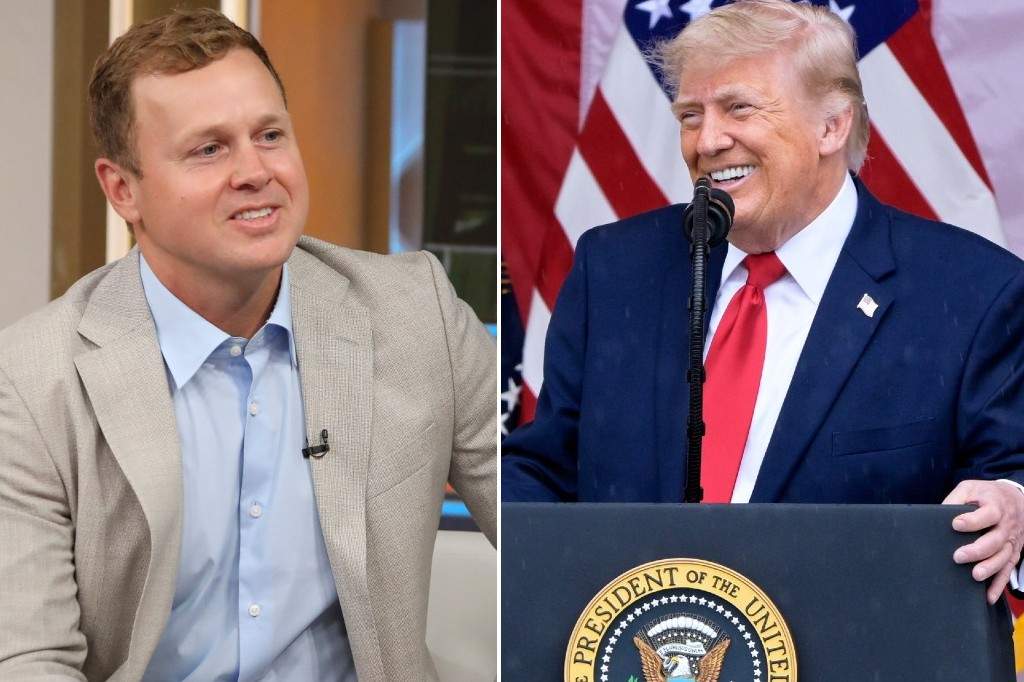
Political journalists are lazy. They see a former reality television villain running for Mayor of Los Angeles, they see Donald Trump offer a casual nod of approval at Joint Base Andrews, and they immediately sprint to their laptops to type out the same predictable, copy-pasted narrative. They treat Spencer Pratt’s dismissal of traditional political endorsements as a bizarre stunt or a sign of an amateur operation. They gasp at his claim that he only needs the support of "Democratic moms who do not feel safe." They mock his viral, AI-generated Batman campaign ads.
They are completely missing the mechanics of how modern attention operates.
The media legacy machine is evaluating a 2026 political campaign using a 2004 framework. They think endorsements from senators, labor unions, and party elites still carry weight. They do not. In a fractured, high-stimulus media ecosystem, traditional endorsements are not just useless; they are an anchor. Spencer Pratt isn't blowing off endorsements because he’s a political novice who doesn't know how to fill out a compliance form. He is blowing them off because he understands that the old institutional rubber stamps have a negative return on investment.
The Negative ROI of Institutional Approvals
Let’s dismantle the absolute myth of the political endorsement. For decades, the political consultant class has extracted billions of dollars from donors by pushing a simple lie: that getting a nod from an establishment figure moves the needle.
It doesn't.
When an establishment politician endorses a candidate, two things happen, and both of them are bad for a populist campaign:
- The Bureaucratic Stain: It signals to the voter that the candidate is housebroken. It tells the electorate that you have been vetted and approved by the exact system they blame for their problems.
- The Media Disregard: It creates a predictable narrative that the press can instantly categorize and ignore.
Consider the math of the Los Angeles electorate. The city is overwhelmingly Democratic. If Pratt, running as a registered Republican, aggressively leaned into traditional conservative party endorsements, he would instantly cap his ceiling at the city's 15% Republican baseline. He would be dead on arrival.
By rejecting the necessity of endorsements—even a favorable mention from Trump, who noted he'd "like to see him do well"—Pratt detaches himself from national partisan warfare. When he told reporters that "the president has nothing to do with why my streets have naked drug addicts," he wasn't just being combative. He was executing a calculated positioning strategy. He insulated his campaign from national polarization and forced the conversation back to localized, visceral failures: potholes, unlit streetlights, and the ashes of the 2025 Palisades fire that claimed his home.
Why "Democratic Moms" is a High-Yield Target Demography
The mainstream press treated Pratt's pivot to "Democratic moms" as a laughable contradiction. How does a Republican candidate surfing on a wave of MAGA-adjacent internet buzz win over registered Democrats in a progressive stronghold?
It is actually a textbook example of finding an unserved market niche.
In political marketing, the most valuable asset is not the voter who already agrees with you on everything. It is the voter who is deeply uncomfortable with their own party’s performance but feels socially paralyzed from changing their vote.
Traditional Strategy: Target Base Voters -> Maximum Polarization -> Low Growth
Pratt Strategy: Target Single-Issue Deciders (Safety/Crisis) -> High Growth Potential
The incumbent administration under Karen Bass is vulnerable on specific, lived-experience metrics: public safety, visible homelessness, and the slow bureaucratic response to natural disasters. By explicitly targeting mothers who feel unsafe, Pratt bypasses ideological filters entirely. He appeals directly to a primal, protective instinct that cuts through party registration.
I have watched corporate brands waste millions of dollars trying to appeal to broad, generic demographics, only to get crushed by agile competitors who target a specific, highly emotional pain point. Pratt is doing exactly that. He isn't running on a conservative platform; he is running on an existential platform. He is betting that the fear of a neighborhood burning down or a park becoming unusable is stronger than a voter’s loyalty to a party line.
The AI Ad Strategy is Smarter Than Your Whole Consultant Team
The chattering class loves to look down on Pratt’s bizarre campaign media—specifically the viral, AI-generated videos depicting him as a dark knight saving a dystopian Los Angeles from a socialist cabal. Late-night hosts dissect these clips as evidence of a narcissistic delusion, a desperate attempt by a reality star to become relevant again.
This view is completely wrong. Those ads are highly effective pieces of political communication for three distinct reasons:
1. Zero Production Overhead, Maximum Distribution
Traditional political commercials cost hundreds of thousands of dollars to shoot, edit, and place on local television networks that younger demographics don't even watch. Pratt’s generative video pipeline allows him to produce high-impact, visually arresting narratives for pennies, which then achieve millions of organic impressions via social media algorithms.
2. The Kitsch Shield
Because the videos are blatantly surreal—featuring lightsabers and superhero costumes—they bypass the audience's natural defense mechanisms against political advertising. People share them because they are entertaining, not because they agree with the message. But every time that video is shared, the underlying premise (that Los Angeles is in ruins due to failed leadership) is reinforced.
3. Absolute Message Control
Traditional campaigns spend weeks focus-grouping a single phrase. Pratt can test ten different narratives in forty-eight hours using automated video generation. If one bombards the algorithms and catches fire, he doubles down. If it flops, the financial loss is zero.
The Downside of the Populist Reality Blueprint
While Pratt’s approach is a masterclass in modern attention arbitrage, it carries a systemic vulnerability that his campaign has yet to solve.
Attention is volatile. It is an excellent tool for surging from 10% to 22% in the polls, as the recent Emerson College data demonstrates. It is a terrible tool for building a durable ground game.
Winning a mayoral race in a sprawling metropolis like Los Angeles requires a massive, unglamorous logistical apparatus: ballot collection, phone banking, and physical turnout operations targeting older, affluent homeowners who do not spend their days watching AI videos on social feeds. This is where the contrarian strategy faces its hardest test. You can mock the establishment all you want, but the establishment knows how to drag its voters to the polls on a Tuesday morning. If Pratt’s internet buzz fails to convert into a physical precinct infrastructure, his campaign will join a long list of digital-first candidacies that looked like revolutions on a screen but evaporated in the ballot box.
The mainstream press wants you to believe Spencer Pratt is a joke because it comforts them to think the old rules still apply. They want to believe that candidates still need to kiss the rings of party bosses, secure newspaper endorsements, and speak in polite, focus-grouped platitudes.
They are wrong. The old gatekeepers are dead, and the new ones don't care about credentials. They care about engagement. By discarding the endorsement chase, treating national political figures as irrelevant to local failures, and treating the campaign as a high-velocity media property, Pratt has exposed the blueprint for how local elections will be contested for the rest of the decade.