The dust of the Sahel does not settle easily. It clings to the heels of power, a gritty reminder of promises made in the heat of desert suns and agreements sealed behind heavy oak doors. For years, the political machinery of France has hummed with a singular, persistent friction: the entanglement between Nicolas Sarkozy and the regime of Muammar Gaddafi. It is a story of ambition that outpaced caution, a narrative that transformed from a high-stakes diplomatic gamble into a legal shadow that refuses to dissipate.
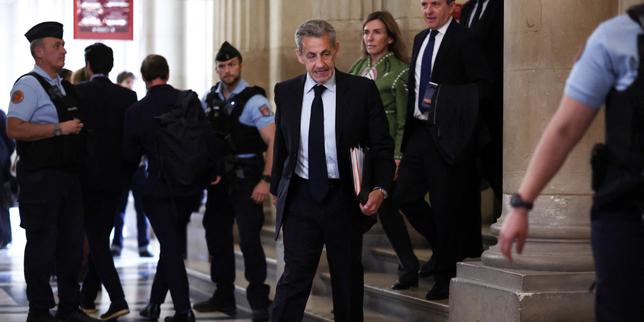
Step into a courtroom in Paris. The air is sterile, recycled, and weighted with the silence of hundreds of pages of testimonies. Here, the grand narrative of statecraft is distilled into the cold, mechanical process of an appeal. The general prosecutor has once again risen, his voice steady, anchoring the proceedings in a request for seven years of imprisonment. Seven years. It is a figure that sounds abstract until you consider the gravity of the accusations: corruption, illegal campaign financing, and the concealment of public funds.
Consider a hypothetical observer, an aide who once stood in the corridors of the Elysée Palace during those feverish months in 2007. They remember the frantic energy, the late-night calls, the sense that France was reshaping the Mediterranean. They didn't see the ledgers then. They only saw the arrivals—the white tents, the theatrical displays of power, the feeling that a new era of influence was being negotiated in real-time. This aide, now older and perhaps more cynical, watches the current legal drama from a distance, understanding that what is truly on trial is not just a man, but the nature of political memory.
The core of the storm involves the alleged funneling of millions in Libyan cash into the coffers of a presidential campaign. It is a claim that has been denied with fierce tenacity for over a decade. Yet, the evidence—fragments of bank transfers, the testimony of intermediaries, the sheer weight of circumstantial threads—has created a narrative arc that refuses to bend. Every time the defense pushes back, citing political persecution or procedural error, the prosecution brings the focus back to the fundamental question of transparency. How much of our democratic process is susceptible to the influence of foreign autocrats?
This is not merely a bureaucratic skirmish over technicalities. It is a collision between two different worlds. In one corner, the refined, structured reality of the French Republic’s judicial system. In the other, the murky, high-stakes arena of international intrigue where boundaries are fluid and cash speaks a universal language.
Think about the sheer scale of the shift. In the early 2000s, there was a tentative thaw in relations with the Gaddafi regime. It was sold as pragmatism, a way to bring a pariah state into the fold, to secure deals, to manage migration. But behind the scenes, the mechanics of this rapprochement remain under a microscope. When the prosecutor stands to demand seven years, they are not just aiming at a politician. They are attempting to define the limits of what a leader can do in the name of national interest.
The defense argues that the case is built on a foundation of sand—unreliable witnesses, questionable documentation, and a desire to see a former head of state fall. They speak of political vengeance. They frame the trial as an institutional assault, a way for the machinery of justice to exert power over those who once held the highest office. It is a compelling counter-narrative, one that resonates with those who fear that the judiciary has become a political actor in its own right.
Yet, the persistence of the prosecutors is equally striking. They operate with a grim, slow-moving momentum that defies the quick cycles of the news media. They are not interested in the flash of a headline. They are interested in the paper trail. They track the movements of money through offshore accounts, the connections between long-forgotten fixers, and the digital footprints left behind in a pre-smartphone era. It is a slow, agonizing process of reconstruction.
What happens when a nation is forced to look at its own history through the lens of a courtroom? The trust between the citizen and the state is fragile. When the central pillar of that trust—the integrity of a presidential campaign—is called into question, the entire structure shudders. People watch these proceedings not because they care about the minutiae of legal statutes, but because they want to know if anyone is truly beyond the reach of the law. They want to know if the high-flying world of diplomacy is as soiled as the rumors suggest.
The case against Nicolas Sarkozy has become a permanent fixture of French political life, a recurring theme in the background music of every election cycle. It is the ghost that sits at the table, whispering that no matter how much time passes, the sins of the past are never truly buried.
There is a profound loneliness in such a trial. The courtroom is full, yet the defendant sits in a space of his own creation, surrounded by a team of lawyers whose job is to translate his life into the language of reasonable doubt. He is a man who was once the center of the world, and now he is a man whose future is being argued by others. The irony is sharp. Power is a currency that depreciates rapidly once you are no longer in the building, and in the quiet of a Parisian court, it has almost no value at all.
We have moved past the initial shock of the allegations. We have entered the phase of weariness. The public follows the updates with a mix of resignation and morbid curiosity. Will this be the day? Will the sentence be finalized? Or is this just another chapter in a book that has no ending?
The truth, as it is, likely resides in the spaces between the courtroom arguments. It is not found in the grand proclamations of innocence or the calculated demands for prison time. It is found in the decisions made in 2007, the handshake deals, the quiet promises, and the belief that the rules of the game were different for the people at the top. The trial is the effort to bring those shadows into the light.
When the judge eventually delivers the final word, the decision will ripple through the French political establishment, setting a precedent that will shape how future campaigns are run and how past actions are scrutinized. But for the average person watching from the outside, the verdict may matter less than the process itself. The spectacle of a former president facing the potential loss of liberty is a visceral manifestation of the idea that, in theory, no one is above the law.
As the proceedings continue, the memory of Tripoli fades, replaced by the mundane reality of legal briefs and judicial debates. The desert heat has cooled, but the consequences remain, tethered to the present by a long, thin thread of accountability. One wonders if, at the end of all these years, the final accounting will ever truly satisfy the public, or if the ghost of that Libyan summer will remain, forever whispering that some secrets are never meant to be fully revealed.
The courtroom lights are bright, but they only illuminate so much. Beneath the surface of every legal argument, there is the human reality of a life once lived in the sun, now confined to the shadow of the law. The silence that follows the prosecutor's demand is not empty. It is heavy with the weight of everything that has been said, and everything that remains unsaid, waiting for a conclusion that feels further away than ever.