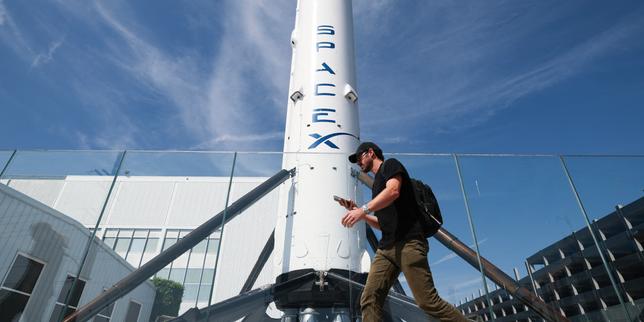
Elon Musk wants to raise $75 billion by taking SpaceX public at an eye-watering $1.77 trillion valuation. The stock market debut, scheduled under the ticker SPCX, is being hyped as a historic milestone. Wall Street analysts are already calling it the largest initial public offering ever recorded, comfortably beating Saudi Aramco's 2019 listing.
But look past the breathless financial headlines. This proposed valuation doesn't look like a standard corporate spreadsheet. It looks like a sci-fi novel.
Investors lining up for shares think they're buying a highly efficient rocket company with a fast-growing satellite internet business. They aren't. They're buying a speculative bet on space-bound artificial intelligence, massive orbital data centers, and an unprofitable tech conglomerate that burns cash at a terrifying rate. If you plan to put your hard-earned money into this IPO, you need to understand exactly what you're actually paying for.
The Massive Loss Hidden Behind the Starlink Hype
The popular narrative surrounding SpaceX focuses entirely on its dominance. The company commands the launch market. Its Falcon 9 rockets fly with industrial regularity, accounting for more than half of all global orbital launches. Meanwhile, Starlink serves over nine million subscribers across 150 countries, pulling in $10.6 billion in high-margin, recurring revenue.
That sounds amazing until you look at the balance sheet. SpaceX reported a brutal $4.9 billion net loss for 2025 on $18.7 billion in revenue. The bleeding hasn't stopped. In the first quarter of this year alone, the company lost another $4.3 billion on sales of just $4.7 billion. It's carrying over $60 billion in debt.
Where is all that cash going? It isn't just rocket fuel.
Earlier this year, SpaceX absorbed xAI, the artificial intelligence company Musk founded. That transaction brought the Grok AI model, the social media platform X, and a massive, power-hungry data center footprint under the SpaceX corporate umbrella. X has lost roughly half its revenue since Musk bought it, and xAI is currently burning through an estimated $1 billion every single month. Public investors aren't just funding a trip to Mars. They are subsidizing a bleeding social media network and an expensive AI arms race.
The $1.77 Trillion Math Requires Miracles
Trading at a $1.77 trillion valuation means SpaceX is priced at a staggering multiple of roughly 70 times its forward revenue. For context, even the most aggressive, high-growth Silicon Valley software firms rarely sustain multiples that high.
To justify that price tag, investment banks like Goldman Sachs are pitching a dream where SpaceX grows its revenue from $18.7 billion to nearly $474 billion by 2030. They expect the company to achieve sustained 50% to 100% year-over-year revenue growth for five straight years.
How do they claim this is possible? They aren't relying on selling more internet subscriptions to rural homes. The entire valuation rests on building giant "AI Sat Mini" constellations. The pitch deck describes thousands of massive satellites generating 80 to 150 gigawatts of orbital compute capacity. The idea is to run AI data centers in space, powered by free solar energy, completely bypassing Earth's electricity grid and land constraints.
It sounds brilliant on paper. In reality, it's a logistical nightmare.
Starship is the Ultimate Bottleneck
Every single dollar of that projected futuristic revenue relies on Starship working flawlessly at an unprecedented scale. To deploy the thousands of heavy AI satellites needed to hit the 2030 revenue targets, Starship needs to fly thousands of times per year.
Right now, Starship is still conducting erratic test flights.
The vehicle has yet to demonstrate reliable booster catching, consistent orbital refueling, or high-cadence commercial operations. A realistic launch projection for Starship looks more like this:
- 6 to 12 flights this year (mostly experimental)
- 20 to 40 flights next year
- Maybe hitting 200 to 400 annual flights by 2030
Flying 400 times a year would be a miraculous engineering achievement. But it's nowhere near enough to build an orbital AI data network. If Starship can only manage a few hundred launches, SpaceX will deploy less than 10% of the planned constellation by the end of the decade. That drops the projected 2030 orbital AI revenue from $322 billion down to a modest $15 billion. The math simply doesn't hold up.
You Have No Say in How Your Money is Spent
If you buy shares of SPCX, don't expect to have a voice in the company's direction. SpaceX is utilizing a dual-class share structure that leaves Elon Musk in absolute control.
Following the public listing, Musk will retain more than 82% of the total voting power despite owning less than half the equity. SpaceX has already filed paperwork to qualify as a "controlled company" under Nasdaq rules. This means the firm is exempt from standard corporate governance requirements, including the need to have an independent board of directors.
If Musk decides to divert billions of dollars from the profitable Starlink division to fund an unprofitable colony on Mars, shareholders can't stop him. Independent valuation analyses from institutions like Morningstar suggest that the fair value of SpaceX's actual current business sits closer to $780 billion. Paying $1.77 trillion means you're handing over a massive premium for a vision you have zero power to guide.
Your Best Moves Before the June 12 Listing
The hype machine will hit full speed as the June 12 listing date approaches. If you're looking at this IPO, stop overthinking the sci-fi promises and focus on practical steps.
First, check your broker. Getting a direct allocation in a hot IPO is incredibly difficult for retail accounts. Firms in the underwriting syndicate usually reserve shares for institutional clients or high-net-worth individuals. Demand will easily outstrip supply.
Second, consider indirect exposure if you want to avoid the initial volatility. Funds like the Destiny Tech100 closed-end fund or the Cambria ERShares Private Investments ETF (XOVR) already hold large private stakes in SpaceX. These vehicles let you track the company without trying to time the chaotic first day of public trading.
Finally, sit on your hands and wait. History shows that nearly half of all highly anticipated tech companies drop below their IPO price within the first year. Let the initial market frenzy fade, see if Starship can actually scale its launch cadence over the next 18 months, and buy in when the valuation reflects reality instead of science fiction.