Football is a game built on violence and choreography, but above all else, it is a game built on sound.
There is the low, structural rumble of fifty thousand pairs of feet shifting on concrete. There is the sharp, concussive crack of shoulder pads colliding at full velocity—a sound that vibrates straight through the chest wall of anyone sitting within twenty rows of the sideline. There is the roar, fluid and immense, that swells whenever a rookie quarterback with a magician's stride escapes the pocket, turning certain doom into a twenty-yard gain.
And then, there is silence.
It is a very specific kind of silence. It does not descend gradually; it drops like a heavy velvet curtain, instantly extinguishing the noise of a packed stadium until the only thing left audible is the distant hum of a television broadcast truck and the frantic clicking of camera shutters.
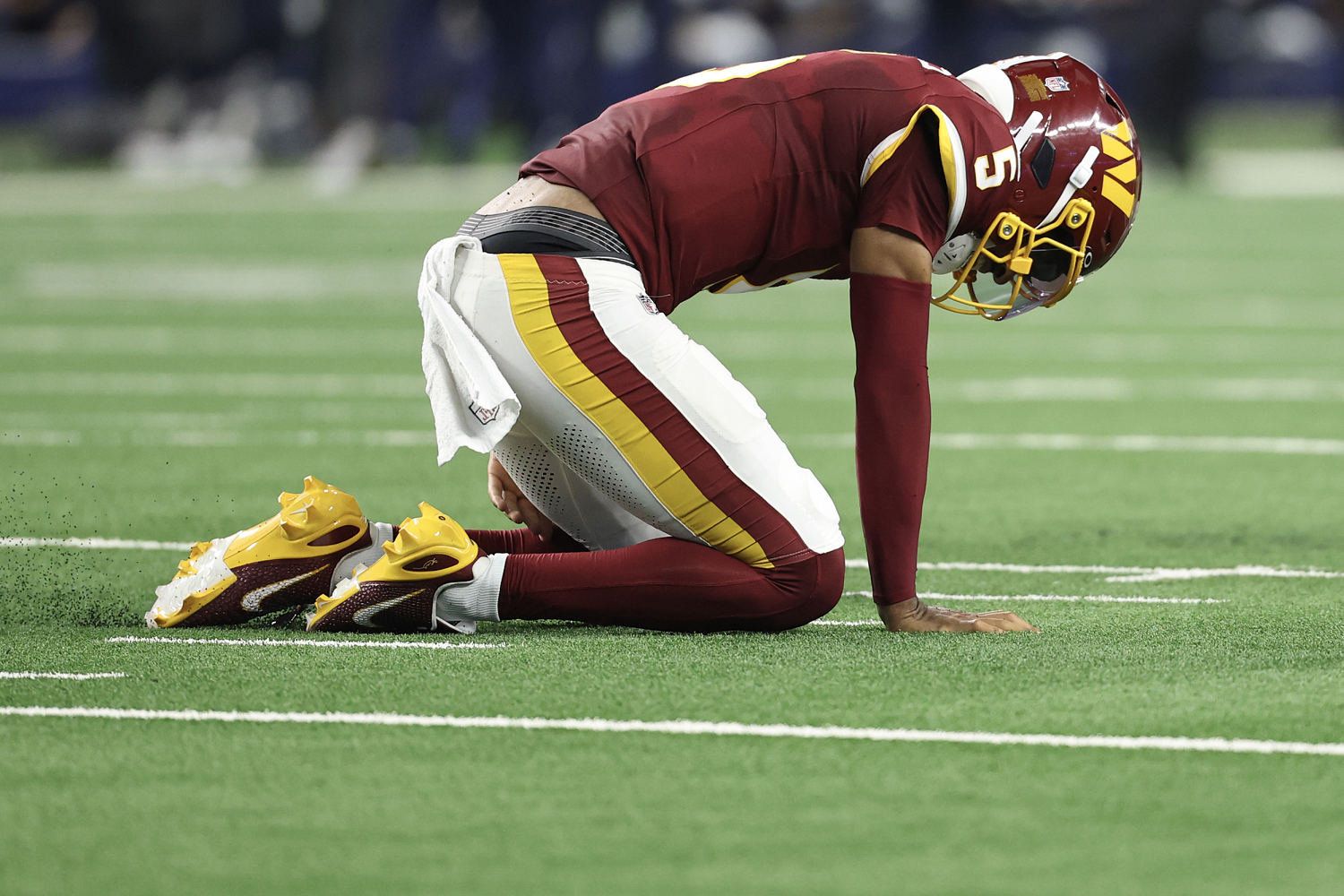
That was the sound that settled over the field when Washington Commanders quarterback Jayden Daniels went down.
To understand why that silence mattered so much, you have to look past the box score. You have to look at what was being built in the nation's capital. For years, autumn in Washington had been an exercise in quiet resignation. Sundays were marked by defensive sighs, organizational churn, and the heavy, gray weight of a franchise searching for an identity. Fans filed into the stadium out of habit, armed with cautious skepticism and memories of better decades.
Then came Daniels.
He arrived with the slender frame of a long-distance runner and an arm that could flick a football fifty yards downfield with an effortless, wrist-snapping flick that defied biomechanics. He did not merely play quarterback; he solved complex spatial puzzles in real-time, reading linebackers like a seasoned chess grandmaster while possessing the foot speed to outrun cornerbacks who ran sub-4.3 seconds in the forty. Week by week, the city began to thaw. The skepticism gave way to a dangerous, intoxicating emotion: hope.
Until the second quarter against the Dallas Cowboys.
It happened in the chaotic wash of a standard passing play. The pocket, which had held firm against the initial wave of a blitz, began to collapse inward like a sinking ship. Defensive linemen converged from multiple angles, their massive frames casting long shadows over the turf. Daniels did what he always did—he kept his eyes downfield, searching for an open receiver, trusting his internal clock to tell him the exact millisecond to escape.
He started to scramble.
What happened next unfolded in jagged, high-definition fragments. A defender lunged, missing the torso but catching an outstretched arm. As Daniels went to the turf, his right elbow absorbed the brutal, unnatural torque of a falling human mass colliding with unyielding artificial ground.
He did not immediately jump up.
In the NFL, toughness is the currency of the realm. Players spend their entire lives learning to mask pain, to pop up quickly after a violent hit, to jog back to the huddle with a slight limp that they pray the cameras miss. They do it because they know the baseline truth of the sport: availability is the ultimate ability.
When a player stays down, when he curls slightly toward the grass and clutches a joint with fingers that suddenly look uncommonly fragile, the arithmetic changes entirely.
The medical staff sprinted onto the field, their neon-vested figures cutting across the green turf with urgent purpose. Television cameras, trained to capture every drop of drama, zoomed in on the quarterback's face. There was no theatrical display of agony, just a tight, pale compression of the lips and a quiet nod of acknowledgment as the trainers knelt beside him.
Pain in football is a familiar language. Every player on that field has torn ligaments, played through bone bruises, and swallowed anti-inflammatory pills like Tic Tacs. But an elbow injury to a throwing arm—especially for a quarterback whose entire offensive arsenal relies on the intricate, microscopic coordination of tendons, ligaments, and nerves—is a terrifying unknown.
Consider the mechanics of a deep ball. It is not merely an arm motion. It is a kinetic chain reaction that starts with the violent rotation of the back foot against the turf, travels up through the hips, transfers through the torso's core torque, whips through the shoulder, and finally snaps out through the elbow and wrist like the lash of a whip. If one link in that chain is compromised—if a single ligament stretches or a bone bruises—the velocity drops, the accuracy wavers, and the entire architecture of the offense crumbles.
As Daniels was escorted toward the tunnel, the gravity of the moment settled over the bench.
The backup quarterback picked up his tablet, eyes scanning defensive coverages with a sudden, sharpened intensity. The offensive coordinator wiped a bead of sweat from his forehead, his mind frantically rewriting the playbook on the fly, eliminating bootlegs and deep crossers that required maximum arm extension, pivoting instead toward quick, safe, horizontal throws.
This is the hidden fragility of modern sports. We worship athletes as modern gladiators, indestructible titans engineered from carbon fiber and willpower. We debate statistics, fantasy football projections, and playoff seeding as if they are abstract mathematics on a whiteboard. We forget that underneath the heavy pads and custom helmets are human beings whose tendons have a finite tensile strength, whose bodies are subject to the same biological laws as a construction worker or a ballet dancer.
The official announcement eventually drifted through the press box: elbow injury, questionable to return.
Words that sound clinical on a television graphic, but to a fanbase watching their entire season hang in the balance, they felt like a sentence.
In the second half, the game continued. Football does not pause for sentimentality. The clock kept ticking. The scoreboards kept flashing. Substitutes filled the gaps, running the same blocking schemes, taking the same violent hits, chasing the same elusive victories. The machine rolled on because it is designed to roll on, indifferent to individual tragedy.
Yet, the atmosphere in the stadium had fundamentally shifted. The roaring party of the first quarter had transformed into a collective vigil. Every time the offense took the field, the crowd watched with bated breath, searching the sideline for a glimpse of a familiar helmet, hoping against hope to see the quarterback warming up his arm on the sidelines.
When the final whistle blew and the stadium lights cut through the damp evening air, the crowd filtered out into the parking lots in a subdued hush. They were talking not just about the final score, but about the future. About resilience. About the fragile, fleeting nature of momentum in a league where a single awkward landing can alter the trajectory of an entire franchise.
The elbow will heal, or it won't. The medical scans will reveal the precise extent of the damage, spelling out recovery timelines in weeks and months. Rehabilitation will be long, tedious, and solitary, far away from the screaming fans and the blinding television lights.
But as the silence of that second quarter proved, the true stakes of the game were never really about the standings or the statistics. They were about the human story unfolding on the grass—the delicate, breathtaking tightrope walk between athletic immortality and a sudden, quiet fall.


