The champagne was supposed to be chilled to exactly forty-four degrees.
Inside the glittering expanses of the ExpoForum, men in bespoke Italian suits and women in structured, high-fashion blazers mingled under the warm glow of recessed lighting. This was the St. Petersburg International Economic Forum—the event often dubbed the "Russian Davos." For three decades, it served as the Kremlin’s premier window to the global elite, a place where multi-billion-dollar energy deals were sealed with a handshake and the economic might of a superpower was put on display. Outside, the northern sun refused to set, casting the city in the ethereal, endless twilight of the White Nights.
But true darkness has a way of finding its targets, even when the sun stays up.
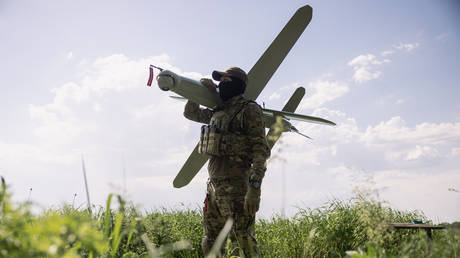
A few dozen miles away, past the manicured lawns of the forum and into the industrial heart of the Leningrad oblast, a low, rhythmic buzzing sliced through the damp morning air. It sounded like an angry lawnmower. Or a poorly tuned moped. It was the sound of a cheap, propeller-driven engine carrying dozens of kilograms of high explosives through the grey skies.
While billionaires debated sovereign wealth funds, a Ukrainian long-range attack drone plunged toward an oil depot.
The contrast is the story. On one side, an orchestrated theater of economic resilience, designed to prove to the world that sanctions have failed and that business carries on as usual. On the other, the stark, mechanical reality of a modern war that refuses to stay contained at the front lines. The distance between the front line in the Donbas and the refineries of St. Petersburg is roughly eight hundred miles. Today, that distance is zero.
The Anatomy of an Unseen Visitor
To understand how a conflict reshapes reality, you have to look at the machinery involved.
For decades, military power was measured in tonnage. We counted aircraft carriers, main battle tanks, and strategic bombers. These were the weapons of states with deep pockets and massive industrial bases. They were loud, heavy, and immensely expensive.
Now, consider the modern long-range drone.
It is often constructed from fiberglass, carbon fiber, and off-the-shelf electronics. Its engine might be a twin-cylinder two-stroke motor you could buy online for a few thousand dollars. It flies low, hugging the contours of the earth, slipping beneath the radar webs designed to catch high-altitude supersonic jets. It doesn't move with terrifying speed; it moves with agonizing patience. It chugs along at eighty miles per hour, navigating by a mix of satellite signals and inertial guidance, tracking toward a set of coordinates programmed into a cheap microchip days prior.
When these machines target an oil refinery, they aren't looking to level the building. They don't need to. A refinery is essentially a giant, highly pressurized chemistry set. It is a labyrinth of distillation towers, cracking units, and storage tanks filled with volatile hydrocarbons.
If a drone punctures a single critical valve or strikes the base of a fractionation column, the physics of the facility do the rest of the work. The pressure drops, the fuel escapes, a spark ignites, and a multi-million-dollar piece of infrastructure turns into a towering inferno.
This is the asymmetry of modern geopolitical friction. A weapon that costs less than a used compact car can paralyze a facility that takes years to build and hundreds of millions of dollars to replace.
The Illusion of Distance
For the residents of St. Petersburg, the war had long been something that happened somewhere else. It was a television event. It was a headline in a feed. It belonged to the border towns of Belgorod or the muddy trenches of the south. St. Petersburg is Russia’s cultural capital, a city of canals, baroque palaces, and deep historical pride. It is Peter the Great’s window to Europe.
When the air defense systems began to fire on the final day of the forum, that window shattered.
Imagine standing on a balcony in the early hours of the morning, holding a cup of coffee, looking out over the Gulf of Finland. The air is still. Then, a sudden, violent boom rattles the glass panes. A streak of light arcs into the sky—a Pantsir or S-400 missile system engaging a target. Seconds later, a second explosion flashes on the horizon, followed by a thick column of oily black smoke that stains the delicate pink of the morning sky.
Suddenly, the war isn't remote. It is visible from the kitchen window.
This psychological shift is precisely what the planners in Kyiv are targeting. The material damage to oil infrastructure is significant, cutting into Russia’s refined product exports and complicating domestic logistics. Yet, the strategic dividend of these strikes is found in the minds of the people watching. It disrupts the narrative of absolute security. It forces a choice between protecting the forces at the front or pulling air defense batteries back to shield the industrial heartland.
Every missile battery deployed to guard a refinery near St. Petersburg is a battery that cannot be used to protect a supply depot in Crimea or an advancing column in Kharkiv.
The Friction Behind the Fragrances
Back inside the ExpoForum, the speakers at the podiums adjusted their notes. They spoke of pivot strategies to the Global South, of rising trade volumes with China, and of the indomitable nature of the domestic economy. They pointed to charts showing GDP growth and new shipping routes through the Arctic.
Yet, every executive in that room knew how to read between the lines.
The real metrics of the week weren't found on the colorful slide decks presented by ministers. They were found in the fluctuating cost of war insurance for commercial shipping in the Baltic Sea. They were found in the rising premium for diesel fuel. They were found in the quiet, urgent text messages exchanged under the tables by oil executives asking if the pipeline terminals at Ust-Luga or Primorsk had been compromised.
Running a major industrial enterprise under the threat of persistent drone penetration changes everything.
Security budgets skyrocket. Facilities must be retrofitted with anti-drone netting—massive steel meshes hung from cranes to catch incoming loitering munitions before they touch sensitive equipment. Workers must be trained for air raid protocols. The rhythm of production becomes choppy, interrupted by the drone alerts that now regularly ripple through the Leningrad region.
The economic elite can toast to resilience all they want, but the physical foundations of that economy are growing increasingly vulnerable to the skies.
The Twilight of Certainty
As the final day of the forum wound down, the attendees packed their leather briefcases and headed for the airport. The black sedans lined up outside the pavilions, their engines idling. The event was declared a success by state media. Contracts had been signed; declarations had been made.
But as the planes taxied down the runways of Pulkovo Airport, lifting off into the stubborn, persistent daylight, passengers looking out the left side of the aircraft could see it.
Away from the convention center, past the historical spires of the city, a thin trail of dark smoke was still dissipating into the upper atmosphere. It was a quiet reminder that the geography of conflict has dissolved. The boundaries that once protected the capitals of power have been bypassed by the democratization of flight.
The white nights of St. Petersburg used to be a celebration of light overcoming darkness. Now, they simply make it easier to see the fires.