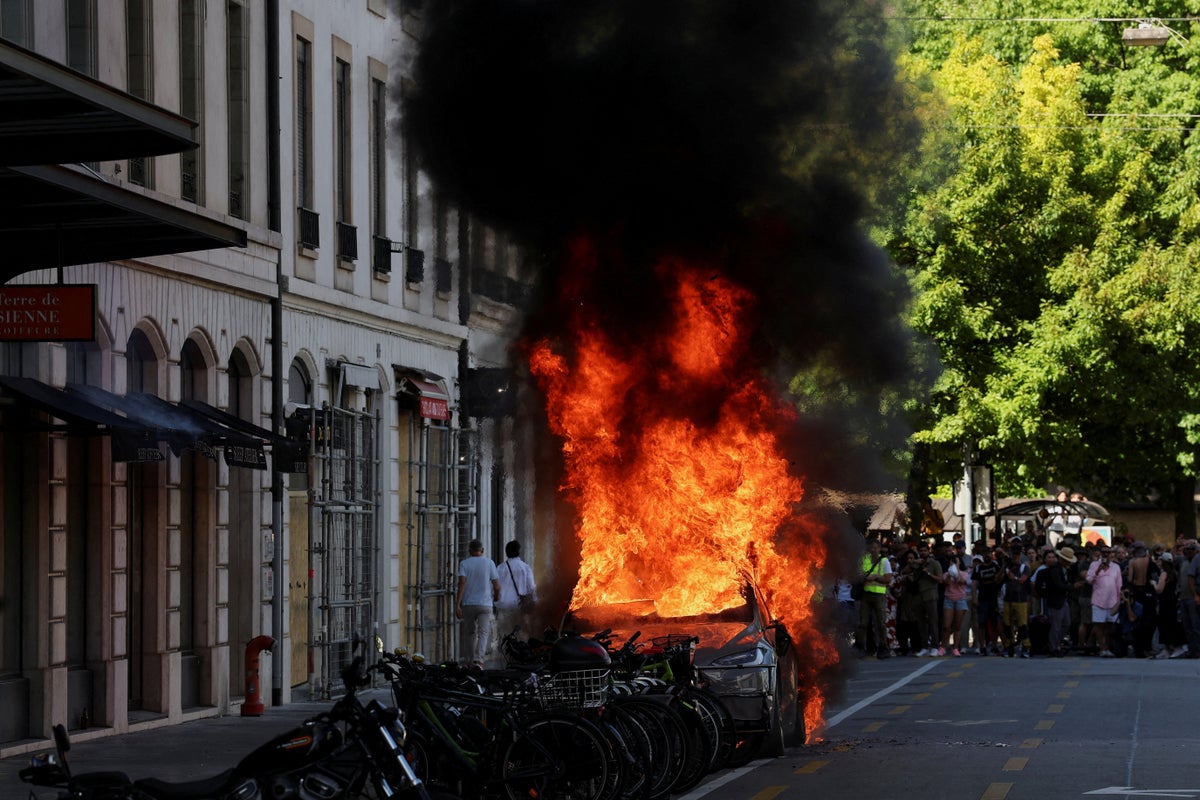
The scent of caramelized lithium is something you never quite wash out of your jacket. It has a sickening, sweet, metallic tang that hangs in the back of your throat long after the fire trucks have packed up and the street sweepers have begun scraping the melted rubber off the cobblestones.
Geneva usually smells of rain, old money, and lakeside dampness. But on a Tuesday afternoon, beneath the heavy gray skies that seemed to mimic the mood of the world below, it smelled like a breakdown.
To understand why a pristine, white electric sedan was flipped onto its side and turned into a roaring bonfire in the middle of a Swiss thoroughfare, you have to look past the shattered glass. You have to look at the friction between two worlds that can no longer find a common language.
On one side of the barricades were the world leaders, the global technocrats, and the economic architects of the G7. They gathered behind thick security cordons, breathing filtered air, discussing carbon credits, algorithmic efficiencies, and the grand transition to a green future. On the other side were thousands of people marching through the streets, filled with a cold, simmering fury that has been building for a decade.
When the two collided, the casualty wasn’t just a luxury vehicle. It was the illusion of a peaceful transition.
The Cracking of the Mirror
It started with the rhythm of boot heels on tarmac. A crowd of several thousand protestors had gathered for what was permitted as a peaceful march against the G7 summit. There were banners demanding climate justice, signs condemning corporate greed, and the usual choruses of chanting. For the first hour, it felt like any other European demonstration—spirited, loud, but contained within the unwritten rules of civic dissent.
Then the rhythm fractured.
A breakaway group, entirely clad in black, masks pulled tight against their faces, drifted to the front of the procession. They didn’t carry signs. They carried heavy iron bars, cobblestones pried from the side streets, and hammers.
Consider what happens when a crowd loses its collective anchor. The atmosphere thins. The air grows electric. The casual marchers, families, and students began to pull back, sensing the shift in gravity. The black-clad figures moved with a terrifying, coordinated purpose.
The first sound was a sharp, high-pitched crack.
It was a boutique window, a high-end storefront displaying watches that cost more than the average global citizen earns in a lifetime. The glass didn’t just break; it spider-webbed, held together by safety film, before a second blow brought it cascading down in a glittering waterfall. To the people swinging the hammers, that glass wasn't just a window. It was a mirror reflecting their own exclusion from the wealth being negotiated a few blocks away.
Smashing windows is an old tactic. It is loud, it is visceral, and it sends an immediate shockwave through a city’s nervous system. But the real flashpoint—the image that would soon flash across global news feeds—lay just around the corner.
The Sacrificial Anvil
Parked innocently along the curb was a brand-new electric vehicle. A Tesla.
In the calculus of modern protest, objects are never just objects; they are symbols. A generation ago, a rioting crowd might have targeted a gas-guzzling SUV or a oil conglomerate's corporate headquarters. Today, the anger has mutated. The electric car, once marketed as the savior of the planet, has become a lightning rod for a different kind of resentment.
To the workers marching in the streets, that vehicle represents a green transition tailored exclusively for the affluent. It embodies a future where the rich can buy their way out of climate guilt while the working class is squeezed by rising energy costs, inflation, and the slow death of local industries.
The crowd closed in on the car.
Hammers swung against the reinforced windshield. The glass held for a moment, starring under the impact, before caving in. Heavy boots stomped on the hood, crumpling the aluminum. Someone produced a crowbar, prying open the door panels. The vehicle was systemic inequality on wheels, and the crowd was systematically dismantling it.
But destruction wasn't enough. Someone produced a flare.
A bright, crimson spark dropped through the shattered window into the cabin. For a few seconds, there was only a lazy coil of white smoke. Then, the fire caught. The interior plastics bubbled, catching light, sending a thick, greasy black column of smoke into the Swiss sky.
When the fire reached the battery pack beneath the floorboards, the nature of the event changed. Lithium fires do not burn like wood or gasoline. They hiss. They spit white-hot sparks. They burn with a fierce, chemical intensity that resists water, feeding on their own internal oxygen. The heat radiating off the vehicle became so intense that the paint on the building across the street began to blister and peel.
The protestors stood back, their faces illuminated by the eerie, orange glow of the burning vehicle. For a brief, terrifying window of time, the street belonged entirely to the fire.
The Invisible Stakes
It is easy to dismiss this as mindless vandalism. The official statements from local authorities did exactly that, calling the rioters "a small minority of agitators intent on chaos." But fixing your eyes only on the broken glass means missing the deeper, structural rot that made the fire possible in the first place.
The real problem lies in the disconnect between the language of the powerful and the lived reality of the governed.
When the G7 meets, the conversations are conducted in abstractions. They speak of macroeconomics, geopolitical alignment, and long-term sustainability metrics. But out on the cobblestones, the metrics are much simpler: the cost of rent, the price of a loaf of bread, and the feeling of powerlessness that comes from knowing your future is being decided by people who will never walk down your street.
The burning car became a bizarre, tragic monument to this divide. It was an eco-friendly machine destroyed by people who feel abandoned by the green economy.
The fire took hours to fully extinguish. Long after the crowd had dispersed into the alleyways, chased by lines of riot police firing tear gas that left everyone weeping and coughing, the frame of the vehicle remained. It was a blackened, hollowed-out skeleton, hiss-cooling in the evening rain.
Tomorrow, the politicians will issue their press releases. The insurance companies will calculate the damages. The city workers will replace the shattered storefronts, and Geneva will return to its quiet, orderly self. But the stain on the asphalt will remain for months, a dark, greasy reminder of the afternoon the city smelled of lithium and rage.
The fire is out, but the air is still thick.