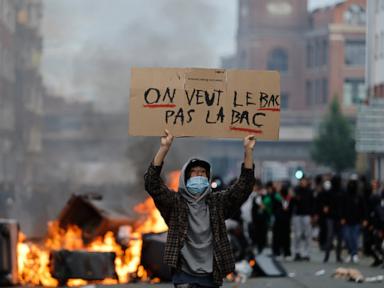
The air above the Boulevard Saint-Michel tasted like burnt rubber and damp wool. It was the smell of a Tuesday that had lost its mind.
Down the narrow canyon of stone buildings, past the shuttered bookshops and the steaming cafes where waiters still balanced silver trays with quiet panic, a wall of gray smoke rolled forward. It wasn't just gas. It was exhaustion, crystallized and set on fire.
If you stood there, wedged against a graffiti-stained limestone wall with your scarf pulled tight over your nose to block the tear gas stinging your eyes, you wouldn't have seen geopolitics. You wouldn't have seen macroeconomic policy or parliamentary procedural votes. You would have seen nineteen-year-olds with ink-stained fingers and bloodshot eyes staring down lines of riot police whose helmets reflected the flickering orange of burning plastic bins.
France was doing what France does best when the future feels like a door being slowly slammed in its face. It was taking to the streets.
To understand why the Prime Minister called an emergency crisis meeting behind the heavy mahogany doors of Matignon, you have to abandon the spreadsheets. You have to walk away from the tidy quarterly projections issued by ministries that have never had to choose between paying for a liter of cooking oil or a textbook on medieval history.
Consider a hypothetical student whom we will call Antoine. Antoine is twenty-one. He lives in a room the size of a walk-in closet in a Parisian suburb twenty minutes past the final metro stop. His walls are thin enough to hear his neighbor's television through the plaster; his kitchen is a two-burner hotplate and a mini-fridge that hums like an angry hornet. Antoine is studying law. He spends twelve hours a day bent over commentaries on the Napoleonic Code, reading about property rights and the social contract while his own contract with society dissolves in real time.
When the government announced changes to the pension system, or labor reforms, or university funding cuts—depending on which week of the legislative calendar you happened to be breathing in—Antoine didn't read the white papers. He didn't have to. He felt the impact in the grocery aisle. He felt it when his monthly stipend didn't stretch to cover both his transit pass and his rent.
The spark didn't start in the halls of the National Assembly. It started in the quiet, desperate mathematics of modern student life.
When a society makes its young people feel like accountants of their own misery, don't be surprised when they bring the ledger books into the street and set them ablaze.
By dawn, the barricades were up. They were constructed with a poetic, desperate architecture: overturned municipal garbage cans, rental bicycles locked together in tangled steel heaps, wooden pallets salvaged from construction sites, and hand-lettered cardboard signs warning that the generation of tomorrow refused to be the collateral damage of today.
Traffic stopped. The delivery trucks from Rungis market couldn't get through. The tourists with their wheel-away suitcases stood bewildered near the Fontaine Saint-Michel, their smartphones held aloft, trying to capture a revolution through square Instagram crops while riot vans idled with their diesel engines thrumming a deep, low bass note that vibrated right through the soles of your shoes.
This is the hidden cost of reform without consensus. It looks neat on paper. It satisfies the technocrats in Brussels. It balances the fiscal deficit by a decimal point or two. But human beings are not decimal points. They are creatures of narrative, of pride, of inherited memory. And in France, the memory of 1968, of 1789, of every time the common folk decided that the elites in their gilded salons had gone too far, is not ancient history. It is an operating system. It runs in the background of every civic dispute.
The Prime Minister’s crisis meeting was supposed to project strength. That is what crisis meetings are for. Ministers in dark suits hurried across courtyards, their briefcases clutched like shields, their faces tight with the strained solemnity of men who realize too late that the steering wheel has come off in their hands. They spoke of law and order. They spoke of public safety. They spoke of the inviolable continuity of the state.
They missed the point entirely.
You cannot negotiate with smoke. You cannot deploy enough batons to beat back a generation's quiet, spreading terror about whether they will ever own a square meter of the soil they walk on.
Down on the pavement, amid the flashing blue lights and the sharp tang of tear gas, a young woman with a green parka and a megaphone was speaking to a crowd of perhaps five hundred people. Her voice was hoarse, shredded by hours of chanting against the roar of traffic and sirens.
She wasn't quoting Marx. She wasn't citing parliamentary articles. She was talking about her mother, who cleaned offices in the fifteenth arrondissement from four in the morning until noon, and how she refused to inherit a life spent bent double over a bucket just to keep the lights on in a damp flat.
"They think we are children playing hooky," she shouted, her voice cracking over the cheap plastic speaker. "They think we don't understand the budget. We understand that there is always money for everything except for us."
A cheer went up. It wasn't angry. That was the most unsettling part of it. It was tired. It was the weary, resolute cheer of people who have already calculated that they have nothing left to lose.
The state apparatus can weather riots. It has tear gas, water cannons, tactical squads trained in the geometry of crowd control. It has the full monopoly of legitimate violence. But it cannot defeat a generation that has stopped believing in the promise of the game.
When the tear gas finally cleared, hours later, and the municipal street-sweeping trucks moved in with their heavy brushes to scour the asphalt clean of burnt plastic and glass shards, the physical debris vanished. The broken bottles were swept away. The overturned bins were righted.
The fear in the corridors of power, however, remained.
Because behind every placard left behind in the gutter, behind every broken window of a chain bank on the boulevard, lay a question that no cabinet meeting could adjourn. What do you do when the children decide that the future you are building for them is a prison cell with a view?
The sun dipped behind the zinc rooftops of the Latin Quarter, painting the gray stone of the old university buildings in a brief, deceptive wash of gold. Somewhere down a side street, far from the cameras and the police cordons, a single guitar was playing. A small crowd sat on the curb, sharing a bottle of cheap red wine, passing it from hand to hand in the gathering dusk.
The smoke was gone. The questions were not.