Silence.
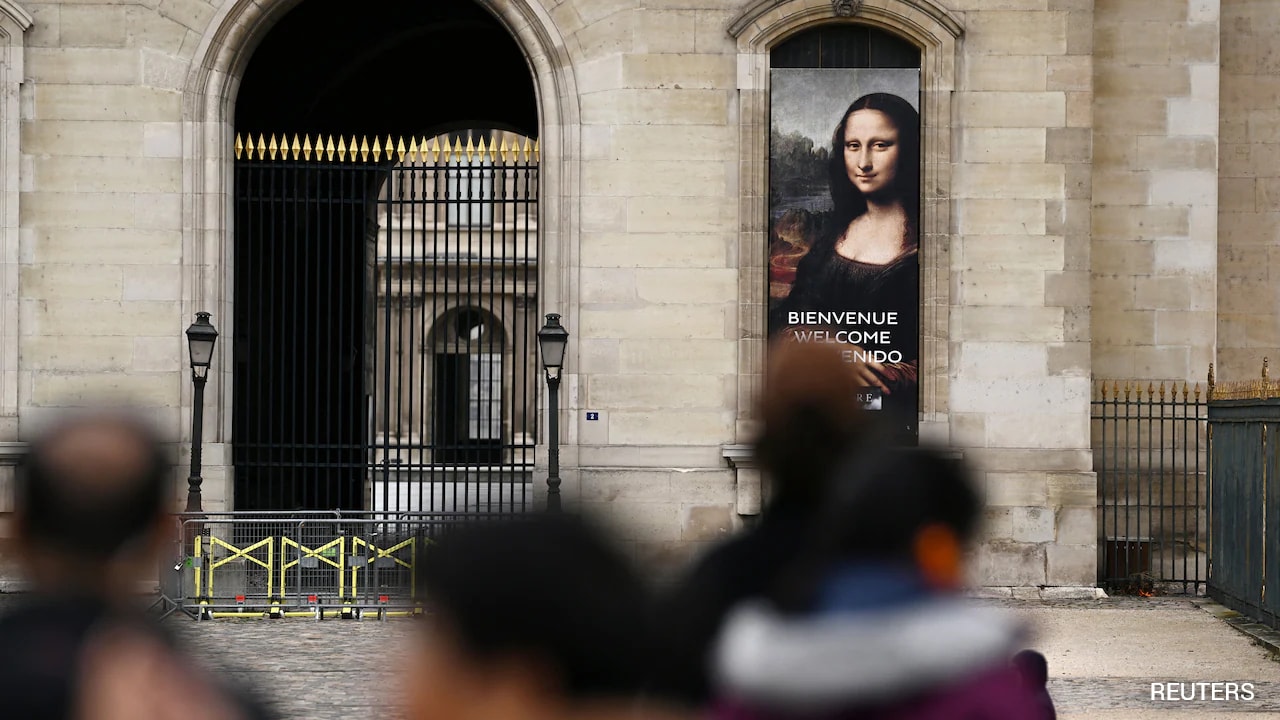
That is the first thing that strikes you when the glass pyramid of the Louvre goes dark, not the shouted chants of the picket line outside on the Rue de Rivoli, nor the confused murmur of ten thousand tourists clutching timed-entry tickets that have suddenly become worthless paper. Inside the Salle des États, where up to thirty thousand people usually press shoulder-to-shoulder every single day to raise glowing smartphone screens toward a thirty-by-twenty-one-inch poplar wood panel, the air hangs completely still. Leonardo da Vinci’s Mona Lisa sits alone behind her bulletproof glass, smiling into an empty room, while the people who guard her, clean her floors, and keep the world’s most visited museum breathing stand out in the Parisian chill, holding hand-painted banners and demanding to be seen.
When headlines flash across international news feeds announcing that the Mona Lisa is off-limits as the Louvre and other major museums across Paris shut down amid protests, the reaction from the outside world is almost always a mix of mild irritation and tourist-brochure disappointment. We treat it like a delayed flight or a rained-out concert. An inconvenience. A scheduling hiccup on a European itinerary.
We get the story completely backward.
To understand why the heavy iron gates of the Louvre, the Musée d'Orsay, the Centre Pompidou, and the Palace of Versailles clang shut during French labor strikes, you have to look past the postcard. You have to look at the invisible machinery of human labor that keeps centuries of fragile human genius from crumbling into dust, and what happens when the people running that machinery realize they are being treated as less valuable than the velvet ropes they stand beside.
The Anatomy of a Closed Door
Consider a hypothetical morning in Paris during a national strike—let us call our traveler Elena, a high school art teacher from Chicago who spent three years saving for a six-day trip to France. She stands outside the Louvre at 8:45 AM, her breath fogging in the damp air, her reservation confirmation open on her phone. Ahead of her, instead of the familiar snake of velvet stanchions and security scanners, there is a knot of museum attendants in dark uniforms, union flags snapping overhead, and a printed notice taped to the glass explaining that the institution is closed due to industrial action.
Elena’s immediate feeling is heartbreak. She came to see the Winged Victory of Samothrace. She came to stand in front of Liberty Leading the People. And, of course, she came to see Lisa Gherardini’s enigmatic half-smile.
Yet if Elena walks twenty paces to the left and listens to the conversation between a striking gallery guard and a frustrated visitor, the frustration begins to shift shape. The guard—let us imagine him as Marc, a fifty-two-year-old civil servant who has spent twenty years standing on marble floors eight hours a day—is not out here because he hates art. He is out here because he loves it enough to know what happens when an institution is hollowed out from the inside.
In reality, French museum strikes rarely erupt out of nowhere. Whether triggered by nationwide pension reforms raising the retirement age from sixty-two to sixty-four, chronic understaffing in the wake of record-breaking post-pandemic tourism surges, or stagnant wages in the face of soaring Parisian living costs, these closures are the final pressure valve of a system pushed past its breaking point. When the Louvre caps daily attendance at thirty thousand visitors—down from peaks that once topped forty-five thousand—it does so because the physical building and its human staff were buckling under the weight of mass tourism. Even with caps in place, a single sick call or a ten percent reduction in floor staff leaves priceless galleries vulnerable to overcrowding, theft, and accidental damage.
You cannot guard the crown jewels of Western civilization with an algorithm. You need human eyes, human patience, and human bodies.
The Invisible Contract of Culture
There is a strange psychological blind spot we carry whenever we walk through great cultural institutions. We marvel at the brushwork of Delacroix or the chiseling of Michelangelo, yet we render the people who protect those works completely invisible. Think of a great museum like a deep-sea submersible: the passengers inside only notice the bioluminescent wonders outside the viewport, never thinking about the engineers monitoring the hull pressure until an alarm sounds and the vessel surfaces.
I remember standing inside the Musée d'Orsay during a tense labor dispute several years ago, watching a lone attendant try to manage three interconnected Impressionist galleries simultaneously because two colleagues had not been replaced after retiring. Every thirty seconds, a visitor leaned too close to a Van Gogh canvas, setting off a shrill proximity sensor. The attendant walked briskly from room to room, repeating the same polite warning in four languages, his shoulders tight, his face pale with exhaustion. When I caught his eye and offered a quiet nod of sympathy, he exhaled a long, shaky breath and muttered that they were running a cathedral on a skeleton crew.
That memory stays with me whenever Paris shuts its doors.
Because France treats culture not as a luxury commodity, but as a public right—a foundational pillar of the Republic—the workers who steward that culture are largely public servants. When the French government pushes through sweeping economic reforms, such as pension overhauls or budget freezes across the Ministry of Culture, museum workers find themselves on the front lines of a national debate over what a society owes its citizens. To strike at the Louvre is to pull the emergency brake on the nation’s most visible symbol of prestige. It is a deliberate, theatrical, and fiercely democratic act of interruption.
And it works precisely because the world watches. If a municipal tax office closes in Lyon, nobody in New York or Tokyo notices. When the Mona Lisa goes behind locked doors, it makes the evening news on five continents. The striking workers know this. They are using the global gravitational pull of Leonardo’s masterpiece as a megaphone for grievances that would otherwise be whispered into empty bureaucratic hallways.
Why Paris Always Strikes First
To visitors from countries where labor unions have been systematically dismantled or where striking is treated as an act of economic sabotage, the regularity of French museum closures can feel bewildering, even infuriating. Why do they always seem to be on strike? Why target tourists who spent thousands of dollars to be here?
The answer lies in two centuries of French history, stretching back to the Revolution of 1789—the very upheaval that transformed the Louvre from a private royal palace into a public museum in 1793. Think about that irony for a moment. The Louvre exists as a public space because ordinary Parisians took to the streets to demand that the treasures of the state belong to the people, not just the monarchy. Protest is not an interruption of the Louvre’s history; it is the reason the Louvre is open to you in the first place.
In French political life, the right to strike (le droit de grève) is enshrined in the constitution, viewed not as a last-ditch nuclear option, but as a vital counterbalance to executive power. Unlike in many English-speaking nations, where unions often build massive strike funds to sustain months-long walkouts, French unions frequently rely on rolling, twenty-four-hour or forty-eight-hour flash strikes across multiple sectors—transit workers, teachers, air traffic controllers, sanitation crews, and museum staff—to demonstrate collective solidarity and paralyze normal life just enough to force negotiations.
For museum staff, the decision to walk out is deeply personal and financially painful. Every day on strike is a day of docked pay. Nobody forfeits a day’s wages in one of the most expensive cities in Europe on a whim. They do it because the alternative—quietly accepting deteriorating working conditions, diminishing pensions, and underfunded security—feels like a slow surrender of their dignity.
What Happens When the Doors Lock
When the decision is made to close, the choreography is swift and unyielding. Under French law, workers do not even have to give individual advance notice to join a national strike call; management often does not know until the morning shift arrives whether enough attendants are present to safely open the galleries.
Safety is the non-negotiable threshold. If fewer than a specific number of fire safety officers, security guards, and gallery attendants report for duty, the museum cannot legally admit the public. Doing so would violate strict heritage protection protocols and put both visitors and irreplaceable artworks at risk. Imagine thirty thousand people wandering unmonitored through the Denon Wing during a fire alarm or a medical emergency. The liability would be catastrophic.
So the call is made. The shutters come down. Across the Seine, the Musée d'Orsay follows suit, leaving Rodin’s The Thinker to brood in solitude. Up the hill in Montmartre or over at the Centre Pompidou, modern masterpieces sit unviewed. Even the gilded Hall of Mirrors at Versailles has seen its gates chained shut when heritage workers join the movement.
For travelers caught in the crossfire, the practical reality is surprisingly straightforward, even if the emotional sting remains. Museums like the Louvre automatically refund online tickets for dates affected by closures, or allow visitors to reschedule without penalty—though during peak season, finding an open slot within a short vacation window can be nearly impossible. Smart travelers learn quickly to build flexibility into Parisian itineraries, keeping outdoor landmarks like the Tuileries Garden, the banks of the Seine, or the labyrinthine streets of Le Marais in reserve, because no union can put a padlock on the architecture of the city itself.
Yet knowing you will get your twenty-two euros back does little to soothe the ache of standing outside a locked door when you have flown four thousand miles to stand in front of a painting.
The Deeper Question Inside the Frame
I have to admit, there is a part of me that always feels torn when I witness these closures. As someone who has spent years writing about art and travel, I know what a pilgrimage to Paris means to ordinary people. I have seen a retired carpenter from Ohio weep silently in front of Rembrandt’s Bathsheba at Her Bath at the Louvre, his calloused hands trembling slightly as he took in the warm, golden brushwork. Art is not an elite pastime; for millions of people, it is a lifeline, a moment of transcendence in an otherwise hard and hurried life. Denying someone that moment—even for a noble cause—carries a real human cost.
At the same time, we have to ask ourselves what kind of culture we are actually worshipping if we care more about access to a painting than about the well-being of the human beings tasked with protecting it.
Consider what happens when a society strips away the protections of its workers in the name of efficiency, profit, or uninterrupted convenience. At first, everything looks smooth. The doors open on time. The lines move briskly. The gift shops hum. Underneath the surface, however, institutional knowledge evaporates. Veteran conservators retire early without training successors. Exhausted guards miss subtle signs of vandalism or environmental damage. The museum slowly transforms from a living sanctuary of human achievement into a lifeless theme park, an Instagram backdrop stripped of its soul.
The protesters outside the Louvre are fighting against that exact hollowing-out. Whether their immediate banner protests a higher retirement age, demands better staffing ratios, or calls for wages that reflect the true cost of living in the capital, their deeper message is simple: Art does not survive on its own. People keep it alive.
The Quiet After the Crowd Leaves
If you walk past the Louvre late in the afternoon on the day of a strike, after the disappointed crowds have dispersed to cafés in Saint-Germain and the union banners have been rolled up for the night, the courtyard takes on an eerie, almost sacred stillness.
The glass pyramid catches the last bruised purple light of the Parisian dusk. Inside, the emergency lights cast faint, elongated shadows across the stone floors of the Grande Galerie. There are no selfie sticks bobbing in the air. There is no shuffling of sneakers on parquet wood, no hum of audio guides murmuring in twenty languages.
Upstairs, behind her climate-controlled glass shield, the Mona Lisa gazes out over an empty room. For five hundred years, she has survived royal theft, acid attacks, thrown rocks, world wars, and the suffocating adoration of hundreds of millions of strangers. A few days of silence will not harm her. In fact, she looks entirely at home in the quiet.
And outside, riding the metro back to their apartments in the outer suburbs of Paris, the men and women who keep her safe massage their aching feet, count the cost of a lost day’s pay, and prepare to return tomorrow—waiting to see whether the world is finally willing to look past the glass and see the people standing guard.