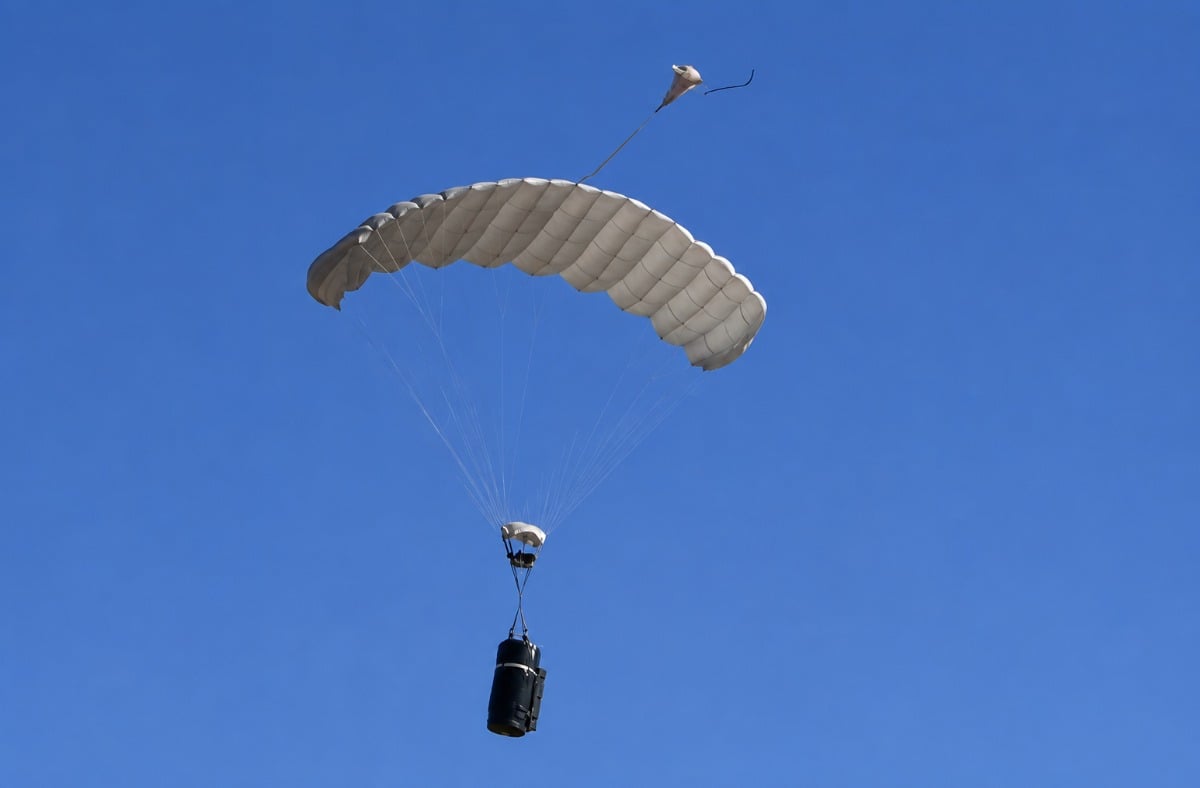
Drop a standard military parachute package from a high-altitude cargo plane, and you're basically at the mercy of the wind. A sudden gust can carry critical supplies miles away from the troops who actually need them. In a combat zone, that means soldiers have to trek across dangerous territory to recover their gear, or worse, the supplies fall straight into enemy hands.
Onyx Industries wants to fix this vulnerability entirely. By combining autonomous flight software with rugged mechanical hardware, the company has been actively testing and developing smart parachute systems that transform dumb air drops into highly precise guided missions. These systems aren't just concepts anymore. They represent a massive shift in how special operations forces and remote units get supplied without exposing heavy cargo planes to surface-to-air threats.
If you think air delivery is still just about canvas sheets and heavy ropes, you're looking at an outdated picture. The reality of modern supply drops involves GPS guidance, steering winches, real-time wind drift calculation, and automated swarming behavior.
The Problem With Traditional Cargo Drops
To understand why companies like Onyx Industries are focusing heavily on guided aerial delivery, you have to look at the math of traditional cargo drops. For decades, the military relied on low-altitude, low-accuracy methods. A plane like a C-130 or C-17 had to fly relatively low and slow to drop equipment accurately.
Flying low makes a massive, multi-million-dollar cargo plane an incredibly easy target for ground fire and shoulder-launched missiles. If the plane flies high to stay safe, say at 35,000 feet, a standard parachute will drift wildly. A strong crosswind can blow a bundle of medical supplies or ammunition completely off course, landing it on a mountainside or in a ravine where nobody can reach it.
The Joint Precision Airdrop System framework was built to change this dynamic. Instead of dropping cargo and hoping for the best, smart systems use an autonomous guidance unit to steer the parachute directly to a set coordinate.
How Autonomous Guidance Units Actually Work
A smart parachute doesn't just open and float. It actively flies. The tech relies on a two-part hybrid system that separates the steering phase from the landing phase.
First, the system uses a high-speed, ram-air elliptical parafoil for the glide portion of the flight. This isn't your traditional round umbrella parachute. It is a wing. The airborne guidance unit contains an on-board flight computer integrated with GPS and inertial navigation sensors.
Once the cargo leaves the aircraft at high altitude, the computer immediately calculates its position, tracks its heading, and assesses the local weather conditions. It controls the flight pattern by interacting with physical steering winches attached to the parafoil lines.
- The computer tells the right winch to pull in or let out line.
- The left winch does the same on the opposite side.
- This mechanical pulling mimics how an airplane uses its ailerons to bank and turn.
These winches rely on high-performance planetary gearheads and modified electric motors that are built to withstand intense shock and extreme vibration. Traditional electric motors would simply snap or fail under the sudden opening force of a cargo parachute. These specialized components use reinforced internal alloys and laser-welded pieces to ensure they can pull the heavy steering lines under immense aerodynamic load.
Just before the cargo hits the ground, a secondary, non-guided round recovery parachute deploys. This ensures a incredibly soft touchdown. Sensitive electronics, heavy weapons systems, or fragile medical equipment land safely without getting smashed by a hard impact or dragged across the dirt by a fast-moving parafoil wing.
Swarming and Active Collision Avoidance in the Sky
One of the biggest engineering hurdles in automated logistics is managing multiple drops at the same time. If a cargo plane drops thirty supply bundles simultaneously, you can't have thirty independent computers ignoring each other in mid-air. They would collide, tangle their lines, and plummet to the earth.
Engineers solved this by implementing advanced self-learning flight control and swarming algorithms. When multiple smart parachutes are dropped into the same airspace, they communicate with each other in real time.
The systems fly in formation, dynamically adjusting their flight paths to maintain safe separation distances. If one parachute encounters a localized updraft or gets knocked off course, the surrounding units adjust their trajectories to prevent a mid-air disaster.
This flocking behavior allows an entire fleet of supply bundles to guide themselves to either a single collective drop zone or split up mid-flight to head toward multiple distinct targets.
Real World Versatility from Inflatables to Ground Sensors
The application of this technology goes far beyond just dropping crates of meals ready to eat. Companies in this space, including Onyx with their modular systems like the RAM-T air delivery platform, build enclosures designed to drop incredibly complex payloads.
For example, military teams can drop complete inflatable watercraft, including the engine, fuel supplies, and inflation systems, packaged tightly into a single container. The guided parachute system flies the watercraft right to the shoreline or directly into the water. The enclosure can protect the payload during high-altitude transit, manage the impact on the water surface, and allow maritime operators to deploy the boat within minutes of landing.
Smaller variants also exist for lightweight logistics. Micro-guided systems handle payloads from 10 to 150 pounds. These are perfect for sending specific medical resupply kits, tactical communication equipment, or automated ground sensors into dense jungle environments or rugged mountain ridges where landing a helicopter is completely impossible.
Overcoming Weight Variance and Flight Damage
In the real world, cargo is rarely rigged perfectly. Rigging errors happen on the airfield, or last-minute cargo swaps alter the weight distribution of a payload. A standard guidance system might overcompensate for an unbalanced load and spin out of control.
To counter this, modern airborne units feature adaptive control software. The system monitors how the canopy responds to winch movements during the first few seconds of freefall. If it notices that the payload is hanging unevenly or that the wing loading is higher than expected, the software rewrites its own control parameters on the fly.
This adaptive capability even keeps the system flying if the parafoil gets torn by shrapnel or damaged during high-speed deployment. The computer recognizes the loss of aerodynamic efficiency on one side and increases winch inputs on the other to compensate, keeping the cargo on track for its destination.
Moving Forward with Guided Air Drops
Implementing smart air drop systems isn't just about buying fancy software. It requires a complete rethink of tactical supply lines. Organizations looking to adopt these capabilities need to focus on a few distinct operational steps.
- Rigger training integration: Supply personnel must learn to pack and program the airborne guidance units alongside traditional parachute rigging. Systems designed today aim to match standard personnel parachute packing methods to reduce the learning curve.
- Mission planning software mastery: Operators need to use base station software capable of simulating wind drift indicators and planning high-altitude release points before the aircraft even leaves the runway.
- Hardware recovery protocols: Because these guidance units contain expensive navigation computers, motors, and winches, units must establish clear recovery procedures to retrieve and reuse the modular guidance hardware after a successful drop.
The days of blind cargo drops are coming to an end. By putting intelligent flight computers in charge of the descent, modern military units can keep their aircraft safe at high altitudes while ensuring their ground forces get exactly what they need, precisely where they need it.