The morning in South Lebanon usually begins with the scent of roasted coffee and the silver-green shimmer of olive groves. In the village of Aadchit, the silence is a heavy thing, but it is a silence the residents have learned to navigate. They know the difference between the wind and the distant hum of a drone. They know the specific vibration of the earth when a strike lands five miles away versus when it lands at their doorstep.
Thirteen lives.
That is the number currently scrolling across news tickers and flashing on smartphone screens. To a reader in London or New York, thirteen is a manageable statistic—a tragic but abstract digit in a conflict that has spanned generations. But in the dust of South Lebanon, thirteen is not a number. It is a dinner table with three empty chairs. It is a wedding dress tucked away in a closet that will never be worn. It is the smell of pulverized concrete and the frantic, rhythmic scraping of fingernails against stone as neighbors search for breath beneath the rubble.
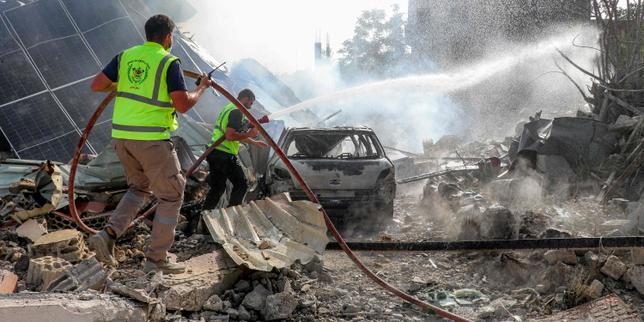
Thirteen people died in a series of Israeli strikes targeting the rugged, beautiful terrain of the south. The military reports speak of infrastructure and strategic targets. They speak of tactical necessity. What they leave out is the way a house, built over thirty years of hard labor, disappears in three seconds.
Consider the anatomy of a strike. First, there is the sound—a roar so profound it feels less like a noise and more like a physical blow to the chest. Then comes the pressure wave, shattering glass into a billion diamonds that slice through curtains and skin alike. Then, the silence returns, but it is a new kind of silence. It is a suffocating, dusty void where the world used to be.
Fatima—a name chosen here to represent the many mothers of the south—wasn't a combatant. She was a woman who worried about the price of flour and whether her youngest son would pass his chemistry exam. When the strikes hit the neighboring village of Al-Sultaniyah, she didn't see a "geopolitical shift." She saw the end of a family lineage.
The geography of this conflict is written in the soil. South Lebanon is a place where history is measured in layers of reconstruction. People here do not leave easily. They are tethered to the land by roots deeper than the reach of any missile. They stay because the olives need harvesting. They stay because their ancestors are buried in the hills. They stay because, in a world that feels increasingly hollow, the home is the only thing that remains real.
But the reality is shifting. The border is no longer a line on a map; it is a wound that refuses to scab over.
The strikes in Aadchit and the surrounding areas represent a terrifying escalation in the daily arithmetic of survival. For months, the exchange of fire remained within an unspoken set of boundaries. There was a grim rhythm to it—a back-and-forth that stayed largely within the sightlines of the Blue Line. Now, those boundaries are blurring. The strikes are deeper. The targets are more frequent. The "accidental" civilian toll is becoming a permanent feature of the landscape.
Logic suggests that the aim is deterrence. History suggests that deterrence in this part of the world rarely takes the form of peace. Instead, it creates a generation of children who can identify the model of an incoming jet by the pitch of its engine before they can solve a long division problem.
What is the cost of a life in a zone of "strategic interest"?
When we read about thirteen dead, we are reading about the sudden, violent interruption of thirteen different universes. One of those people might have been the village’s only mechanic—the man who knew exactly how to coax a 1994 Mercedes back to life. Another might have been a grandmother who held the secret recipe for the village’s best kibbeh. When they die, that knowledge dies with them. The community doesn't just lose people; it loses its library, its hands, and its heart.
The international community watches through the clinical lens of a satellite. They see heat signatures. They see troop movements. They see the cold geometry of war. But they do not see the way the dust settles on a child's toy. They do not hear the sound of a phone ringing inside a collapsed house, unanswered, until the battery finally gives up.
There is a specific kind of exhaustion that settles into the bones of those living through this. It is not the exhaustion of work, but the exhaustion of vigilance. It is the weight of constantly asking: Is today the day?
When the strikes hit South Lebanon, the shockwaves travel far beyond the craters. They ripple through the Lebanese economy, already a fragile ghost of its former self. They ripple through the hospitals where doctors, already short on supplies, must decide who gets the last unit of blood. They ripple through the diaspora, where millions of Lebanese citizens spend their nights staring at their phones, waiting for a text message that says "We are okay" to arrive from a village that no longer has electricity.
The tragedy of the thirteen is not just that they died. It is that their deaths have become expected. We have been conditioned to accept that certain parts of the world are simply destined for fire. We treat the Middle East like a stage where the play never changes, forgetting that the actors are made of flesh and blood, not scripts and tropes.
If you walk through these villages after the cameras leave, you see the true face of the conflict. You see men sitting on plastic chairs in front of ruins, smoking in a stunned, rhythmic silence. You see women sweeping dust from doorsteps that lead to rooms that no longer exist. There is a stubborn, defiant grace in the way they refuse to disappear.
But grace does not stop a missile.
The political actors discuss "proportionality" and "red lines." These are comfortable words for people sitting in air-conditioned rooms. In the south, there are no red lines, only red earth. The proportionality of losing a child is an equation that can never be balanced.
We must look past the headlines. We must look into the eyes of the thirteen who are gone and the thousands who remain, waiting for the next whistle in the sky. The sky above South Lebanon is no longer blue; it is a canvas of anxiety, painted with the streaks of outgoing rockets and incoming fire.
As the sun sets over the Mediterranean, casting long, golden shadows across the scarred hills of the south, the coffee is still being brewed. The olives are still being tended. The people are still there. They are the invisible stakes of this war, the human anchors in a storm of steel.
The world may move on to the next headline by tomorrow morning. The tickers will refresh. New numbers will replace the thirteen. But in Aadchit, the silence of the thirteen will remain, a permanent hole in the fabric of the village, a ghost that refuses to be ignored.
The earth remembers every drop of blood, even when the world forgets the names.