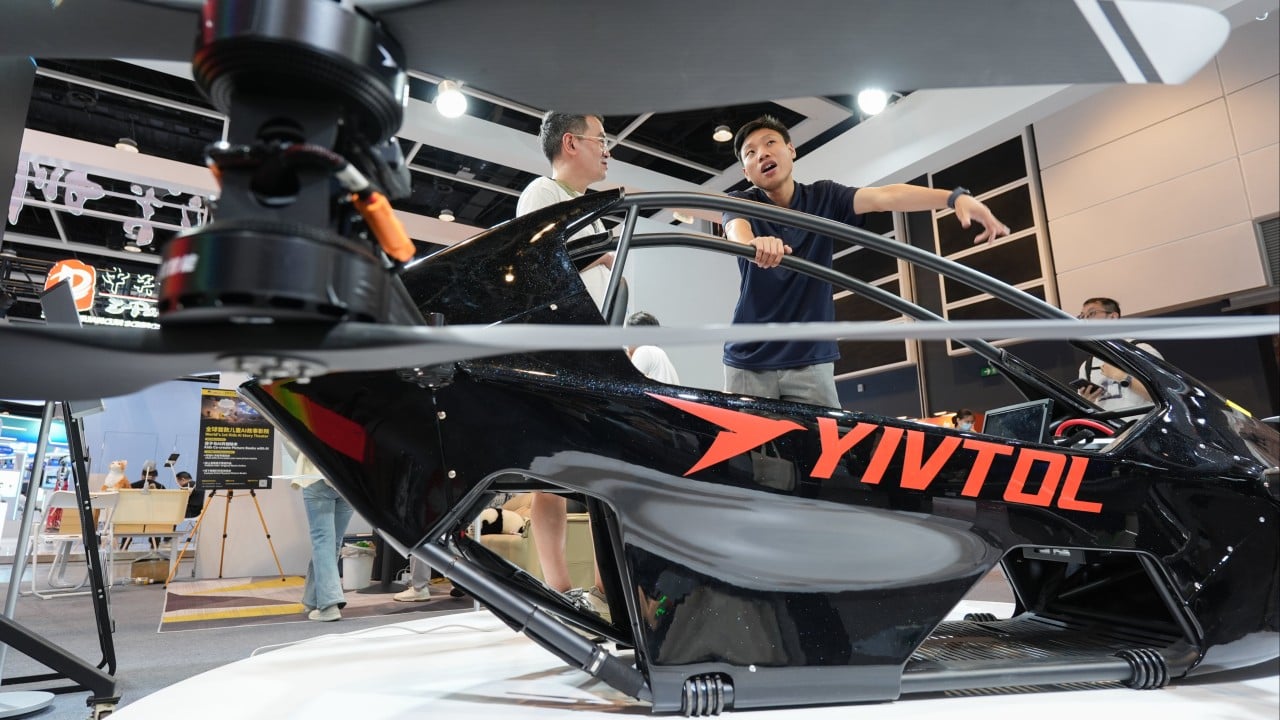
The rain over Victoria Harbour doesn't stop for innovation. It trickles down glass, blurrs neon signboards, and turns a ten-mile commute into a ninety-minute test of human patience.
Down on the asphalt, thousands of commuters sit bumper to bumper. They watch their lives tick away in red brake lights. Above them, the sky sits completely empty. Wide. Open. Waiting. Read more on a similar topic: this related article.
For decades, we were promised that the future would be airborne. We expected personal flying vehicles to swoop between skyscrapers, effortlessly untangling the knot of urban transit. Yet the future kept getting delayed. Not because we couldn't build the machines. Engineers solved the physics years ago. Motors spun, carbon-fiber blades hummed, and multi-rotor aircraft hovered gracefully in test hangars from Shenzhen to Silicon Valley.
The real roadblock wasn’t gravity. It was risk. Further analysis by MIT Technology Review delves into comparable views on the subject.
Who pays when a flying car drops a battery pack onto a crowded boulevard? How do you calculate the financial ripple effect of a mid-air collision over one of the most densely populated real estate corridors on Earth?
Until someone put a concrete dollar figure on that anxiety, the sky remained off-limits.
The Paperwork That Unlocked the Clouds
A quietly revolutionary piece of paper changed the math.
Shenzhen, China’s buzzing technological forge, has spent the last few years nurturing the electric vertical takeoff and landing industry. Companies there built the aircraft, tested the rotors, and mapped the flight paths. But crossing the border into Hong Kong—a distinct legal and financial ecosystem—required more than just flight permits. It required insurance.
Not standard automobile coverage. Not traditional commercial aviation policy work either. Something entirely new.
A landmark insurance policy was finalized, specifically structured to cover cross-boundary flying vehicle operations between Shenzhen and Hong Kong. It sounds dry on the surface. Insurance documents rarely inspire poetry. But in the world of emerging technology, an underwritten policy is the ultimate vote of confidence. It means actuary tables have met high-tech ambition and decided: Yes, this risk is manageable.
Without this policy, these aircraft were magnificent, multi-million-dollar paperweights. With it, they are a commercial fleet waiting for takeoff.
Crossing the Invisible Border
Picture a medical specialist in Shenzhen who needs to reach a critical patient at Hong Kong General.
Right now, that journey involves navigating customs control, switching transport, or sitting in a cross-border car service while traffic throttles down to a crawl at the checkpoints. It is a journey measured in hours, where every lost minute carries a physical cost.
Now shift the frame.
The doctor steps onto a pad atop a Shenzhen tower. The vehicle—sleek, electric, surprisingly quiet—lifts straight up. Within seconds, it clears the treeline and the traffic. Below, the Shenzhen River winds like a silver ribbon dividing two distinct economic giants. The craft accelerates forward, smoothly transitioning across the border zone in a fraction of the time it takes to clear a single traffic light on the ground.
Fifteen minutes later, the rotors spin down in Hong Kong.
This isn't sci-fi. It is the direct consequence of clearing legal and financial hurdles. The technology creates the capability, but the framework creates the reality.
When you remove the friction of borders and terrain, cities stop being separate islands of activity. They fuse. The Greater Bay Area has long envisioned this kind of deep integration, but ground transport always created a hard physical ceiling. The sky removes that ceiling.
The Quiet Math of Trust
Every new era of transportation carries an initial wave of public skepticism.
When steam locomotives first chugged across countryside tracks, critics warned that the human body couldn't survive traveling at thirty miles per hour. When commercial airlines expanded after World War II, convincing ordinary families to step inside a metal tube at thirty thousand feet took years of steady, relentless safety records.
Flying cars face an even higher hurdle. They will operate not miles above us in empty airspace, but right over our heads, right outside our high-rise office windows.
Fear is natural. Doubt is rational.
That is precisely why this cross-border insurance milestone matters far more than any flashy product demonstration or press release. Underwriters do not operate on hope. They do not care about futuristic aesthetics or bold corporate promises. They care about cold data, redundancy systems, fail-safes, and statistical probability.
When insurers agree to underwrite cross-border flights over densely populated urban zones, they are declaring that the technology has moved from experimental to operational. They are betting millions of dollars that these machines will not fail.
Beyond the Horizon
We tend to measure progress in speed. We ask how fast a vehicle goes, how much time it saves, how far it can travel on a single charge.
But true progress is usually measured in access.
The real magic of opening the low-altitude sky isn't just that executives can dodge traffic jams. It is the way it reshapes urban geography entirely. Distance ceases to be measured in miles and starts being measured purely in minutes. Suburbs that once felt isolated suddenly sit within a quick hop of major financial hubs. Remote areas gain rapid access to emergency services. Supply chains reach upward instead of grinding through choked city streets.
The sky over Victoria Harbour is still quiet today. The rain still falls on long lines of idling cars stuck on the bridges below. But the legal foundation has been poured. The financial safety net has been woven.
The propellers are ready to turn, and for the first time in history, the route ahead is completely clear.

:max_bytes(150000):strip_icc():focal(749x0:751x2)/Arnold-Schwarzenegger-Joseph-Baena-032926-a90f8d3315fc44a6aebc6d7bb44bda01.jpg)