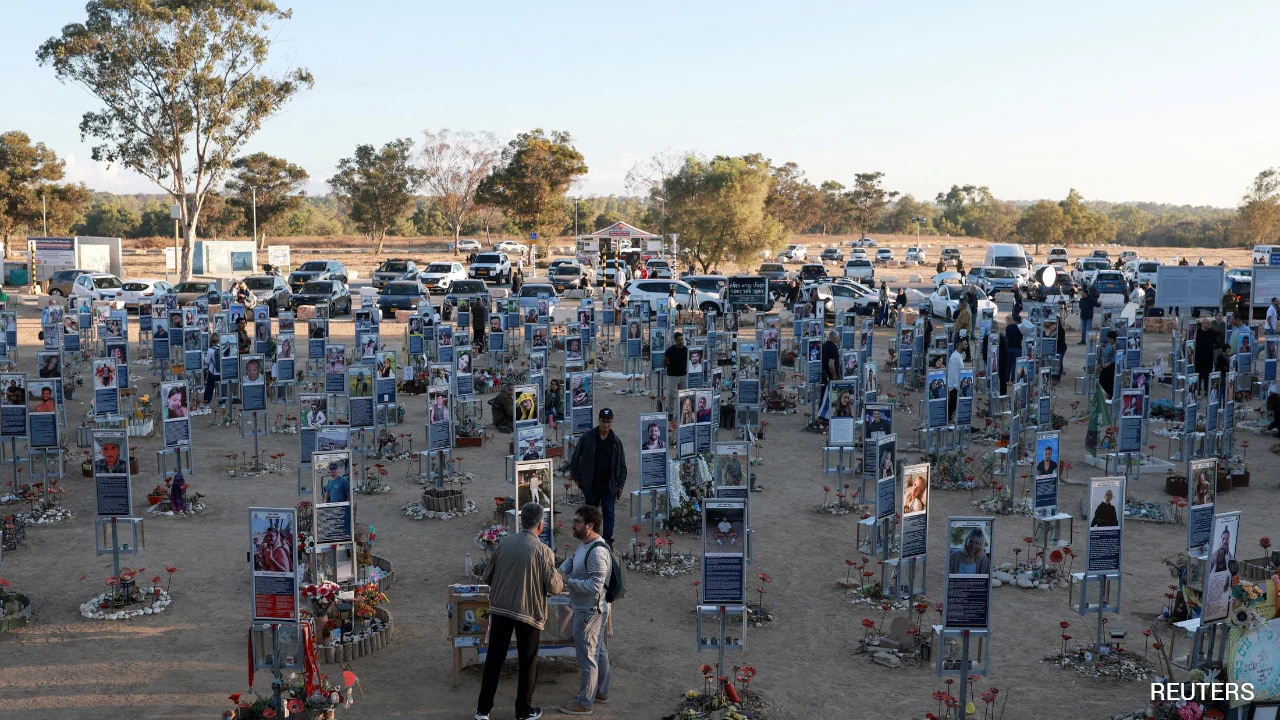
The air in Tel Aviv does not smell like fear on ordinary mornings. It smells like roasted cardamom, salt blowing off the Mediterranean, and the sharp, anxious exhaust of a thousand idling delivery scooters. But there is a different currency circulating through the streets now. It is measured in the heavy, unblinking stares of soldiers standing outside cafes, the hurried glances at wristwatches, and the quiet, collective holding of breath as the autumn air turns crisp.
Three years.
To the rest of the world, a three-year anniversary is a milestone for reflection, a marker on a timeline to be parsed by historians and analysts in distant capitals. Here, it is a physical weight. It sits on the chest. It dictates how people walk down Dizengoff Street, how parents text their teenagers during the school day, and how an entire country prepares for a calendar date that has become synonymous with fracture.
Memorial events loom, and the state stands on high alert.
Consider the anatomy of anticipation. It is not the explosion itself that drains the color from a city; it is the absolute certainty that someone, somewhere, is trying to recreate it. Intelligence desks are buried under an avalanche of threat warnings—chatter intercepted in subterranean rooms, digital footprints traced across porous borders, the endless, grinding work of finding the needle in a digital haystack before it can draw blood.
To understand what it means for a nation to be on high alert, you have to step away from the flashing red banners on international news networks. You have to look at Maya.
Maya is thirty-four, an architect with a penchant for geometric earrings and a laugh that used to come easily. Her brother was taken three years ago. His name is still spoken in the present tense by his mother, and in the past tense by the government. On most days, Maya manages the alchemy of living—she designs apartment complexes with large, forgiving windows, she drinks coffee too fast, she pays her taxes. But when October approaches, the architecture of her life shifts.
She does not stock up on canned goods or water bottles anymore. That panic belongs to the first year, the raw, bleeding months when nobody knew if the sky would fall again tomorrow. Instead, her preparations are psychological. She maps out her days based on proximity to reinforced spaces. She checks her phone every twenty minutes, not for work emails, but for updates from the Home Front Command.
"It is like living with a low-grade fever," she told me last week, her fingers tracing the rim of an empty espresso cup. "You function. You go to meetings. You pay for groceries. But your nervous system never quite remembers how to turn off. You are just waiting for the shoe to drop, wondering whose name will be added to the wall this time."
That is the invisible stake of memorial season in a traumatized society. The rituals meant to honor the dead are perpetually shadowed by the frantic effort to keep the living from joining them. Security forces are doubled, triple-shifted, stretched to the absolute breaking point. Border fences are monitored by exhausted young men and women who were in high school when the world cracked open three years ago. Every public square, every synagogue, every cemetery where grief is scheduled to be performed under the gaze of television cameras becomes a potential flashpoint.
The paradox is cruel. How do you mourn openly when you have to look over your shoulder to do it?
How do you weep for the victims of yesterday while actively dodging the architects of tomorrow?
History is full of turning points that people refuse to recognize until the dust settles, but October 7th was different. It was an abrupt, violent severing of a timeline. Before that morning, a certain complacency had taken root—the dangerous belief that high walls, iron domes, and sophisticated algorithms could insulate a modern society from the ancient, visceral hatreds of its neighborhood.
The illusion did not just shatter; it vaporized.
And in its place grew a complex, jagged resilience. You can see it in the volunteer networks that sprang up overnight three years ago and never really went away. You can see it in the thousands of reservists who drop their lives—their businesses, their universities, their newborns—the moment a mobilization order pings their phones. It is not blind militarism. It is a desperate, fierce protectiveness of a shared home, born from the terrifying realization that no one else is coming to save them.
Yet, this resilience extracts a toll in currency that never appears on a government ledger.
Children raised on the sound of interceptors overhead learn a vocabulary of war before they learn fractions. Grandparents who survived atrocities decades ago find themselves reliving the exact helplessness they thought they had buried in another century. The collective psyche of the country is a patchwork of scar tissue—tougher in some places, agonizingly tender in others.
As the memorial events draw closer, the tension in the atmosphere thickens into something almost palpable. Sirens are tested in empty noon streets, their mournful wails echoing off concrete apartment blocks, sending stray cats darting under cars. People pause on the sidewalks. Some close their eyes. Some mutter under their breath. For a few long seconds, everyone is listening to the same ghost.
The threat reports are real. The intelligence is actionable. The soldiers on the rooftops are cold, tired, and hyper-vigilant. Every precaution that can be taken is being taken, woven together by a security apparatus that has learned its lessons in the harshest school imaginable.
And still, life insists on happening in the margins.
Just down the street from where a heavy security detail inspects vehicles entering a public plaza, a bakery is selling warm rugelach. A dog chases a ball across a patch of yellowed grass. Two old men argue loudly over a chessboard, entirely unbothered by the sirens of passing police cruisers.
This is the quiet defiance at the heart of it all. Not the speeches that will be given at the official ceremonies, not the solemn editorials published in morning papers, but the sheer stubbornness of ordinary existence continuing in the shadow of catastrophe.
The calendar will turn. The names of the fallen will be read aloud through microphones, their echoes floating over weeping families and stoic statesmen. The alert level will remain high, the borders will remain tense, and the world will watch to see how a scarred nation holds its breath once more.
Maya will go to work. She will design her buildings with wide windows, refusing to live in a bunker, even as the world outside trembles. And when the sun dips below the Mediterranean, painting the Tel Aviv skyline in shades of bruised purple and gold, the city will stand together—weary, bruised, wide awake, and refusing to let go.