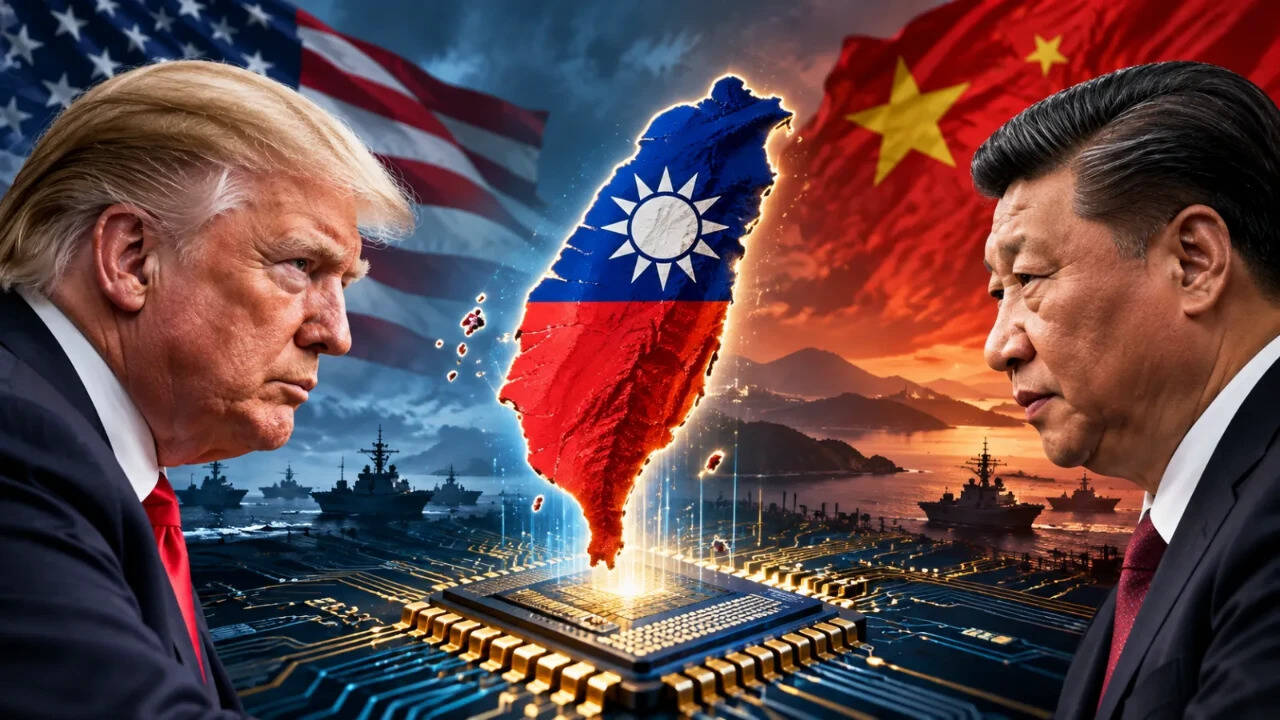
For decades, Washington and Taipei have peddled a comfortable bedtime story. It goes like this: Taiwan is too important to fail. Because Taiwan Semiconductor Manufacturing Company (TSMC) pumps out the world’s most advanced nodes, any kinetic conflict across the strait would detonate the global economy. Washington would have no choice, the theory runs, but to rush the beaches and defend Hsinchu.
It is the geopolitical equivalent of strapping a bomb to your own chest and walking into a crowded bank, expecting the teller to treat you like royalty forever.
This lazy consensus assumes that economic interdependence equals absolute immunity. It misses the core reality of modern industrial geography. Monopolies do not deter aggression. They concentrate targets. TSMC’s extreme centralization is not a shield protecting the island from Beijing; it is a giant red bullseye painted across a twenty-mile stretch of the Taiwan Strait.
I have watched strategists in defense think tanks and boardrooms across Silicon Valley nod along to the silicon shield myth for years, treating a terrifying single-point-of-failure as an insurance policy. They are confusing dependency with deterrence. When your adversary’s entire technological advancement relies on a single island, the rational strategic move for a rising power seeking regional hegemony is not to preserve that bottleneck. It is to capture it, control it, or render it irrelevant before anyone else can use it against them.
The Geography of Fragility
Look at the physical reality of chip manufacturing. We talk about semiconductors as ethereal, digital assets, but they require the most hyper-concentrated, brittle physical infrastructure on earth. Pure water, specialized gases, uninterrupted power grids, and extreme ultraviolet lithography machines sourced from a single Dutch monopoly converge in a few tightly packed industrial parks on a seismically active island.
The standard narrative suggests that China will stay its hand because a war would halt its own supply chains. This view assumes that Beijing values short-term quarterly GDP growth over dynastic territorial unification. That is a dangerous projection of Western corporate logic onto a regime operating on a completely different historical timeline.
Beijing’s planners do not look at TSMC and see an untouchable monument. They see an occupied asset. If you believe a superpower aiming to reclaim a breakaway province is going to pass on an invasion because Apple might run out of smartphone chips for six months, you do not understand how great powers behave. They take the hit, absorb the short-term shock, and rebuild the foundry floor under new management.
Furthermore, the silicon shield argument completely ignores the shifting calculus of redundancy. The United States and its allies spent decades outsourcing their manufacturing foundation to Asia because it was cheap, efficient, and profitable. Now, panic has set in. Programs like the Chips Act are pouring hundreds of billions of dollars into domestic fabrication plants in Arizona, Ohio, and Dresden.
What happens to the shield when those fabs come fully online?
If the entire premise of Taiwan’s geopolitical safety rests on the West’s absolute dependence on its foundries, what occurs the moment that dependence drops from ninety percent to fifty percent? The shield does not hold. It evaporates. By sprinting to reshore semiconductor supply chains, Washington is systematically defusing the very deterrent it claims to rely on.
The Myth of Mutually Assured Economic Destruction
During the Cold War, Mutually Assured Destruction meant that launching a nuclear strike guaranteed immediate, catastrophic retaliation that destroyed both sides. It was clean, terrifying, and symmetrical.
The silicon shield is asymmetric and deeply flawed. If China moves on Taiwan, the global economy crashes. Inflation spikes, equity markets implode, and the tech sector grinds to a halt. Western pundits point to this impending catastrophe as proof that Beijing wouldn't dare strike.
They forget a fundamental rule of asymmetric coercion: the party with local escalation dominance cares far more about the regional objective than the distant superpower cares about supply chain friction.
China views Taiwan through an existential lens of national sovereignty and historical grievance. The United States views Taiwan through a strategic lens of global hegemony and alliance credibility. When an existential local interest clashes with a distant economic interest, geography and resolve win every single time. Beijing calculates that it can absorb the economic pain, insulate its command economy through state controls, and ride out the global depression better than open, market-driven democracies can.
When you tell an autocrat that he cannot touch a territory because it builds your microchips, you are not deterring him. You are giving him a masterclass on how to cripple your entire civilization with one surgical operation.
The Corporate Complicity
TSMC management knows this better than anyone, which explains their deeply conflicted behavior. On one hand, they lean into the silicon shield rhetoric because it aligns with Western security guarantees. On the other hand, they are quietly shipping their best engineers and newest process nodes to fab sites in Phoenix, Kumamoto, and Dresden.
They are hedging against the exact disaster that the pundits pretend is impossible.
Corporate leaders love to talk about global supply chains as monuments to efficiency. In reality, they are fragile glass houses built on cheap energy and geopolitical stability. TSMC built a manufacturing miracle, but it built it on a fault line.
When you concentrate the world's brain trust for sub-3-nanometer logic chips into a target-rich environment sitting ninety miles off the coast of a hostile nuclear-armed superpower, you haven't secured peace. You have created the most lucrative hostage situation in human history.
Unraveling the Geopolitical Fallacy
People ask why Beijing hasn't already moved if the shield is a myth. The answer isn't that TSMC is magical armor. The answer is military readiness, amphibious logistics challenges, and the time required to build out domestic capabilities like SMIC so that a takeover doesn't accidentally destroy the very machinery they want to inherit.
The delay is tactical, not strategic. Every new foundry breaking ground in Ohio or Japan is a countdown clock ticking down the final days of Taiwan's perceived geopolitical indispensability.
We need to stop treating advanced manufacturing as a substitute for hard defense and diplomatic clarity. Pretending that a semiconductor foundry acts as a nuclear deterrent is a lazy intellectual shortcut used by analysts who refuse to look at the brutal mechanics of hard power.
The silicon shield is a temporary illusion. Once the fabs are built elsewhere, and once the cost-benefit analysis in Beijing shifts from deterrence to execution, that shield will shatter like a silicon wafer dropped on a concrete floor. Stop waiting for microchips to save geopolitics. Real security is won with deterrence, resolve, and balance, not by daring your enemies to break your most expensive toys.