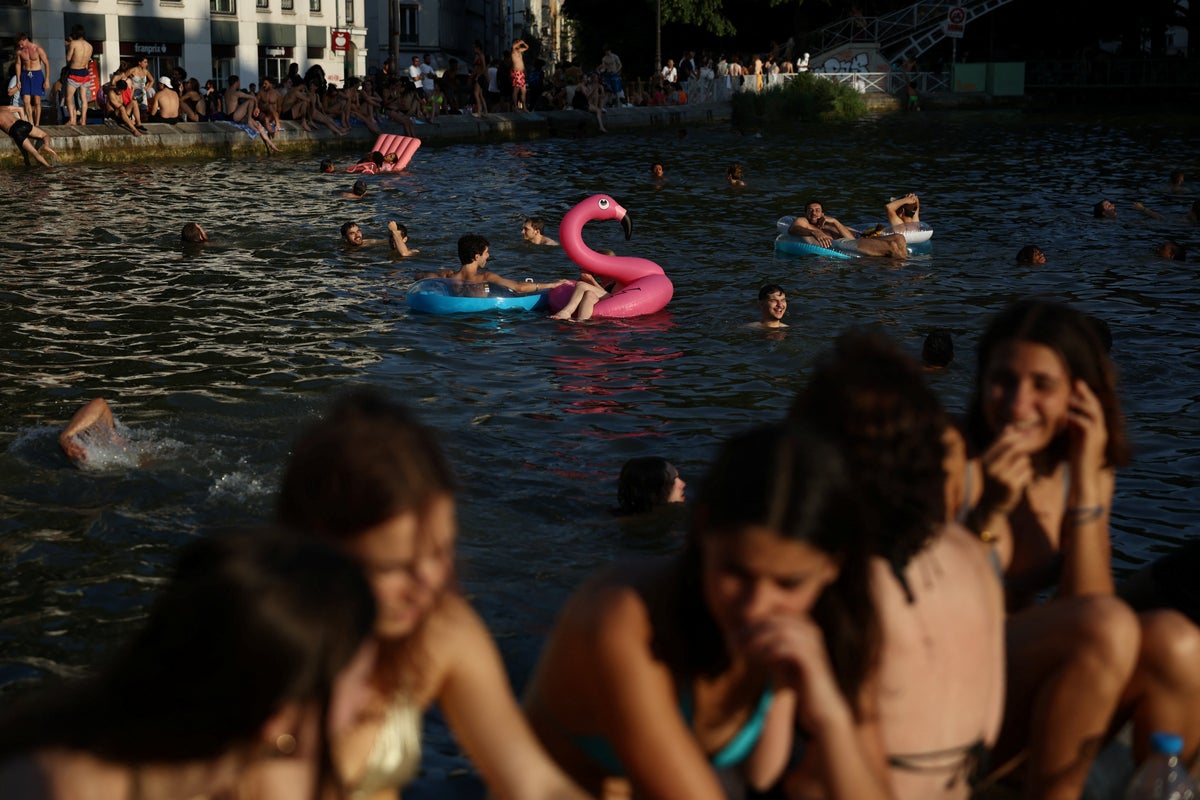
If you walk through a French town in the blinding white heat of mid-July, the first thing you notice is the silence. It is not the peaceful quiet of a sleepy Sunday. It is an enforced, heavy stillness. The heavy wooden shutters of every stone house are slammed shut, bolted against the sky. Inside, behind the thick walls, people are hiding from the air itself.
For generations, the midday closing of the shutters—the volets—was a ritual of comfort. It kept the midday glare at bay while the tarmac outside grew tacky under the sun. But over the last few years, this ritual has morphed from a tradition of leisure into a strategy for survival.
When the temperature in Paris or Lyon climbs past forty degrees Celsius, the air stops moving. It feels thick, almost metallic. You breathe it in, but your lungs find no relief. Your skin grows tacky, but the sweat cannot evaporate because the ambient air is already choked with humidity. For a healthy twenty-year-old, this is miserable. For an eighty-year-old living on the top floor of a classic Haussmann-style apartment building, it is an invisible trap.
The numbers eventually catch up to the quiet. When the French health agency released the mortality data following a recent summer heatwave, the headline figures were stark: over one thousand excess deaths across the country in a matter of weeks. It is a massive number, the kind of statistic that belongs to natural disasters or major transportation accidents. Yet, when a thousand people die of heat, there are no sirens. There are no shattered buildings. There are no flashing red lights.
They die quietly, one by one, in rooms where the air simply grew too heavy to bear.
To understand how a modern, wealthy European nation loses a thousand citizens to a summer spike in temperature, you have to look past the thermometers and look at the architecture. Consider a hypothetical resident—let us call her Monique. She is eighty-two, fiercely independent, and lives in a beautiful, fifth-floor apartment in Paris. Her building is a masterpiece of nineteenth-century design, built with cream-colored limestone and topped with a classic zinc roof.
In the winter, that zinc roof holds in the warmth. In July, it acts like a giant frying pan inverted over the top floor.
Monique does not have air conditioning. Virtually no one in traditional French residential buildings does. For decades, it was deemed an unnecessary luxury, a wasteful American habit for a climate that only grew truly hot for a week or two in August. The building’s stone walls are thick, designed to absorb heat during the day and release it into the cool night air.
But what happens when the night air never cools?
During a modern European heatwave, the nighttime temperature frequently refuses to drop below twenty-five degrees Celsius. The stone walls, instead of cooling down, keep radiating heat inward. The apartment becomes a thermal battery that never discharges. By day three, Monique’s home is hotter than the street outside. She opens the window, but the air outside is a furnace. She closes the shutters, but the heat is already inside, trapped under the zinc, pressing down on her.
The human body is an exquisite machine for shedding heat, but it relies on a very simple mechanism: pumping blood to the skin so the air can cool it, and producing sweat. But as we age, our bodies become less efficient at signaling thirst. Our sweat glands do not activate as quickly. Our cardiovascular systems are already working harder just to maintain baseline operations.
When Monique sits in her thirty-eight-degree living room, her heart has to beat significantly faster just to keep her internal temperature from spiking. It is the physiological equivalent of running a slow, permanent marathon while sitting perfectly still in an armchair.
After forty-eight hours of this internal marathon, the margins of safety evaporate. Dehydration sets in, thickening the blood. The kidneys begin to strain. It is not usually "heat stroke" that claims a life like Monique's in the official records; it is a cardiovascular collapse, a sudden stroke, or kidney failure. The heat is the executioner, but the certificate blames the preexisting frailty. This is why epidemiologists look at "excess mortality"—the gap between how many people usually die in a normal week versus how many died when the mercury shattered records. The gap is where the truth hides.
We often treat climate change as a problem of the future, a series of projections involving melting glaciers and rising sea levels decades down the line. But the thousand empty chairs at French dinner tables are not a projection. They are a ledger of the present.
The real danger of these contemporary heatwaves is their duration and their relentless, compounding weight. A single day of forty-degree heat is an ordeal. A five-day block of it is a systemic crisis for human biology. The body can fight off the heat for twenty-four hours, even forty-eight, by drawing on its reserves. But by the third night of sleepless, sweat-drenched exhaustion, the defenses crumble.
There is a profound isolation that accompanies extreme heat. In a blizzard or a flood, the danger is visible. Neighbors check on neighbors; emergency vehicles plow through the snow. But heat drives people deep into the shadows of their own homes. It forces isolation. You pull the blinds, you turn off the lights to avoid generating extra heat, and you sit in the dark, waiting for the sun to drop.
If you are old, or living alone, or struggling with mobility, you disappear from the world long before your heart gives out.
The response to this recurring crisis cannot just be a matter of telling people to drink more water. It requires a fundamental rethinking of how we construct our lives and our cities. For centuries, European urban design prioritized keeping the cold out. Streets were narrow to block the wind; buildings were clustered tight to share warmth. Now, those same design choices are turning cities into urban heat islands, where asphalt and concrete absorb the sun’s energy during the day and blast it back at the inhabitants all night.
We are entering an era where the architecture of the past is at war with the climate of the present. Fixing it is not as simple as snapping an air conditioning unit into every window; the electrical grids of historic European cities were not built to handle the massive, simultaneous power draw of millions of compressors running at maximum capacity. Doing so would only dump more ambient heat into the narrow streets, worsening the problem for anyone walking outside.
Instead, the solutions must be as quiet and systemic as the crisis itself. It means planting massive urban forests to create natural cooling canopies. It means painting roofs with reflective white compounds instead of leaving them as exposed zinc and dark slate. It means creating municipal registries of vulnerable citizens so that social workers can physically knock on doors when the alerts turn red.
But even with these interventions, the underlying reality remains unchanged. The climate we grew up with, the one that dictated the rhythm of the seasons and the design of our homes, is fading. The volets will continue to slam shut every July, a wooden shield against an increasingly hostile sky.
When the heat finally breaks and the thunderstorms arrive to wash the heavy air from the streets, the shutters will open again. The towns will wake up, the cafes will spill back onto the sidewalks, and the standard rhythm of European life will resume. But in a thousand apartments across the country, the air will remain perfectly still, a silent testament to a summer that demanded a price regular people were never supposed to pay.