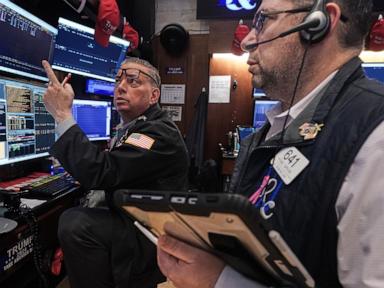
At 3:58 PM on a Tuesday afternoon in midtown Manhattan, the air inside an institutional trading desk smells like cold espresso, ozone, and quiet panic.
If you look at the glowing red and green tickers scrolling across the wall, you might think you are watching a simple game of numbers. A ticker symbol flashes red. Another flashes green. A broadcast anchor in a tailored suit calmly announces that Nvidia and other Big Tech stocks have lifted Wall Street, successfully making up for a noticeable drop by Apple.
To the casual observer sipping coffee at a kitchen table two thousand miles away, that sentence is financial white noise. It is background hum.
But if you understand the machinery beneath those numbers, your stomach drops. Because you aren't watching a routine afternoon of stock trading. You are watching the tectonic plates of the modern economy grind against one another, shifting trillions of dollars of human ambition, retirement security, and technological destiny from one era into the next.
Apple falling while Nvidia rises isn't just a market fluctuation. It is a generational coup.
The Weight of an Invisible Crown
To grasp why a single afternoon on Wall Street carries so much emotional and financial freight, we need to step away from the trading floor and look at someone like Elena.
Elena is a hypothetical character—a 54-year-old high school chemistry teacher in Ohio who has spent thirty years dutifully contributing eight percent of her paycheck to a target-date retirement fund. She does not follow semiconductor supply chains. She does not read quarterly earnings transcripts. She owns an iPhone because it works, and she checks her 401(k) statement once every six months with a mixture of hope and low-grade dread.
Here is the secret that Wall Street rarely explains in plain English: Elena is a silent high-stakes gambler.
Because modern index funds like the S&P 500 are weighted by market capitalization—meaning the biggest companies take up the largest slice of the pie—Elena’s retirement is not spread evenly across five hundred businesses. Instead, a handful of Silicon Valley giants sit at the top of the pyramid like Atlas, holding up the entire roof of the global market.
For more than a decade, Apple was the undisputed king of that roof.
Think back to the first time you held an iPhone. Remember the cool weight of the glass, the intuitive glide of a finger unlocking a screen, the sudden realization that the internet was no longer chained to a desk in your spare bedroom. Apple built an empire on human intimacy. They sold hardware you carried in your pocket, slept next to on your nightstand, and used to send photographs of your children to your parents.
When Apple’s stock stumbled, the whole market caught a cold. That was the rule of gravity on Wall Street for fifteen years.
Until the rules changed.
When the Consumer Engine Sputters
The drop in Apple’s share price that rattled traders wasn't caused by a single catastrophic failure. There was no exploding battery, no public scandal, no sudden bankruptcy. It was something far more insidious and harder to fix: saturation.
Wall Street is a ruthless, forward-looking machine. It does not reward you for the billions of phones you sold yesterday; it punishes you if it suspects you cannot sell twice as many tomorrow. Investors looked at Apple and saw a company facing headwinds in China, sluggish upgrade cycles among everyday consumers, and regulatory scrutiny tightening around its lucrative App Store walls. People were holding onto their old phones for three, four, sometimes five years. Why buy the newest model when the one in your pocket already takes crystal-clear photos and checks your email?
When Apple’s stock slid downward, it dragged billions of dollars in index value down with it. On the trading desks, red numbers multiplied. Pension managers watched their daily performance metrics bleed. For a brief, tense window, it looked as though the broader market was going to buckle under the weight of its longtime champion.
Then, the counterweight kicked in.
The Architecture of the New Gold Rush
If Apple represents the technology you hold in your hand, Nvidia represents the invisible brain humming inside giant, windowless warehouses across the globe.
To understand what happened when Nvidia and its Big Tech peers surged upward to rescue the market, picture the California Gold Rush of 1849. Thousands of prospectors rushed west hoping to strike it rich by panning for nuggets in icy rivers. Most went broke. The people who made guaranteed, generational fortunes were the merchants selling the picks, the shovels, and the heavy denim trousers.
Today, artificial intelligence is the gold rush, and Nvidia sells the only shovels that work.
Years ago, Nvidia was known primarily to teenagers and hardcore PC gamers as the company that made graphics cards—the silicon chips that rendered realistic shadows and explosions in video games. Then, computer scientists realized a strange mathematical quirk: the exact same parallel-processing architecture required to render a dragon’s scales in a video game was also the ideal engine for training artificial intelligence models.
While the rest of the world was still marveling at smartphones, Nvidia’s leadership bet the entire company on this realization. They didn't just build faster chips; they built the software ecosystem around them, locking developers into a standard that competitors have struggled to match.
So when Apple’s consumer-driven empire hit a patch of rough weather on Wall Street, institutional money didn't flee the stock market altogether. It rotated. It flowed out of the company that sells devices to individual humans and poured straight into the companies building the infrastructure of machine intelligence.
The Anatomy of a Market Rescue
Let’s look closely at what actually happens behind the scenes when Big Tech "makes up" for a drop by Apple. It is easy to read a headline and assume it means everything is fine, that the market is balanced and healthy.
The reality is much more precarious.
Imagine a tightrope walker crossing a canyon in high winds. On one side of the balancing pole sits Apple, slipping downward. To keep from plunging into the abyss, the walker has to shift an enormous amount of weight to the other end of the pole—Nvidia, Microsoft, Alphabet, Meta, and Amazon.
On the day in question, that is precisely what occurred. As Apple’s valuation shed tens of billions of dollars, buyers flooded into Nvidia and other cloud-computing giants. Why? Because Microsoft, Meta, and Alphabet are locked in an existential arms race. None of them can afford to fall behind in AI, which means they are spending tens of billions of dollars in capital expenditures—money that flows directly onto Nvidia’s balance sheet.
This creates a fascinating, slightly terrifying feedback loop.
When you buy an iPhone, you are paying with your own after-tax paycheck. If inflation squeezes your grocery bill, you delay buying a new phone, and Apple feels the pain.
When Big Tech companies buy Nvidia chips, they are spending corporate cash reserves fueled by fear of obsolescence. They will keep buying even if consumers are tightening their belts, because to stop buying is to surrender the future.
That dynamic is why Nvidia and its peers were able to lift Wall Street despite Apple’s slump. The market shifted its faith from the consumer’s wallet to the corporation’s survival instinct.
The Vulnerability We Rarely Admit
I have watched market cycles turn for long enough to recognize the exact emotional cocktail that accompanies moments like this. It is equal parts exhilaration and vertigo.
When a handful of mega-cap technology stocks carry the entire S&P 500 on their shoulders, it feels miraculous on the way up. Retirement accounts grow. Headlines celebrate record highs. Financial commentators talk about unstoppable momentum.
Yet if we are being completely honest with ourselves, this extreme concentration should make every thoughtful investor pause.
Consider what happens when the fortunes of millions of ordinary people—teachers like Elena, firefighters, nurses, small-business owners—are tethered to the quarterly earnings of five or six companies in Northern California and the Pacific Northwest. We call our portfolios "diversified" because we own an index fund containing five hundred names. In practice, we are riding in a bus where five giant engines do ninety percent of the pulling, and the other four hundred and ninety-five are mostly along for the ride.
When Apple faltered and Nvidia stepped in to catch the falling weight, the system worked as designed. The net result on the closing bell was green. Crisis averted.
But what happens on the afternoon when both ends of the pole dip at the exact same time? What happens if AI spending hits a wall before companies figure out how to turn all that computing power into actual, sustainable profits, while consumers are simultaneously too tapped out to upgrade their smartphones?
Nobody on Wall Street has a clean answer to that question, no matter how confidently they speak on television. The truth is that we are living through an unprecedented experiment in market concentration, and we are writing the textbook while the plane is in the air.
Reading Between the Ticker Symbols
The next time you glance at your phone and see a dry, three-line summary about Big Tech offsetting a drop in Apple, stop for a second and look past the jargon.
Look at what that single sentence reveals about the world you actually live in. It tells you that the smartphone revolution—the defining technological story of the last twenty years—has matured into a slow, steady utility, much like the refrigerators in our kitchens or the cars in our driveways. We still need them, we still buy them, but they no longer represent the frontier of human invention.
At the same time, it tells you that capital—the lifeblood of modern civilization—has chosen its new favorite child. Money is voting with brutal clarity. It is betting that the next decade will not be defined by the screens we hold in our hands, but by the invisible intelligence operating behind those screens, analyzing medical scans, writing code, routing supply chains, and reshaping every white-collar profession on earth.
For Elena, grading chemistry papers at her dining room table in Ohio, the closing bell in Manhattan means her retirement balance ticked up by a fraction of a percent instead of dropping. She will close her laptop, turn off the kitchen light, and go to sleep without ever knowing how close her nest egg came to taking a bruising—or which silicon giant stepped into the breach to hold the line.
Down in Manhattan, the trading floor finally goes quiet, save for the low hum of cooling fans keeping the servers alive through the night, waiting for the opening bell to ring again at 9:30 AM.


