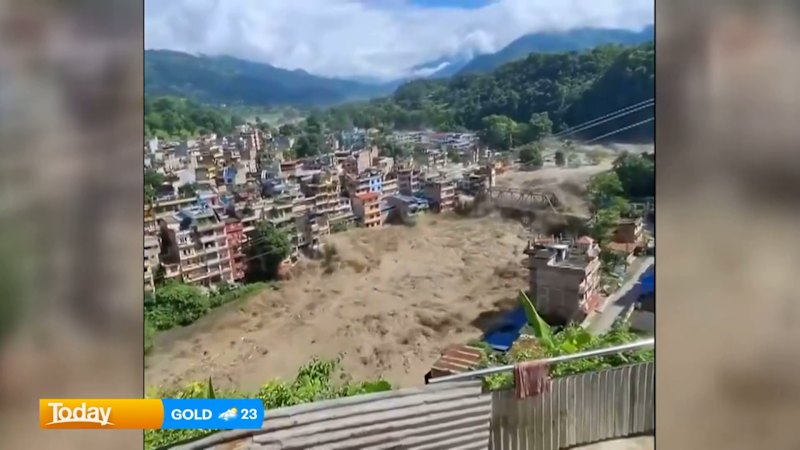
The monsoon does not ask for permission. It arrives from the Bay of Bengal as a heavy, water-logged breath, shoving itself against the Himalayan wall until the clouds break, spilling gray tons of water over terraced hillsides and roaring riverbeds. To anyone sitting thousands of miles away, reading a cold casualty report, the numbers are flat. Dozens missing. Infrastructure damaged. Communications down.
Statistics do not bleed.
They do not show the way a father in Sydney stares at an unresponsive WhatsApp screen, watching a single gray checkmark sit stubbornly beside a message sent twenty-four hours ago. They do not capture the copper smell of churned mud, the terrifying bass of a swollen river eating its banks, or the blinding white flash of a landslide tearing a guesthouse from its concrete foundations in the middle of the night.
Let us talk about what it actually feels like when the roof of the world turns into a trap.
Imagine standing on a narrow footpath in the Annapurna or Langtang region during peak trekking season. The air is thin, crisp, smelling of pine smoke and damp wool. The mountains above you are impossibly sharp against an azure sky. You are tired, your thighs burn from the ascent, but you are alive in a way that modern city life rarely permits. Every step is deliberate. Every breath is earned.
Then comes the rain.
Not a shower. Not a passing storm. A biblical deluge that turns dry mountain tracks into vertical mudslides.
When communications fail, the distance between Kathmandu and Melbourne stretches into an eternity. For families of dozens of Australian nationals caught in the catastrophic flooding and landslides across Nepal, that distance became an emotional purgatory. Phones went dark. Power grids failed. Roads snapped like dry twigs under the weight of surging torrents. In the initial hours after a disaster of this scale, the official channels are agonizingly slow. Consulates scramble. Local authorities count bodies and clear boulders with ancient machinery. Meanwhile, kitchens in suburban homes across New South Wales and Victoria stay lit all night, televisions tuned to rolling news, coffee cups left half-full and forgotten.
This is the hidden cost of global adventure. We export our wanderlust to the most breathtaking, fragile landscapes on earth, assuming that modern technology—satellite messengers, international roaming, global positioning apps—will always act as an invisible tether back home.
It does not. When a mudslide takes out a fiber-optic relay station or a flash flood sweeps away a wooden suspension bridge, all the technology in the world reverts to stone-age silence.
Consider the mechanics of a Himalayan flood. The geography itself conspires against rescue efforts. Nepal is a nation of vertical extremes, where deep river valleys act as natural funnels. When relentless monsoon rains saturate the topsoil, the earth loses its grip. Entire hillsides let go, taking forests, roads, and human settlements with them in a matter of seconds. Tourists and independent trekkers, drawn to the remote beauty of trails far from paved roads, find themselves cut off instantly. There is no grid. There are no secondary escape routes. There is only up, or down, and often both ways are blocked by thousands of tons of wet rock.
The Department of Foreign Affairs and Trade works around the clock in these moments, fielding panicked calls, coordinating with local rescue coordinators, and trying to cross-reference permits with airline manifests. But bureaucracy moves at the speed of paperwork, while nature moves at the speed of gravity.
We need to confront an uncomfortable truth about how we consume these tragedies. We scroll past headlines on our phones while waiting for a commuter train, feeling a fleeting pang of sorrow before tapping through to the next update on sports or finance. We categorize foreign disasters as distant geography. But those dozens of missing Australians are not abstract data points. They are graphic designers, nurses, university students on gap years, and retirees fulfilling lifelong dreams. They are people who posted a smiling photograph of a steaming cup of masala chai in a teahouse yesterday, only to become a desperate inquiry today.
The anxiety of not knowing is a peculiar kind of torture. It lives in the chest. It makes every ring of the telephone feel like a physical blow.
As search and rescue teams finally push past blocked highways—using helicopters when the weather temporarily clears, navigating treacherous air pockets and low cloud cover—every rescued survivor tells a story of terrifying margins. A guide who heard the mountain groan moments before the lodge collapsed and screamed for everyone to run. A group of travelers who huddled in a stone shed for thirty-six hours, rationing chocolate bars while the river roared ten feet from their door.
These are the moments where human resilience meets stark vulnerability. The mountains do not care about passports, travel insurance, or bucket lists. They are ancient, indifferent giants engaged in a perpetual process of erosion.
When the floodwaters finally recede, they leave behind a radically altered landscape. Mud cakes the floors of ancient temples. Boulders the size of houses sit where suspension bridges used to span dizzying gorges. The economic lifeline of tourism, which sustains so many remote Nepali mountain communities, is instantly choked.
Yet, long after the breaking news cycle shifts to the next global crisis, the families of those affected are still picking up the pieces of a normal life that will never quite fit the same way again. The silence of the mountains leaves a long echo in the suburbs.
The rain eventually stops. The sun breaks through the heavy Himalayan mist, casting a brilliant, mocking gold across the snowy peaks. Down below, the rivers slowly drop back into their stone channels, carrying the debris of a catastrophe out toward the plains. The air clears, cold and sharp. The trails remain, waiting for the earth to dry, waiting for the world to return, indifferent to the lives rearranged in the dark.