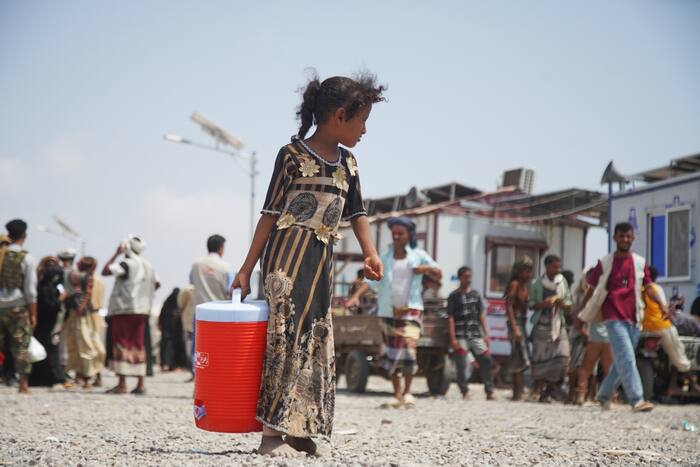
Standard reporting on the renewed encirclement of Taiz treats the crisis as a sequence of discrete shocks: a missile strike, a UN warning of "grave risk," a spike in local prices, and a plea for humanitarian corridors. That framing captures the surface drama while missing the operating system of the conflict. A siege in Yemen's highlands is not merely a military perimeter; it is a price-distortion engine, a coercive population filter, and a secondary front tied directly to wider regional escalation across the Red Sea and Gulf.
To understand what is happening in and around Taiz, analysts need four structural models: The Siege Cost Function, The Three-Pillar Encirclement Mechanism, The Escalation Spillover Loop, and The Humanitarian Access Trade-Off. Distinguishing verified operational facts from educated hypotheses clarifies where pressure is actually building and where external interventions routinely fail.
Deconstructing Competitor Logic and Structural Blind Spots
Conventional dispatches on Taiz typically follow a predictable chain: Houthi forces press around the city, UN officials warn of civilian danger and soaring costs, international actors announce diplomatic or defensive posture shifts, and civilians are caught in between. This reporting is useful as a real-time log of events, yet it flattens cause and effect into parallel observations.
The first blind spot is treating food and fuel price spikes as a simple byproduct of scarcity rather than a structured extraction mechanism. When access roads are severed or contested, transport risk rises, inventories shrink, and informal control over remaining arteries dictates who eats, who moves, and at what markup. The second blind spot is isolating Taiz from broader maneuvers along the Red Sea coast, Bab al-Mandab, and inland governorates such as Marib and Al-Jawf. Taiz sits at a geographic hinge connecting highland interiors with southern and western approaches, meaning local encirclement interacts with theater-wide resource allocation.
The third blind spot is conflating humanitarian appeals with operational leverage. Calling for safe passage and restraint is a legal and moral baseline, not a mechanism that alters troop incentives on the ground. Without mapping those incentives, observers mistake diplomatic statements for strategic shifts.
The Three-Pillar Encirclement Mechanism
A durable urban encirclement operates through three interlocking pillars that compound one another over time:
- Physical Chokepoint Control: Seizing or dominating key approaches and bypass routes—such as southern and western corridors linked to At Turbah or coastal districts—restricts commercial freight, fuel cylinders, and medical resupply. Even partial closure forces longer, riskier detours that multiply transit times and vehicle wear.
- Firepower and Psychological Attrition: Periodic artillery, drone, and missile strikes, combined with localized clashes, raise the expected cost of daily movement and market activity. Civilians face a continuous trade-off between exposing themselves to strikes and rationing essentials.
- Mobility Asymmetric Filtering: Leaving or entering a contested pocket is rarely symmetric. Residents with documentation, financial reserves, or family networks outside may attempt displacement, while journalists, activists, men of military age, or households without resources face severe friction or trap dynamics.
In terms of verified facts, UN agencies have documented renewed encirclement and road closures cutting off Taiz's population—estimated by the World Food Programme at more than 800,000 people affected in the city, including hundreds of thousands reliant on aid and large numbers of women and children—alongside hundreds of thousands displaced across Yemen since August 2026. It is an educated hypothesis, rather than a directly audited accounting line by line, that Houthi commanders calibrate road throttling and shelling intensity to pin down pro-government forces while conserving heavy maneuver units for other fronts.
The Siege Cost Function and Household Survival
Economically, a besieged or semi-besieged city behaves like an island with rising transaction costs and shrinking elasticity. In plain terms, household survival depends on three variables: delivered supply volume, local transport and security risk premiums, and household cash or commodity reserves.
When supply volume drops and risk premiums climb, prices do not rise smoothly; they jump in step-changes as informal intermediaries price in confiscation, interdiction, and fuel scarcity. Cooking gas, diesel for water pumping and generators, staple grains, and trauma or chronic-care medicines become scarce simultaneously. Diesel scarcity is especially damaging because it links energy directly to water access and hospital operations—a classic infrastructure coupling where one bottleneck starves two essential services.
What about people asking whether residents can simply leave? Evacuation is not a frictionless choice. Families stranded outside when routes close face lodging costs and crowding, while those inside weigh property loss, checkpoint risks, and the absence of guaranteed shelter elsewhere. Another common question involves why ceasefires or partial road openings repeatedly fail to hold. In a fragmented conflict where local commanders, coalition partners, and external patrons have diverging priorities, a local truce collapses quickly whenever a faction perceives a tactical opening or responds to pressure on an adjacent front.
The Escalation Spillover Loop
Taiz does not sit in a vacuum. Fighting in Yemen during late 2026 has unfolded alongside wider regional confrontation involving Iran, Saudi Arabia, and maritime chokepoints, shattering the relative calm of the 2022 truce. Analysts can trace this as a Spillover Loop with four linked stages:
- External Pressure Shifts: Regional hostilities and cross-border missile or drone exchanges alter the calculus of external backers and local belligerents.
- Multi-Front Resource Allocation: Forces on the Presidential Leadership Council (PLC) side and Houthi forces contest ground across multiple axes—including Taiz, the Red Sea coast, Marib, and Al-Jawf—forcing constant trade-offs between holding defensive lines and launching counter-offensives.
- Defensive Posture Expansion: External powers such as Britain and regional states such as Egypt have focused on air defense, maritime security, or defensive patrols rather than committing ground troops to Yemen's interior, signaling a preference to contain aerial and maritime threats rather than resolve the ground war.
- Local Civilian Blowback: As front lines shift and airstrikes, shelling, or ground offensives intensify, civilian casualties and displacement spikes—with Taiz governorate absorbing large displacement numbers—reinforce humanitarian strain without producing a decisive political settlement.
A known fact is that regional escalation has coincided with heavy combat across multiple Yemeni governorates and expanded defensive air and missile support outside Yemen's ground battles. An educated hypothesis is that Houthi leadership views pressure on contested hubs like Taiz and coastal corridors as dual-purpose: weakening domestic rivals while demonstrating reach and resilience during broader regional confrontation.
The Humanitarian Access Trade-Off and Operational Limits
Aid agencies operating near an active siege face a stark Access Trade-Off between speed, scale, and negotiated consent. Rapid, small-scale deliveries or improvised routes can reach pockets of need quickly, but carry high security risks for convoys and staff. Large-scale, predictable convoys offer higher volume per trip, yet require clearances, road stability, and deconfliction that are hardest to secure precisely when encirclement tightens.
From a practitioner's perspective, three operational realities govern humanitarian and stabilization work in this environment:
- Corridors Are Political Instruments, Not Neutral Pipes: Every route into a contested city has strategic value to armed actors. Treating access purely as a technical logistics problem underestimates how quickly checkpoints or shelling can turn a lifeline into leverage.
- Market Support Beats One-Off Drops When Goods Still Trickle In: Where some commercial trade persists at high prices, targeted cash or voucher assistance—when paired with supply stabilization—often outperforms rigid commodity rations, whereas total physical blockades require direct physical stock movement and local medical prepositioning.
- External Air Defenses Do Not Substitute for Ground De-escalation: Intercepting drones or missiles over neighboring territory or shipping lanes reduces specific external risks, yet leaves urban sieges and local front lines intact.
The limitation of any humanitarian or diplomatic measure here is straightforward: aid and appeals can mitigate suffering and buy time, but they cannot manufacture political compromise while armed factions believe military pressure still yields bargaining chips.
Strategic Play for Decision-Makers
For policymakers, aid planners, and strategic analysts tracking Taiz and the broader Yemen theater, the decisive move is to decouple civilian lifeline protection from maximalist front-line bargaining while tying any local de-escalation mechanism to verifiable route and infrastructure guarantees.
In practice, that means sequencing actions around concrete bottlenecks rather than broad declarations. First, prioritize protected, monitored movement for fuel, medical supplies, and civilian exit/entry along defined corridors, backed by clear rules against striking civilian infrastructure and market hubs. Second, pre-position emergency medical, water, and shelter stocks in adjacent hubs—such as Aden and southern districts—to absorb displacement shocks immediately when fighting flares. Third, treat any local pause around Taiz as provisional unless paired with incentives across connected fronts, because an isolated calm on one road will fail if neighboring governorates remain in full offensive motion. Expect the siege dynamic around Taiz to remain a primary barometer of Yemen's wider war: as long as encirclement imposes high costs on rivals without triggering decisive external ground intervention, pressure on the city will persist as a core lever of attrition.