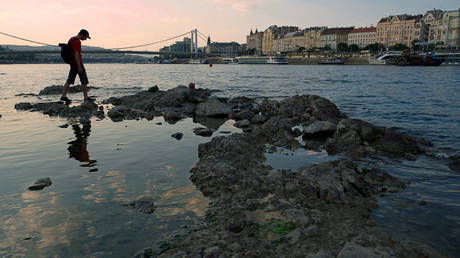
Severe summer droughts are doing something wild to Europe's second-longest river. As water levels on the Danube plummet, long-lost chapters of twentieth-century history are literally dragging themselves out of the mud.
Recent drops in the riverbed have exposed an eerie collection of submerged relics. We aren't just talking about a few stray coins or rusty anchors. Along the banks of the Danube in downtown Budapest, receding water recently laid bare a nearly intact German military motorcycle from the Second World War. Right beside it lay the remains of two Wehrmacht soldiers, complete with unexploded anti-tank mines, hand grenades, and artillery fragments.
If you think this is an isolated incident, look further down the water route. Near Prahovo in eastern Serbia, dozens of scuttled Nazi warships are poking out of the surface again. These vessels have sat at the bottom of the river for more than eighty years. When the Soviet Red Army forced a brutal German retreat in September 1944, Hitler's forces deliberately sank roughly two hundred ships to block the channel. Now, extreme heat and dry spells are dragging those explosive hulls back into the daylight.
How Mud Preserved the Past for Eight Decades
Finding human remains and military hardware decades later sounds impossible, but the unique chemistry of the riverbed helped freeze these moments in time.
When military experts and recovery teams pulled the Budapest motorcycle from the silt, they faced a massive two-hundred-kilogram hunk of metal heavily weighted down by decades of sediment. Firefighters had to step in to help lift it. More astonishingly, the dog tags belonging to the fallen soldiers remained completely intact.
Experts from the German War Graves Commission noted that diesel fuel mixed into the surrounding soil helped shield the metal and organic matter from total decay. Because those dog tags survived, historical researchers can actually trace who these soldiers were. For eighty years, they were simply listed as missing in action, their final resting place swallowed by the deep currents of Central Europe.
The Hidden Danger Beneath the Surface
While history buffs and amateur metal detectorists look at parched riverbeds as an incredible opportunity, local authorities view them with sheer dread.
Those resurfacing Nazi warships near Serbia are not empty metal shells. They are packed tight with unexploded mines, torpedoes, and heavy ordnance left behind from a desperate wartime exit. When summer heatwaves drop the water line, those explosives turn into literal ticking time bombs sitting right in the middle of a major commercial shipping lane.
Modern cargo vessels struggle to navigate the narrow bottlenecks created by the wrecks. In some spots, the channel narrows drastically, costing regional economies millions of dollars in halted trade and transport delays. Governments are spending fortunes trying to extract the dangerous debris without triggering a catastrophic blast.
What Happens When the Water Recedes for Good
Climate shifts and persistent droughts mean we will likely see more hidden history forced out into the open.
Beyond military hardware, the falling water has even revealed prehistoric fossils, including ancient woolly mammoth bones resting in the Bulgarian stretches of the river. Every time a heatwave hits Europe, the river tells another forgotten story.
If you plan to walk along European riverbanks during a dry spell, keep your distance from strange metal objects sticking out of the mud. What looks like a cool historical artifact might just be an unexploded ordnance waiting for the wrong kind of disturbance. Let the bomb squads and military historians handle the heavy lifting while you watch history repeat itself from a safe distance.