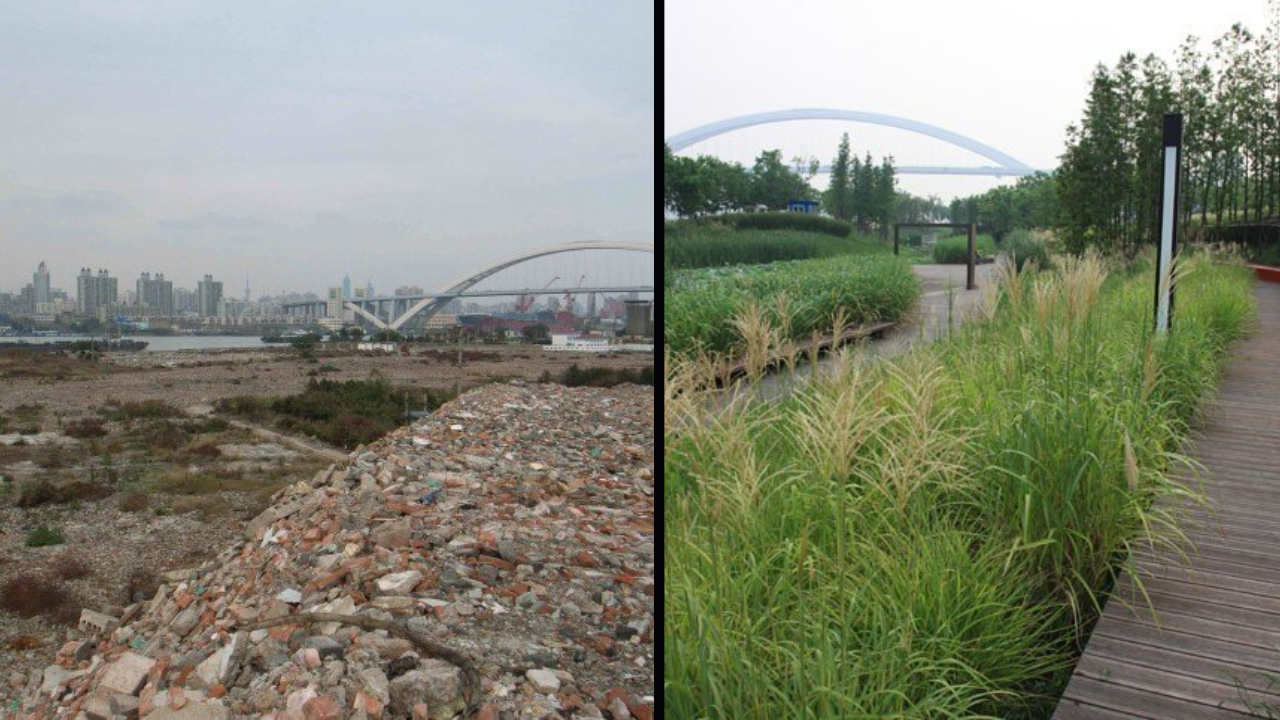
Everyone loves a redemption story. Take a toxic, dead piece of industrial wasteland on a heavily polluted river, pump millions of dollars into wetland grasses, and presto: you have an international award-winning eco-park. That is the consensus story of Shanghai Houtan Park. The lazy narrative champions it as a miracle of ecological engineering, a victory for green spaces over brute industrial output, and a blueprint for every waterfront city on the planet.
They missed the point entirely.
Houtan Park is not an ecosystem. It is an expensive vanity project wrapped in reeds. It treats the symptom while leaving the root disease untouched, serving as an urban distraction rather than a systemic fix. If you think duplicating this design in your own backyard will solve modern city planning woes, you are falling for greenwashing wrapped in landscape architecture.
I have spent two decades watching cities blow public budgets on cosmetic environmentalism while actual infrastructure rots. Let us tear down the myth of the miraculous brownfield turnaround and look at the brutal mechanics of what actually happened on the Huangpu River.
The Flawed Premise of the Eco-Park Savior
Walk into Houtan Park today and you will see tourists strolling along wooden boardwalks, admiring the duck weed and the restored industrial steel framing. Landscape architects point to the constructed wetlands as a triumph of biological water filtration. The claim is that the tiered terraces clean polluted water from the Huangpu River before it enters the site.
Here is what the brochures omit: scale.
Houtan Park spans roughly fourteen hectares. The Huangpu River moves billions of gallons of water daily, carrying industrial runoff, agricultural chemicals, and urban sewage from millions of upstream residents. Pumping a microscopic fraction of that river through a terraced marshland is the ecological equivalent of using a single paper towel to clean up a warehouse flood. It looks productive. It feels satisfying. It is mathematically irrelevant to the actual health of the river basin.
When cities prioritize decentralized, high-maintenance ornamental wetlands over aggressive, unglamorous upgrades to heavy municipal sewage treatment plants, they choose PR over problem-solving. We are paying millions for aesthetic reassurance while the core pathology remains unaddressed.
The Maintenance Trap Nobody Mentions
Let us talk about the dirty secret of high-design public infrastructure: decay.
Constructed wetlands do not maintain themselves. Natural wetlands are self-sustaining because they are backed by vast, dynamic watersheds. Artificial parks built on compressed industrial clay, contaminated fill dirt, and constrained concrete edges require constant human intervention to keep from turning into dead stinking swamps or getting choked out by invasive species.
- Silt accumulation: Urban runoff carries massive loads of sediment and heavy metals. In a natural flood plain, that sediment spreads out. In a constrained linear park, it chokes the engineered terraces within a decade.
- Hydraulic pumping costs: Moving billions of liters of water through tiered treatment cells requires energy. If your "green" park relies on massive electric pumps running 24/7 to circulate dirty water through decorative reeds, your carbon footprint just ate your PR victory.
- Material degradation: Steel framing and timber boardwalks in a humid, industrial waterfront environment degrade fast. The lifecycle replacement costs of these projects routinely blindside municipal budget committees fifteen years down the line.
I have seen developers walk away from projects like this once the ribbon is cut and the awards are handed out, leaving local taxpayers holding the bag for perpetual remediation.
The Real Question is Not How to Beautify Ruin
People ask: "How can we transform our abandoned industrial waterfronts into vibrant public assets?"
That is the wrong question. It assumes the primary failure of an industrial brownfield is a lack of greenery. It assumes that if you slap grass over heavy metal contamination, you have healed the land.
The correct question is: Why are we building fragile tourist attractions on toxic foundations instead of doing the brutal, invisible work of complete environmental decontamination and high-density, mixed-use economic integration?
Shanghai did not clean its industrial past; it put a green filter over it. The heavy metals in the soil do not magically disappear because you planted specialized hyperaccumulating sunflowers. They are sequestered, managed, capped, or ignored. If a major flood event breaches those containment layers, the illusion shatters instantly.
The Uncomfortable Truth About Urban Greenwashing
Let us be completely transparent about the trade-offs here. My contrarian stance has a massive downside: it is boring, expensive, and politically unrewarding.
Nobody gets a glossy feature in an architecture magazine for funding a buried underground concrete stormwater retention vault. No mayor cuts a ribbon for a state-of-the-art chemical filtration facility hidden beneath a parking lot. Politicians want the Instagram-ready wetland. They want the boardwalks, the native grasses, and the international design trophies.
True urban resilience is unsexy. It looks like boring zoning laws, mandated industrial pre-treatment at the factory gate, massive investments in subterranean grey infrastructure, and brutal enforcement of polluter-pays accountability.
When you prioritize parks over pollution control, you are subsidizing bad corporate behavior with public parkland. You let factories dump upstream because the downstream wetland will catch the blame and mask the poison.
What to Do Instead of Building Another Wetland
If you are a city planner, a developer, or a citizen tired of paying for expensive ecological theater, stop copying Shanghai's Houtan Park playbook.
- Audit the source, not the sink: Spend 80 percent of your remediation budget upstream at the point of discharge. Force industries to clean their own effluent before it ever hits public waterways.
- Prioritize containment over cosmetics: If a brownfield is chemically compromised, seal it completely or excavate it. Do not pretend a shallow layer of topsoil and some decorative reeds turn a chemical dump into a safe ecosystem.
- Build for density, not recreation: Waterfront land is too valuable for low-intensity ornamental parks. Combine high-density, flood-resilient urban housing and commercial infrastructure with genuinely robust, industrial-grade greywater treatment.
- Demand long-term financial transparency: When a firm pitches a green infrastructure project, demand the fifty-year operational and maintenance cost projections. If the city cannot afford to dredge the sediment cells in twenty years, do not build them.
Stop treating urban design like a landscape painting competition. Nature does not care about your boardwalks, and the river does not care about your reeds.
Clean up the poison, stop subsidizing corporate pollution with pretty parks, and build cities that actually survive reality instead of looking good in photographs.