A standard smartphone screen glows with a soft, blue light inside a high-security prison cell in Gujarat, India. The man holding it is Lawrence Bishnoi. He has been behind bars since 2015. Yet, with a few taps on a smuggled device, his reach stretches across oceans, traversing time zones and national borders to dictate life and death in the quiet suburbs of North America.
We often view crime through a local lens. A shooting on a Vancouver street or a drug bust at a California border crossing feels isolated, a tragic headline specific to a single neighborhood. But reality is far more interconnected. The threat does not always originate from the alleyway down the street. Sometimes, it is coordinated from a concrete cell ten thousand miles away.
A coordinated global offensive code-named Operation Hard Ball shattered these invisible threads. Law enforcement agencies across the United States, Canada, and Europe executed a sweeping teardown of three interconnected, India-based transnational organized crime syndicates. The sweep netted 24 arrests, unsealed three major grand jury indictments against 37 defendants, and exposed a sprawling modern underworld that treats international borders as mere suggestions.
The Illusion of Distance
To understand how a prisoner in India can alter the security landscape of a Canadian suburb, look at the geography of the modern diaspora. The Bishnoi gang, along with rival-turned-syndicate leader Jaggu Bhagwanpuria and drug kingpin Ravinder Singh Dhanda, realized long ago that their primary target was not just local territory, but global influence. They realized they could weaponize the deep cultural and financial ties connecting India to Western nations.
Consider a hypothetical immigrant business owner in California. Let us call him Raj. He spent two decades building a logistics company, sending money back to his aging parents in Punjab, and quietly integrating into his local community. One afternoon, his phone rings. The voice on the other end knows the name of his childhood school, his current home address, and the exact route his daughter walks to class. The caller demands a hundred thousand dollars. The penalty for refusal is a drive-by shooting, or worse.
This is not a cinematic exaggeration. This is the exact mechanism of the Hobbs Act extortions detailed in the unsealed US federal indictments. The Department of Justice explicitly notes that the Bishnoi gang systematically cultivated a climate of fear among Indian diaspora communities worldwide. They targeted prominent religious, social, and political leaders, using high-profile violence to force compliance from thousands of ordinary citizens who just wanted to live in peace.
The reach of these groups relies on an intricate, fractured supply chain. The unsealed indictments reveal a highly organized structure where tasks are siloed to avoid detection. One faction manages the high-altitude politics of targeted assassinations, another runs cross-border narcotics logistics, and a third handles the ground-level intimidation.
The Intersection of Geopolitics and the Streets
The most explosive revelation in the unsealed documents centers on the June 18, 2023, assassination of Hardeep Singh Nijjar. Nijjar, a prominent pro-khalistan figure, was shot and killed outside a Sikh temple in the Vancouver suburb of Surrey, British Columbia. The murder triggered a severe diplomatic freeze between Canada and India, resulting in expelled diplomats and public accusations.
But criminal networks operate on their own cold logic, detached from official statecraft. The US federal indictment unsealed in Los Angeles directly charges Lawrence Bishnoi and his key lieutenant, Satinderjeet Singh, known globally as Goldy Brar, with ordering the assassination of Nijjar.
For years, Bishnoi cultivated a public persona on social media as a deeply religious nationalist and patriot, a carefully manufactured image designed to recruit vulnerable youth into his syndicate. Yet the indictments paint a different picture: a pragmatic, ruthless criminal enterprise utilizing violence to expand its territory and enforce its will. When Bishnoi claimed responsibility for a subsequent shooting at the Vancouver residence of a prominent Indian actor, his Facebook post phrased it bluntly in Punjabi: "no one can save you from us."
The scale of the operations required massive capital, which brings the narrative back to the physical trade of illicit goods. While Bishnoi managed the terror, Ravinder Singh Dhanda operated the infrastructure.
From Vancouver, the 57-year-old Dhanda allegedly managed a sophisticated international smuggling service. This was not a matter of hiding contraband in suitcases. This was industrial-scale logistics, moving bulk quantities of cocaine and methamphetamine across the borders of Mexico, the United States, and Canada.
To bypass security, the network didn't just rely on luck. They allegedly corrupted the systems meant to protect us. The indictment states that an associate, Gurtej Singh Smagh, obtained inside information from a source working within the Canada Border Services Agency. They knew exactly when and where border inspections would take place. They knew which lanes to avoid. They treated the international border like a commercial toll road.
The Anatomy of the Take Down
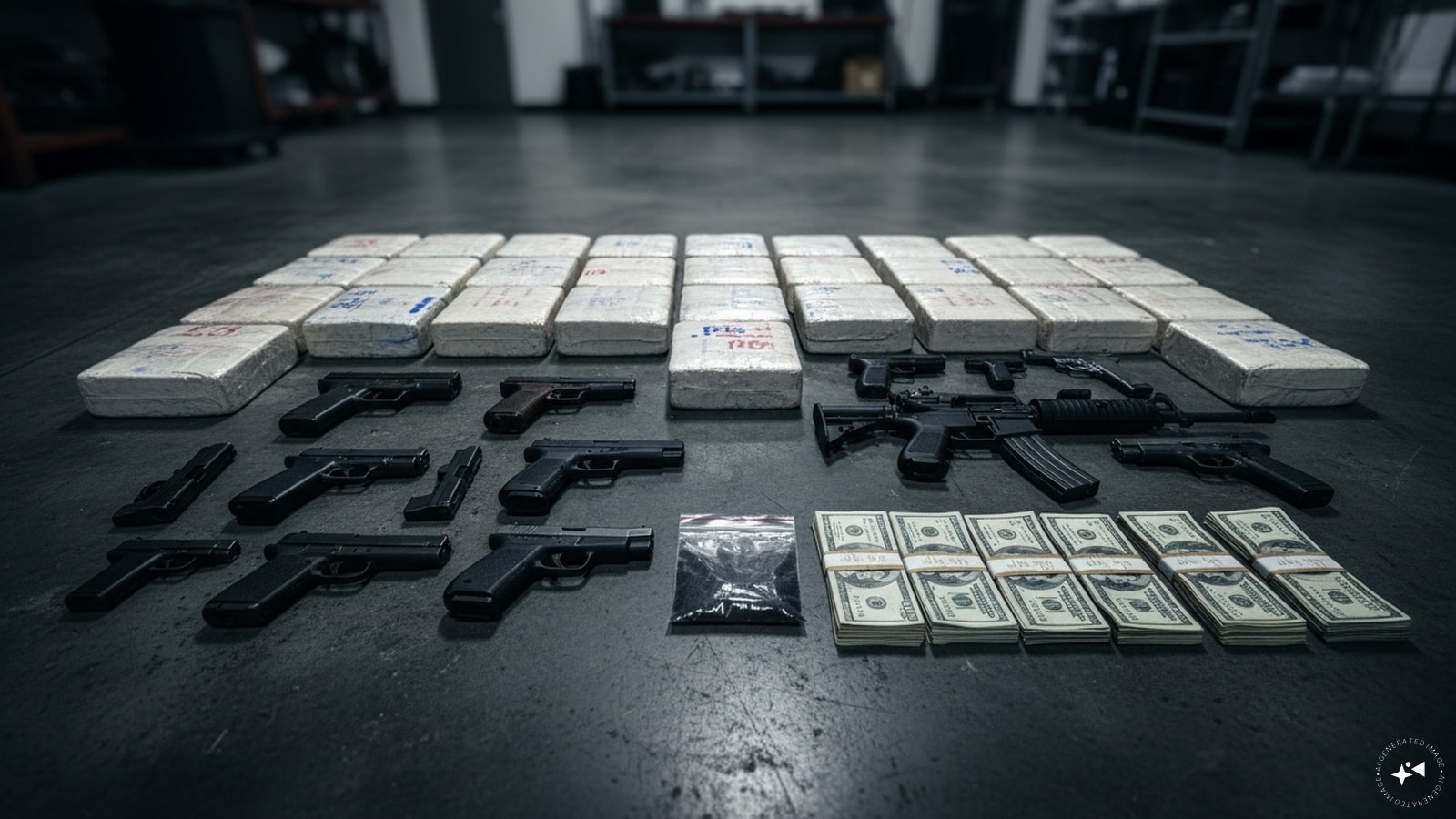
The sheer volume of evidence seized during Operation Hard Ball illustrates the immense scale of the threat. Law enforcement agencies recovered roughly 1,000 kilograms of cocaine, a kilogram of heroin, a dozen firearms, and tens of thousands of dollars in cash. Officers executed 23 search warrants in the Sacramento area alone, alongside 11 warrants in Los Angeles and three in British Columbia.
The arrests were concentrated heavily in California, where 11 defendants were taken into custody, alongside others in Indiana, Georgia, Spain, and Canada. Ten fugitives remain on the run, scattered across the United States, India, and Europe.
The Bhagwanpuria gang, once a localized force in Punjab before expanding into a transnational syndicate, was heavily hit in the sweep. Jaggu Bhagwanpuria, like Bishnoi, directed operations from an Indian prison cell, overseeing a network involved in murder-for-hire, weapons trafficking, kidnappings, and drug distribution. Even men not directly initiated into the gang became cogs in the machine. Garinder Deo, a 40-year-old from Vancouver, was charged with racketeering conspiracy for allegedly purchasing bulk narcotics from Southern California to enrich the network, fueling the cash flow that kept the syndicate alive.
This interconnectedness makes transnational crime so elusive. If you cut off a street-level dealer in Los Angeles, the cell in Surrey keeps moving. If you arrest a smuggler at the border, the extortion calls from Punjab continue uninterrupted. The network simply reroutes, adapting like water finding a new crack in a dam.
The Fragile Illusion of Security
It is deeply unsettling to realize how vulnerable our globalized systems are to exploitation. We live in an era where an individual can sit in a prison cell on the other side of the planet and orchestrate a shooting in a quiet North American cul-de-sac. The borders we draw on maps, the oceans that separate continents, and the security checkpoints we build at our frontiers are only as strong as the human beings who operate them.
Operation Hard Ball is a monumental achievement in international law enforcement cooperation, a rare moment where global agencies moved in perfect synchronization to strike a blow against the new underworld. The legal battle is just beginning. Many of the defendants face mandatory minimum sentences of ten years to life in a federal penitentiary.
But the true victory of this operation is not found in the statistics, the weight of the seized narcotics, or the number of handcuffs clicked into place. The true impact lies in the quiet relief felt by thousands of diaspora families who can finally answer their phones without fear.
The blue light of that contraband screen in Gujarat has finally begun to fade, chased away by the cold glare of a global spotlight. A network built on the weaponization of distance has learned that the world is much smaller than they believed.


