Salt crusts on the skin after twenty minutes in the Strait of Gibraltar, drying into a white film that cracks whenever you move your face.
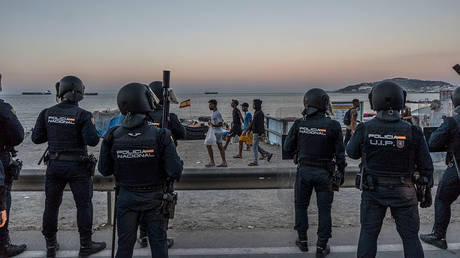
I remember that specific sting from my years reporting along the southern edge of Spain, standing on the concrete breakwaters of Ceuta at four in the morning while spotlights swept the black water like nervous white fingers. You watch the silhouettes pull themselves onto the rocks, shivering, exhausted, clutching plastic bags wrapped tightly in duct tape to keep a single photograph or a damp passport dry. From a distance, the scene looks like a straightforward story of desperation meeting a border fence.
Wait.
Look closer at the faces in the holding centers, and the simple story fractures into something far darker, older, and infinitely more complicated. When Spanish police announce that a group of migrants in Ceuta has been detained for human trafficking and sexual assault, the headlines land like blunt instruments, flat and devoid of context, stripping away the terrifying machinery operating inside the shadow economy of the borderlands.
The Architecture of a Trap
Ceuta is an anomaly on the map, a tiny Spanish enclave clinging to the northern coast of Morocco, separated from the rest of Europe by nine miles of choppy sea and from its immediate neighbor by a double-layered fence topped with razor wire and acoustic sensors. For decades, this eighteen-square-kilometer patch of land has functioned as a pressure valve and a bottleneck. People arrive from sub-Saharan Africa, from the Maghreb, from conflict zones thousands of miles away, carrying the weight of families who pooled every spare coin to buy them a chance at a European wage.
Once they cross that perimeter—whether by scaling the six-meter steel mesh or swimming around the Tarajal breakwater in the dark—they enter a legal purgatory. You cannot simply walk onto a ferry to Algeciras on the Spanish mainland. Without approved asylum paperwork or a deportation order, you are stuck in Ceuta, often housed in the Temporary Stay Center for Immigrants, known locally as the CETI, or drifting through makeshift camps tucked into the pine hills overlooking the bay.
Stagnation breeds predators.
Consider a hypothetical young woman—let us call her Amina, a composite drawn from dozens of verified testimonies documented by human rights monitors and Spanish judicial filings—who leaves her home in West Africa with three thousand euros sewn into the lining of her coat. By the time she reaches the hills outside Ceuta, the smugglers in Morocco have taken two thousand of it, and the remaining cash vanishes during a chaotic scramble over the border fence. She arrives in Spanish territory technically safe from immediate pushback, yet entirely penniless, undocumented, and terrified of authorities who might deport her before she can file an asylum claim.
That fear is the primary currency of the trafficking networks operating inside the enclave.
Predators within these transit hubs rarely look like cinematic villains. Often, they are fellow travelers who arrived six months earlier, men who learned the gaps in the Spanish bureaucracy, who speak enough Spanish to translate at the police station, and who understand precisely how to weaponize a newcomer's terror of deportation. They offer a dry mattress in an abandoned warehouse near the port, a hot meal, or a promised connection to a boat captain who can smuggle a person across the strait to mainland Spain without passing through border control.
Debt becomes a collar.
Once a vulnerable migrant accepts that initial favor, the price inflates overnight, transforming a fifty-euro loan for food into a two-thousand-euro debt payable only through coercion, forced labor, or sexual exploitation. Because the victims believe that approaching the Guardia Civil or the National Police will result in immediate expulsion back to Morocco, they endure horrific abuses in silence, trapped inside a prison built not of iron bars, but of legal invisibility.
When the Mask Slips in Ceuta
The recent detentions in Ceuta did not happen in a vacuum, nor were they an isolated eruption of random violence. According to Spanish law enforcement records and European Union border agency reports, criminal cells embedded along the Western Mediterranean route have increasingly shifted from simple smuggling—charging a fee to move someone from Point A to Point B—to full-spectrum human trafficking, where the human being remains an asset to be exploited long after the border is crossed.
Smuggling ends at the border; trafficking begins when freedom ends.
Think of the difference like a toll road versus a company town. A smuggler runs a toll road: you pay your fee at the gate, you cross the bridge, and your transaction is over. A trafficker builds a company town where the store prices are rigged, the exits are guarded, and you can never earn enough to pay off the rent on the shack you sleep in. In the recent Ceuta arrests, investigators uncovered precisely that kind of closed ecosystem operating right under the noses of local authorities.
Police intelligence revealed that a small group of detained migrants had established a coercive ring targeting newly arrived women and unaccompanied minors who had slipped past the perimeter patrols. Rather than helping them register at the official reception center, the suspects intercepted these newcomers near the industrial polygons and coastal cliffs, confiscating their phones, destroying their identification papers, and isolating them from humanitarian workers.
Then came the violence.
Victims were subjected to repeated sexual assaults, filmed on mobile phones to ensure their silence through shame, and threatened with exposure to their families back home or betrayal to immigration authorities. In communities where social honor and family survival are tightly bound together, a video clip sent to a village elder in Guinea or Mali is a death sentence of a different kind, severing a person from the only support network they have left on earth.
I have sat across from survivors in cramped legal aid offices in Andalusia and Ceuta, watching them stare at the linoleum floor while a court-appointed interpreter gently asks them to recount dates, locations, and names. You quickly realize that the hardest part of their ordeal is rarely the physical crossing of the sea; it is the realization that the people who spoke their language, shared their food, and prayed beside them in the forest camps were the ones selling them by the hour in a concrete room three hundred meters from a Spanish police precinct.
It makes you question everything you think you know about solidarity.
Why the Headlines Miss the Real Danger
Whenever news breaks that migrants have been arrested for rape and trafficking in a European border town, two predictable reactions immediately hijack the public conversation. On one side, hardline commentators seize on the arrests as blanket proof that every person crossing the fence is a violent criminal threatening European safety. On the other side, well-meaning advocates sometimes downplay the crimes out of fear that acknowledging predator networks within migrant populations will fuel xenophobia and harsher border crackdowns.
Both reactions fail the victims.
When we flatten a complex criminal investigation into a partisan talking point, we erase the actual human beings who suffered inside those rooms in Ceuta, almost all of whom were migrants themselves. Data from the United Nations Office on Drugs and Crime consistently shows that trafficking networks disproportionately prey on displaced people from their own regions because shared language, cultural familiarity, and knowledge of family vulnerabilities make coercion dramatically easier.
Look at how the legal confusion around Ceuta compounds this tragedy. Many people outside Spain assume that once someone sets foot in Ceuta, they immediately receive European Union residency, housing, and legal protection. The reality is far messier. Under Spain's special border regime for Ceuta and Melilla, individuals who enter irregularly face months—sometimes over a year—of administrative limbo while authorities verify nationalities, process asylum interviews, and determine whether the person qualifies for transfer to the Iberian Peninsula.
During those months of waiting, thousands of people occupy a gray zone where formal employment is illegal, shelter capacity frequently overflows during summer surges, and mental health deteriorates under the crushing boredom and anxiety of uncertainty. Criminal recruiters thrive in that dead time, scanning the perimeter of the reception center every afternoon for faces that look desperate, hungry, or freshly traumatized by the crossing.
I used to think better border fencing would solve the chaos at Ceuta. Years of watching the fences grow taller—from three meters to six, then ten, topped with rotating rollers and infrared cameras—proved me wrong. Every time the physical wall rises, the price charged by smugglers climbs, the debts owed by migrants deepen, and the power of the criminal syndicates controlling both sides of the fence grows stronger. A higher wall does not stop human desperation; it simply hands a monopoly over human movement to the most ruthless operators willing to breach it.
Breaking the Silence Inside the Enclave
So how did Spanish investigators finally crack this ring in Ceuta, and what stops the next cell from taking its place tomorrow morning?
The breakthrough came not from satellite surveillance or perimeter sensors, but from a single act of terrifying courage inside a hospital emergency room. A survivor, brought in for medical treatment after a severe assault, found herself alone with a Spanish nurse and a specialized cultural mediator trained to recognize the subtle physical and behavioral markers of human trafficking—avoidance of eye contact, scripted answers, a companion who refuses to leave the examination room, and an inability to state where she slept the previous night.
Once separated from her handler under the pretext of a routine diagnostic scan, she spoke.
Under Spanish anti-trafficking protocols, specifically Article 59 bis of the Organic Law on the Rights and Freedoms of Foreigners, undocumented victims of human trafficking who cooperate with authorities or are formally identified by specialized police units are granted a reflection and recovery period, shielding them from immediate deportation and opening a legal pathway to residency and protection. That single legal firewall—separating immigration enforcement from criminal victim protection—is the sharpest weapon law enforcement possesses against borderland predators.
Without that guarantee of non-deportation, no victim in Ceuta would ever testify.
Think about what happens when a trafficking ring loses its monopoly on fear. Once the first survivor testified, National Police units specializing in immigration networks and organized crime—the UCRIF—spent weeks mapping phone records, tracing money transfers sent through informal hawala brokers, and surveilling abandoned structures near the port until they had enough corroborated evidence to arrest the ringleaders without forcing the victims to confront their abusers prematurely.
Yet arrests alone are only a temporary tourniquet.
If Ceuta remains a bottleneck where vulnerable newcomers are left idling without swift screening, safe shelter, and clear legal pathways, another group of opportunists will inevitably step into the vacuum left by the detainees. Protecting people at the edge of Europe requires treating border enclaves not merely as militarized buffer zones, but as high-risk humanitarian triage centers where identifying victims happens in the first forty-eight hours, not six months after a predator has already broken them.
The Sea Does Not Care
Down by the Tarajal beach in Ceuta, when the Levante wind blows hard from the east, the waves slam against the tetrapod concrete blocks with a dull, rhythmic thud that vibrates right through the soles of your boots.
In the morning light, the strait looks deceptively narrow, close enough that you can clearly see the whitewashed buildings of Fnideq across the Moroccan side and the ferries gliding smoothly between Europe and Africa like toys on blue glass. Between those two shores lies a strip of water barely wider than a commuter drive, yet inside that narrow gap, people routinely surrender their names, their savings, their bodily autonomy, and their faith in human decency just for the chance to stand on European pavement.
The men detained in Ceuta will face a Spanish judge, their names entered into court dockets and police archives, their story neatly closed for the evening news cycle. Outside the courthouse, however, the wind keeps blowing off the strait, the reception center gates keep swinging open at dusk, and another boat is already pushing off from the rocks across the water in the dark.


