The ice does not care about your experience. It does not respect a resume built over decades of high-altitude packing, nor does it recognize the quiet heroism of the men who lay the lines so Western tourists can stand on top of the world. At 26,000 feet, the air is a thin, toxic soup, and the human brain begins to misfire in slow motion.
When a veteran Sherpa guide vanished into the blinding whiteout of Mount Everest’s upper reaches, the mountain community braced for the standard, tragic protocol. Usually, there is a frantic, short-lived search. Then, the grim acceptance. Finally, a name added to the running tally of the frozen dead. Seven days passed. A week in the Death Zone is not a disappearance; it is an obituary.
Yet, a week later, a shape moved against the shifting gray of the lower Khumbu Glacier. It was not walking. It was dragging itself through the freezing slush, millimeter by agonizing millimeter, toward the tents of Everest Base Camp.
The survival of this guide upends everything we pretend to know about the limits of human endurance, exposing the brutal, unseen mechanics of the commercial climbing industry.
The Thin Line Between Safety and Oblivion
To understand the sheer impossibility of surviving seven days alone on the world's highest peak, look at the biological math. At the altitude where the guide was lost, the atmospheric pressure is a third of what it is at sea level. Your lungs scream for oxygen that isn't there. Your blood thickens to the consistency of motor oil. Without supplemental oxygen, a highly trained elite athlete will deteriorate within hours.
The standard narrative of Himalayan climbing treats Sherpas as biological anomalies—superhumans who do not feel the cold or suffer the same cognitive collapse as foreign clients. This is a comforting lie. It allows the adventure tourism industry to operate with a clean conscience.
Consider a hypothetical climber, an affluent executive who paid seventy thousand dollars to be guided up the Southeast Ridge. If that executive loses a glove, three people scramble to replace it. If that executive slows down, a guide is there to adjust their regulator. But when the guide is the one who slips through the cracks of a shifting icefield, there is no safety net. The safety net is the guide.
When the storm rolled in, pinning the veteran tracker above the high camps, the system broke down entirely. Communication cut out. The wind at that altitude regularly exceeds hurricane force, screaming at eighty miles per hour, turning loose ice into shrapnel. For seven nights, while the world below assumed he was gone, he existed in a space devoid of warmth, shelter, or liquid water.
The Anatomy of the Descent
How does a man move when his feet are black with frostbite? He doesn't use his legs. He uses his elbows. He uses his knees. He uses the raw, desperate leverage of a spine that refuses to quit snapping.
The journey from the upper camps back to the relative safety of Base Camp is a vertical labyrinth of crumbling ice cliffs and hidden crevasses. Under normal conditions, negotiated with ropes and crampons, it takes a fit climber a day of intense concentration. The rescued guide did it over the course of a week, blind, delirious, and entirely unassisted.
Imagine the psychological landscape of those middle days. The hallucinations start by night two. The brain, starved of oxygen, begins to invent companions. You hear voices in the wind. You see tents that do not exist. The temptation to simply stop, to lay your head down on the soft, inviting snow and let the sleep take you, is overwhelming. It is a peaceful death, the experts say. Hypothermia wraps you in a false warmth before the end.
Reaching out to drag yourself forward another six inches requires a conscious, violent act of will. It is a rejection of peace.
When the climbing sherpas at Base Camp first spotted the figure, they didn’t believe their eyes. It looked like a ghost, or a trick of the midday glare off the ice. It was only when they ran out into the rocks and felt the cold, torn fabric of his suit that the reality set in. He was alive. His fingers were frozen stiff, his face hollowed out by starvation and dehydration, but his heart was beating.
The Invisible Engine of the Mountain
This rescue pulls back the curtain on a truth that the glossy brochures of adventure travel agencies rarely mention. The entire economy of Everest relies on an asymmetric distribution of risk.
Every spring, hundreds of climbers arrive in Nepal with dreams of conquest. They write blog posts about their personal journeys and their inner battles. But the literal paths they walk are carved out by men who carry three times their body weight in gear, risking their lives to set the anchors.
- The Route Fixers: A small group of Sherpas enters the treacherous Khumbu Icefall before anyone else, establishing the ladders over bottomless cracks.
- The Logistics Chain: For every client who summits, multiple support climbers must carry oxygen tanks, tents, and food up to the high camps, exposed to objective hazards for weeks on end.
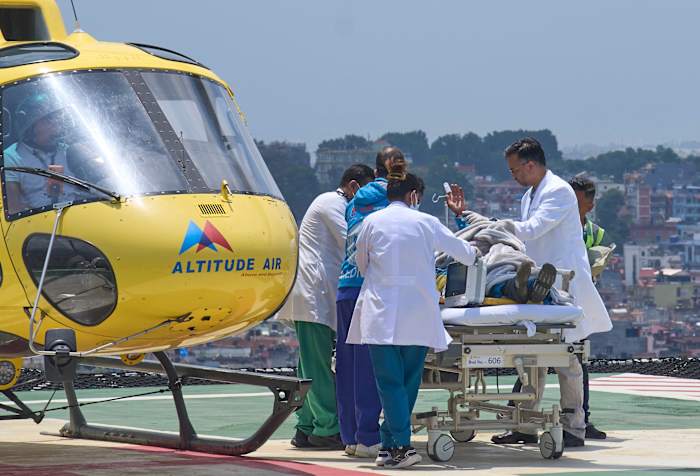
- The Rescue Reality: When things go wrong at 8,000 meters, helicopter evacuation is frequently impossible due to thin air and unpredictable winds. Human muscle is the only option.
The fact that this guide had to crawl back to camp on his own, rather than being found by an organized rescue party, highlights the terrifying isolation of high-altitude work. When a storm hits, the mountain becomes a solitary confinement cell. Even your closest friends cannot save you if stepping outside their tent means certain death.
The Cost of the Summit
The aftermath of a survival story like this is rarely poetic. There are no corporate sponsorships waiting for a Sherpa who survives a disaster. Instead, there is the quiet, painful reality of medical recovery in a Kathmandu hospital. There is the question of whether he will lose his toes, his fingers, or his livelihood.
For the international climbing community, this incident should serve as a sharp dose of reality. The mountain is not a theme park. The infrastructure that makes it feel safe is fragile, held together by the blood and stamina of a local workforce that bears the brunt of the danger.
We want to believe in miracles. We want to look at a man crawling out of the dead zone after seven days and see a triumphant testament to the human spirit. It is that, certainly. But it is also a warning.
The ice keeps score, even if the tourists don't. The next man left behind in the dark may not have the strength to crawl back.