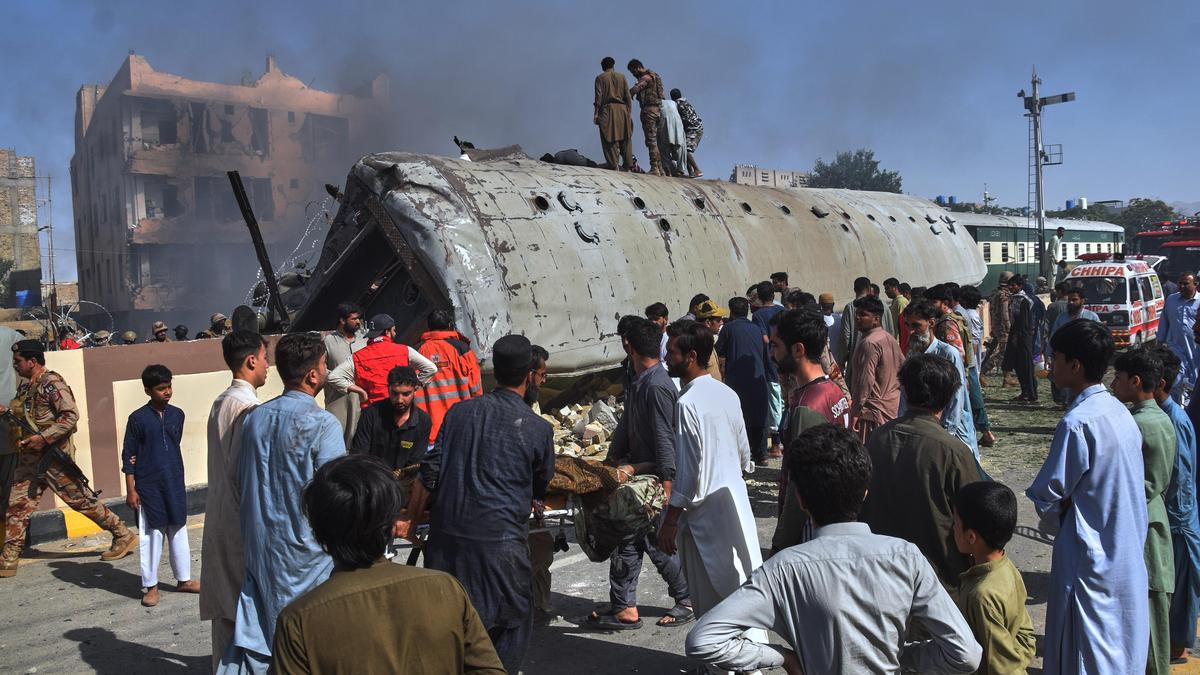
A devastating blast shattered the morning routine in Quetta, the provincial capital of Pakistan’s restive Balochistan province. A massive explosion struck a shuttle train near the Chaman Phatak area. At least 24 people are dead, and well over 100 others are left fighting for their lives in local hospitals.
The attack wasn't an accident. It was a highly organized, targeted assault aimed directly at a train carrying hundreds of Pakistani military personnel and their family members. Security officials confirmed that the train had just picked up passengers from the Quetta military cantonment and traveled only a short distance before the nightmare unfolded.
The immediate scene was absolute chaos. The impact of the blast derailed multiple carriages, flipping at least two train cars completely upside down. A violent fire broke out instantly, sending thick, toxic black smoke billowing into the sky. Local volunteers and emergency workers rushed to the tracks, desperately pulling bloodied passengers from the mangled steel wreckage. The blast was so incredibly violent that it blew out windows in nearby residential buildings and absolutely crushed over a dozen vehicles parked along the road.
The banned Baloch Liberation Army (BLA) wasted no time claiming responsibility. Through their elite, suicide-focused Majeed Brigade, the group released a statement confirming they carried out a fidayeen (suicide) operation. They explicitly stated their goal was to hit the "occupying forces" moving through Quetta. This is a severe, alarming escalation in the region's long-running conflict. It shows a level of coordination and intelligence that should make everyone in Islamabad deeply uncomfortable.
The Reality Behind the BLA Security Failure
Let’s be completely honest about what happened here. This wasn't a random roadside bombing. This was a catastrophic failure of intelligence and physical security in an area that is supposed to be heavily fortified.
The train was reportedly carrying more than 300 military personnel. It departed directly from the Quetta Cantonment—one of the most heavily guarded, secure zones in the entire province. For an explosive-laden vehicle to get close enough to a moving military transport train at a signal intersection like Chaman Phatak requires planning, timing, and an obvious gap in local security protocols.
This tragedy pattern isn't new, and that's the most frustrating part. If you track the history of the BLA’s Majeed Brigade, they’ve transitioned from hit-and-run mountain warfare to highly precise, devastating urban suicide missions. Just over a year ago, a massive suicide bombing tore through the main platform of the Quetta railway station, killing dozens. Security forces promised overhauled security, tighter checkpoints, and total surveillance. Clearly, the current strategy isn't working.
When you look at the mechanics of this latest attack, it’s clear the militants are evolving faster than the state’s defensive measures. Using a Suicide Vehicle-Borne Improvised Explosive Device (SVBIED) against a moving train demonstrates a terrifying level of operational capability. They didn't just plant a bomb on the tracks; they rammed a moving target.
The Human Cost and Urgent Medical Response
While politicians trade statements, the real crisis is unfolding inside the packed wards of Quetta’s medical facilities. Local authorities immediately declared a state of emergency at the Combined Military Hospital (CMH), the local Civil Hospital, and the Frontier Corps (FC) Hospital. Doctors, nurses, and surgeons were frantically summoned from their homes to deal with a sudden wave of critical trauma patients.
Medical personnel on the ground report that over 20 of the wounded are in highly critical condition. Many survivors suffer from severe shrapnel wounds, deep blast impact injuries, and extensive third-degree burns caused by the subsequent carriage fires. The death toll will likely climb over the coming days as teams struggle to stabilize the most severely injured.
What makes this timing even more heartbreaking is that many passengers were reportedly traveling home early to see their families ahead of the upcoming Eid holiday. Instead of a holiday reunion, families are now identifying bodies or waiting anxiously outside intensive care units.
The Broader Geopolitical Fallout
You can't look at this attack in isolation. Balochistan is Pakistan's largest but least populated province. It's incredibly rich in minerals, natural gas, and strategic coastline, yet it remains the poorest part of the country. This stark contradiction has fueled a bitter separatist insurgency for decades.
The region is also the geographic heart of the China-Pakistan Economic Development corridor, a multi-billion-dollar infrastructure project. The BLA and other separatist groups oppose these massive projects. They openly accuse Islamabad and foreign entities of exploiting the province’s immense natural wealth while completely ignoring the local population. By targeting logistics, infrastructure, and military personnel, the insurgents are trying to send a loud message: the state cannot guarantee safety here.
Prime Minister Shehbaz Sharif issued a strong condemnation from Islamabad, calling it a cowardly act of terrorism and promising that the nation's resolve wouldn't weaken. President Asif Ali Zardari echoed those sentiments, promising to eliminate the facilitators and financiers of these networks. But tough words don't save lives on the ground. The local population is tired of hearing the same empty political scripts after every major tragedy.
What Needs to Change Immediately
If Pakistan wants to stop these mass-casualty events, the military and civilian leadership must fundamentally rethink their approach to security in Balochistan. Relying entirely on reactive, static checkpoints along roads and tracks clearly isn't enough to stop a determined suicide bomber.
- Implement Dynamic Perimeter Intelligence: Checkpoints are easy to map and bypass. Security forces need real-time, intelligence-driven surveillance around key rail corridors and military transit points to disrupt attackers before they reach their targets.
- Secure Critical Rail Intersections: Intersections like Chaman Phatak cannot remain vulnerable to regular civilian vehicle traffic when high-value military transports are moving through. Physical barriers and automated clearance zones must be established.
- Address the Root Grievances: You cannot win a counter-insurgency with force alone. Until the state addresses the profound economic alienation, political marginalization, and human rights concerns within Balochistan, insurgent groups will always find new, angry recruits willing to volunteer for these horrific suicide missions.
The tragedy in Quetta is a stark reminder that the conflict in Balochistan is escalating into a much more dangerous phase. The state must adapt immediately, or it will continue to lose precious lives to an increasingly sophisticated enemy.
Deadly railway bomb blast in Quetta
This video provides direct news footage and visual context showing the aftermath of the devastating railway explosion in Quetta.