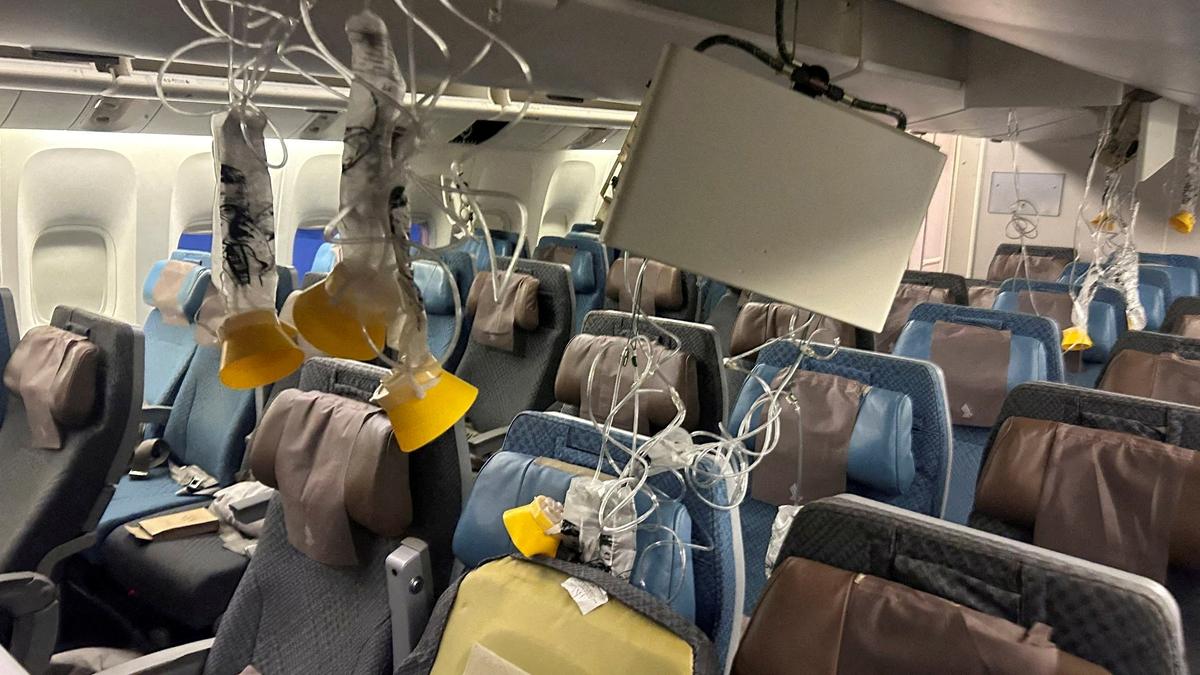
Coffee cups do not usually fly.
They stay on trays. They rest on fold-down tables. They obey gravity, that quiet, invisible agreement we make every time we board a tube of aluminum and hurl ourselves thirty-eight thousand feet above the curvature of the Earth. We surrender control to strangers in pressed uniforms, trading our autonomy for speed. We sleep. We watch movies on tiny screens. We forget that the blue ocean outside is not a floor, but an abyss. You might also find this connected coverage useful: Stop Blaming Nature for Grand Canyon Flash Floods When Human Stupidity is the Real Disaster.
Then, the sky breaks.
Consider Flight SQ321. A routine metal path carved through the humid, predictable expanse between London and Singapore. Inside, trays clattered. A passenger reached for water. And then, in less time than it takes to blink, the floor vanished. As discussed in recent articles by The Points Guy, the results are notable.
Physics is cold. It does not care about your flight plans, your weekend reservations, or the book you left open on your tray table. When a Boeing 777-300ER drops one hundred and seventy-eight feet in four seconds, the human body inside becomes a projectile.
We need to talk about why that happens. Not with dry meteorological jargon about vectors and pressure gradients, but with the visceral reality of what it means to cross an invisible threshold in the atmosphere.
The Ghost in the Air
To understand the violence that tore through that cabin, you have to unlearn what you think you know about wind.
Most people picture weather as a storm. We look for the bruised purple bellies of cumulonimbus clouds. We scan the horizon for lightning. We brace when the captain's voice crackles over the intercom warning of impending weather, giving us a polite heads-up to secure our seatbelts.
Clear-air turbulence offers no such courtesy.
It is the ghost in the machine. It happens in skies so brilliantly blue and cloudless that pilots describe them as deceptively serene. There is nothing to see. No radar can paint a picture of it because there are no water droplets to bounce radio waves back to the cockpit. It is invisible.
Imagine running your hand smoothly through still water. The resistance is uniform. Now, imagine thrusting your hand across the invisible boundary where a fast-moving underwater current collides with a stagnant pool. Your hand jerks. It stumbles.
That is the jet stream.
Rivers of air circle the globe at hurricane velocities, high above our heads. Where these massive ribbons of wind brush against slower-moving air masses, they create friction. Invisible friction. They roll, they twist, and they snap, forming atmospheric waves akin to the invisible undertow of an ocean.
When a multi-ton aircraft slips across that invisible fault line, the air stops supporting it. The lift vanishes for a fraction of a heartbeat.
The Physics of Free Fall
Gravity is patient. Acceleration is brutal.
When SQ321 hit that sudden drop, the vertical acceleration forces reversed instantly. In aviation, we measure these in gs. Normal life sits at one g. Rollercoasters thrill us at two or three.
What happened over the Irrawaddy Basin in Myanmar was different. Witnesses and preliminary flight data recorders pointed to a chaotic tumbling of vertical forces—a sudden negative g spike that lifted unsecured passengers, bags, and meal trays straight toward the ceiling, immediately followed by a bone-crushing positive g slam back down.
Bones broke. Skulls impacted overhead luggage compartments, cracking the plastic honeycomb structures meant to hold light duty-free bags, not human weight.
Let's pause the statistics. Let's look at a hypothetical passenger—call him David, traveling home to Singapore after a grueling business trip. He had loosened his seatbelt just an inch to let his stomach settle after the second meal service. He was looking out the window at the endless, unbroken carpet of white clouds far below.
He didn't hear a warning. There was no screech of metal.
There was only the sound of a thousand items—laptops, metal cutlery, ceramic mugs—becoming airborne all at once, followed a millisecond later by the collective, primal gasp of two hundred people realizing the floor had turned to air.
David didn't fall down. The plane fell away from him.
That is the terrifying distinction of severe turbulence. You aren't being pushed down by the wind; the air beneath your wings has literally ceased to exist for a moment. You are suspended in an elevator whose cables have been cleanly severed, floating for a horrifying second before the impact catches up with you.
Why the Skies are Changing
Why now? Why does it feel like the air is getting angrier?
The answer lies in a thermometer.
As global temperatures rise, the thermal structure of our atmosphere shifts. The equator warms faster than the poles, and the upper troposphere—the highway where our commercial jets cruise—is undergoing radical alterations in wind shear.
Data compiled by atmospheric scientists over the past four decades shows a clear, undeniable upward trend in clear-air turbulence over the North Atlantic and major global flight corridors. It is not an anomaly anymore. It is a symptom.
Jet streams are shifting their positions and intensifying their internal friction. The invisible rivers are running faster, and their banks are growing more turbulent.
Airlines know this. Meteorologists track it. Yet, predicting the exact location of a clear-air turbulence pocket is like trying to forecast where a single bubble will form in a boiling pot of water. You know the water is boiling. You know bubbles will rise. But pointing to the exact square millimeter where the steam will break surface tension? Impossible.
This leaves our modern aviation system in a precarious dance with nature. We fly faster, higher, and more frequently than at any point in human history. Millions of souls aloft every single day, trusting the resilience of carbon-fiber wings and titanium rivets to keep them safe from an invisible enemy.
The Cost of Comfort
We have traded caution for convenience.
We hate the seatbelt sign. We sigh when the chime sounds, annoyed that the pilot is interrupting our movie or delaying our trip to the lavatory. We treat the nylon strap across our laps as a bureaucratic nuisance rather than a life-saving tether.
We want our flights to feel like a living room. We want quiet engines, smooth service, reclining seats, and the illusion that we are simply sitting in a stationary room while the world moves past our window.
The sky refuses to maintain that illusion.
When the cabin of SQ321 filled with smoke-like dust from shattered panels, oxygen masks dangling like strange vines, and the horrifying chorus of human pain, the illusion shattered with it.
People asked why the seatbelt sign wasn't on. They asked if the pilots could have seen it. They looked for someone to blame—an airline, a forecast model, a radar screen.
The uncomfortable truth is that blame belongs to the medium itself. We are swimming in an ocean of gas that is constantly churning, heating, and shifting. To step onto an airplane is to accept that you are entering a wild, untamed wilderness three hundred times faster than a cheetah can run.
The Final Descent
The injuries were severe. Spinal fractures, internal bleeding, concussions. One life was lost to a heart attack triggered by the sheer physiological shock of the event.
And then, the descent into Bangkok.
The emergency landing was textbook. Fire trucks with flashing red beacons lined the tarmac like waiting sentinels. Medical personnel swarmed the cabin doors. The doors opened, letting in the heavy, humid air of Thailand—ground air, safe air, unmoving air.
Passengers walked down the stairs. Some were crying. Some were silent, staring blankly at the concrete beneath their feet with a new, profound appreciation for something as mundane as a solid, unyielding floor.
The metal tube had held together. The wings had not sheared off. The engineering of human ingenuity had triumphed over the structural failure of the airmass, even if the human bodies inside had paid the price for the invisible violence of the jet stream.
Next time you board. Next time you settle into your seat, sliding that metal buckle into its clasp with a casual, mindless click.
Listen for the chime. Feel the solid pull of the strap across your hips.
Look out the window at the brilliant, deceptive blue.
And remember that somewhere out there, hidden in the clear and quiet air, the river is running wild.