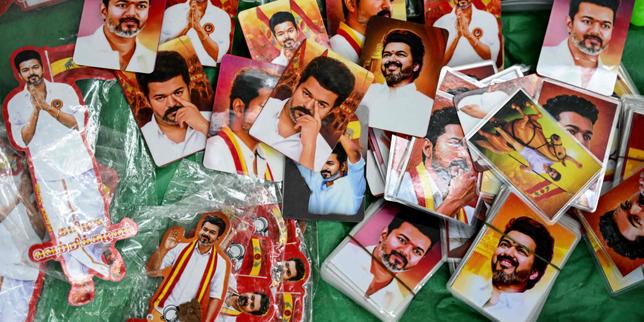
The lights in the studio are blinding. They hum with a peculiar heat that smells like ozone and expensive hairspray. For fifteen years, Vijay Chandrasekhar lived under those lights. He knew exactly where to stand to catch the perfect shadow across his cheekbone. He knew how to tilt his chin to make a million hearts skip a beat. He was the hero of the frame, the man who always rescued the girl, the face on billboards draped over the sides of Mumbai skyscrapers.
But then, the director yelled cut. And this time, he didn't wait for the next setup.
He walked off the set. He walked out of the costume trailer. He walked away from the contract that guaranteed him a fortune, all for the sake of a dusty, fluorescent-lit room in a municipal building.
The transition from the silver screen to the ballot box feels like a death to most people. When a star trades the adulation of a stadium for the grind of constituent meetings, the public usually assumes one of two things: they are bored, or they are desperate. We watch them walk into the political arena with a skepticism that borders on cruelty. We look for the vanity project hidden behind the policy proposal.
Yet, watch him now.
There is a specific kind of exhaustion that hangs on a politician who actually listens. It isn't the exhaustion of a long day of filming, where someone else carries your bags and tells you when to eat. It is the hollowed-out fatigue of someone realizing that the script he’s writing now has no editor. If he makes a mistake in a film, the take is ruined, but the scene is reprinted. If he makes a mistake here, the stakes are measured in water pipes, electricity access, and the dignity of people who have never once cared about his box office numbers.
Vijay Chandrasekhar stood in a rain-slicked alleyway in his district last Tuesday. His suit was damp. The expensive watch on his wrist was buried under the sleeve of a drab, functional jacket. He was listening to an elderly woman explain why the drainage system had failed for the third year in a row. He wasn't smiling for a camera. He wasn't posing. He was taking notes on a stained piece of paper, his forehead creased with the kind of genuine confusion that no actor can fake—the confusion of a man realizing that the world he once occupied was a curated, sanitized lie.
This is the invisible wall that separates the celebrity from the public servant.
For years, he was a projection. We projected our dreams, our lust, and our insecurities onto his visage. He was a symbol of what we wanted to be. Now, he is trying to be a conduit for what we need. It is a violent pivot. The transition requires a total shedding of the ego, a process that is as painful as it sounds. You have to stop being the sun around which the room revolves and start being the gravity that holds the room together.
I remember meeting a man much like him years ago, a retired athlete turned councilor. I asked him, over coffee that tasted like burnt rubber, why he did it. Why trade the applause for the insults of a town hall meeting? He didn't look at me. He stared out the window at the parking lot. He said, "When I was playing, I was performing a life. Now, I am finally living one."
That is the pulse of the story. It isn't about Bollywood. It isn't about the glitz or the transition to power. It is about the hunger for reality that eventually consumes the people who have spent their lives pretending.
There is a danger here, of course. We are conditioned to distrust the performer. We wait for the moment the mask slips, for the moment he reverts to the soundbites he perfected on press junkets. We look for the performance in his policy. When he talks about infrastructure, we wonder if he is auditioning for a better seat. When he speaks about the marginalized, we question his sincerity because he has lived so far above the clouds for so long.
He knows this. He feels the weight of our gaze, the way we watch him like a hawk waiting for a stumble. That pressure is his new lead role. It is a role he didn't audition for, and one he cannot resign from without losing the only thing he has left: his own respect.
Consider the complexity of his position. He carries the baggage of his former life—the fame that draws crowds, the name recognition that buys him an audience—but he must constantly apologize for it. He has to prove that he isn't just another pretty face in a suit. He has to demonstrate that the empathy he displayed on screen wasn't just a learned behavior, but a dormant muscle he is finally exercising.
It is a difficult thing to watch. We want him to be the hero, but we also want him to fail because failure is easier to understand than the idea that a person can actually change. We find it comforting when a celebrity falls flat on their face in the real world, because it validates our belief that they belong on the screen, not in the driver’s seat.
But what if he succeeds?
What if the man who learned how to communicate emotion to millions of people can actually translate that into a language that moves a bureaucracy? What if his fame isn't a distraction, but a bridge to the people he serves? The cynicism we pour onto his political career acts as a friction, slowing him down, making every step forward feel like he is trudging through deep sand.
He is not a savior. He is not a god. He is simply a man who realized that the applause of a theater is quiet compared to the sound of a community finally finding its voice.
The irony is not lost on him. He spent a decade telling stories that were designed to make us feel something, only to realize that he was the only one in the room not feeling anything at all. Now, the roles are reversed. He is the one trying to feel, trying to understand, trying to navigate the mess of a real city with all its broken pipes, forgotten neighborhoods, and silenced voices.
The camera is still pointed at him, but the angle has changed. He isn't looking at the lens anymore. He is looking at us. He is waiting to see if we can handle the truth of his transition, or if we will keep demanding that he stick to the script we wrote for him long ago.
The streetlights in his district flicker. The rain continues to fall. He turns the page of his notebook, his pen hovering over the paper, ready to draft a plan for a reality that is far more difficult than any script he ever read. The performance is over. The work is just beginning.
He walks away from the light, stepping into the shadows of a backstreet, his coat collar turned up against the wind. No one stops him for an autograph. No one screams his name. For the first time in his life, he is completely, terrifyingly, and wonderfully invisible. And for the first time in his life, he is exactly where he needs to be.