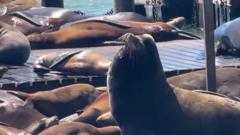
The local news is cooing over a "massive" sea lion showing up in San Francisco like it’s a Disney movie come to life. The headlines treat this animal as a majestic visitor, a rare treat for tourists, and a sign that nature is somehow healing.
They are dead wrong.
When an outsized male Zalophus californianus—the California sea lion—hauls its 800-pound frame onto a high-traffic area where it doesn't belong, it isn't a "rare appearance." It is a biological red flag. We have spent decades romanticizing the presence of these pinnipeds in urban environments, specifically at Pier 39, to the point where we’ve forgotten they are apex predators with a high caloric demand and a dwindling buffet.
Seeing a lone, massive bull sea lion in a new or unusual urban spot isn't a sign of environmental health. It’s a sign of a broken food chain.
The Myth of the Happy Harbor
The "lazy consensus" among travel bloggers and local reporters is that sea lions love San Francisco because it’s a safe haven. The reality is far more transactional and, frankly, grim.
Sea lions are opportunistic foragers. They are governed by the Optimal Foraging Theory. This biological principle dictates that an animal will try to maximize its net energy intake per unit of time spent foraging. If a massive bull is hauling out in a high-density human area away from the usual colony, it’s not because he’s curious. It’s because he’s exhausted or starving.
The Pacific coast is currently grappling with shifting prey distributions. Anchovies and sardines—the high-fat fuel these animals need—are moving due to rising sea surface temperatures. When the food moves, the sea lions follow. When the food disappears, they get desperate. A "rare appearance" is often the final act of a desperate animal looking for a haul-out spot because it no longer has the energy to swim back to the Farallon Islands or the Channel Islands.
Stop Calling Them Cute
The public’s refusal to see these animals as dangerous wildlife is a failure of education. A sea lion of that size possesses a bite force of approximately 1,000 PSI. For context, a German Shepherd clocks in at about 238 PSI.
We’ve created a "circus atmosphere" around San Francisco’s waterfront that encourages dangerous proximity. I have seen tourists attempt to get selfies within three feet of a bull sea lion, completely oblivious to the fact that these animals can move faster than a human on land over short distances.
- Misconception: They are "dogs of the sea."
- Reality: They are territorial, aggressive carnivores.
- The Nuance: Their "playful" barks are often vocalizations of territorial stress. When you crowd them for a photo, you aren't "connecting with nature." You are participating in animal harassment that is federally prosecutable under the Marine Mammal Protection Act (MMPA).
The Economics of Pinniped Parasitism
Let's talk about the uncomfortable truth that San Francisco's tourism board won't touch: the sea lion population is an ecological and economic tax on the city's infrastructure.
While Pier 39 enjoys the foot traffic, the actual maritime industry suffers. A massive bull sea lion can cause thousands of dollars in damage to docks, electrical conduits, and vessels in a single night. They sink small boats. They destroy expensive netting.
The city treats them as mascots because they don't have to pay for the "upkeep." The "upkeep" is paid by the fishermen whose hauls are decimated and the boat owners who have to find new ways to "sea lion-proof" their livelihoods. We are subsidizing a tourist attraction at the expense of a functional harbor.
The Marine Mammal Center is Overworked and Underfunded
Every time a "massive" sea lion appears, people ask: "Is he okay? Can someone help him?"
The assumption is that there’s a secret army of rescuers ready to swoop in. I’ve seen the inside of these operations. The Marine Mammal Center in Sausalito is one of the best in the world, but they are constantly triaging a flood of "domoic acid" cases.
Domoic acid is a neurotoxin produced by harmful algal blooms. It accumulates in the fish sea lions eat. It causes seizures, brain damage, and "unusual behavior"—like showing up in places they shouldn't be. When you see a massive sea lion acting "tame" or "rarely" appearing in a public square, you aren't seeing a friendly visitor. You are likely witnessing a victim of a toxic neurological event.
By celebrating these appearances, we are ignoring the underlying pathology. We are cheering for a symptom while the patient is dying.
How to Actually Respect the Wildlife
If you want to be a responsible citizen and not a "tourist trap" casualty, you need to change your behavior.
- Maintain a 50-Yard Buffer: This isn't a suggestion. It’s the law. If the animal changes its behavior because of your presence—if it lifts its head, barks at you, or starts to move—you are too close.
- Report, Don't Record: Instead of hitting "Live" on Instagram, call the local stranding network. Give them coordinates. Describe the animal's behavior.
- Acknowledge the Smell: People always comment on the "stink" of the sea lions. That smell is a mixture of rotting fish, excrement, and decomposing organic matter. It’s a biological warning. Listen to your nose.
The Counter-Intuitive Truth
The best thing for San Francisco’s "massive" sea lion would be for it to leave.
If it stays, it’s because it’s too sick to go or because we’ve made it a "beggar" animal. Beggar animals lose their natural fear of humans, which sounds nice until the animal gets frustrated that you don't have a fish in your hand and decides to take a chunk out of your thigh.
The "rare appearance" isn't a miracle. It’s an anomaly. And in biology, anomalies are usually a sign that something is going sideways.
Stop treating the bay like a petting zoo. These animals don't want your admiration; they want a cold ocean filled with fatty fish and a place to rest where they aren't being poked by a selfie stick. If we actually cared about these "massive" visitors, we’d be more concerned about why they’re here and less concerned about getting the perfect shot for the grid.
The ocean is screaming. Maybe we should stop clapping.
Don't wait for the next viral video to realize the ecosystem is off-balance. Put the camera down and walk away.



