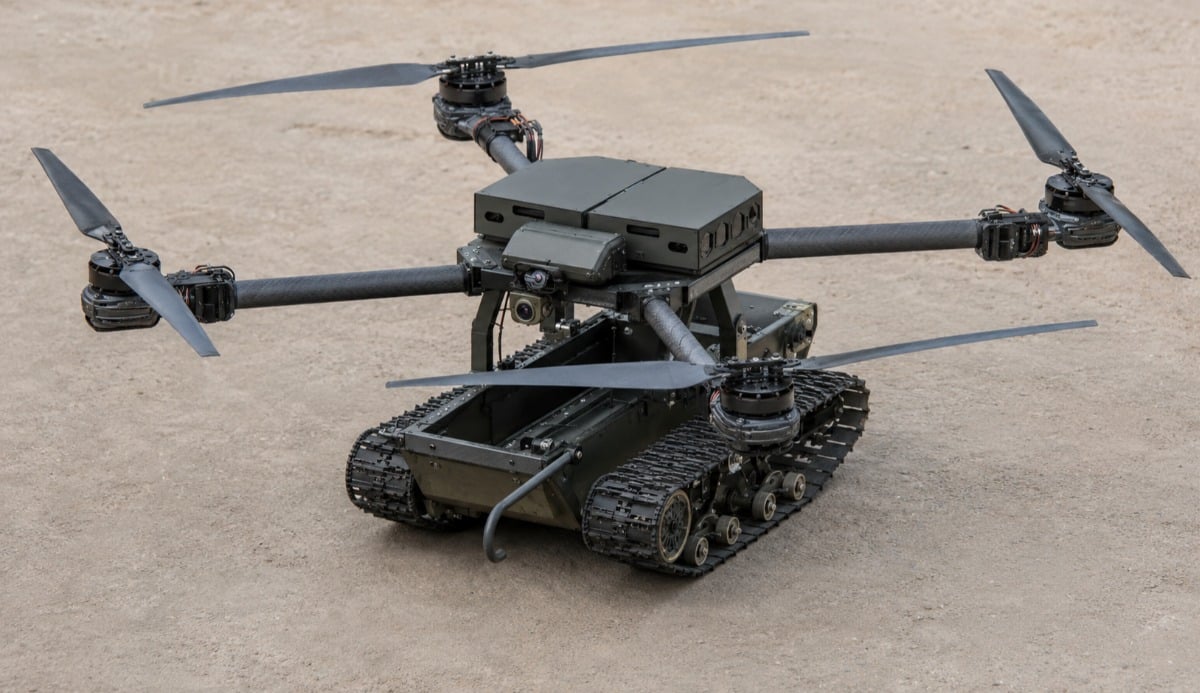
Russia has patented an unmanned ground vehicle designed to launch and recover its own reconnaissance drone, aiming to solve the severe communication limits plaguing remote-controlled armor. The patent, filed through the Russian Federal Institute of Industrial Property, details a tracked robot tank acting as a mobile mothership for a small quadcopter. This aerial companion serves a dual purpose: expanding the vehicle's situational awareness and acting as an elevated signal relay. While Moscow presents this as a leap forward in autonomous combat, the blueprint actually exposes a critical vulnerability that has crippled mechanized robots on modern battlefields. Ground combat vehicles are fundamentally blind and deaf without an airborne umbilical cord.
Defense analysts monitoring Russian military procurement recognize this patent as a direct response to operational failures. For nearly a decade, the Kremlin has attempted to field heavy unmanned ground vehicles with disastrous results. The underlying physics of radio frequency propagation have consistently defeated the propaganda promises of remote-controlled armor brigades.
The Horizon Problem Blinding Unmanned Armor
Radio waves travel in straight lines. When a human operator sits in a control bunker five kilometers away from an unmanned tank, they rely on a clean line of sight to maintain data links. The ground is rarely flat. Concrete walls, dense forests, rolling hills, and even slight depressions in the terrain degrade or completely block high-bandwidth signals.
This is the horizon problem. A heavy robot tank weighing several tons can be neutralized not by an anti-tank missile, but by a simple dirt berm. When the vehicle dips into a ditch, the control signal drops. The multi-million-dollar machine becomes an expensive, immobile hunk of steel waiting to be picked apart by enemy infantry.
Modern electronic warfare compounds this physical limitation. The electromagnetic spectrum on a contemporary battlefield is thick with jamming signals designed to sever the connection between a machine and its human master. A ground-based robot operating close to the earth must push its signals through immense ground clutter and interference. The energy required to cut through this noise is unsustainable for battery-powered or generator-reliant field systems.
By launching a small drone from the deck of the tank, the system attempts to lift its antenna above the terrain obstructions. The drone flies a few hundred feet into the air, establishing a clear line of sight to both the tank below and the distant operator. It turns a vulnerable ground-to-ground communication link into a much more reliable ground-to-air-to-ground relay circuit.
Lessons From the Uran Syrian Disaster
To understand why Russian engineers are filing these patents now, one must examine the combat debut of Russia's previous robotic flagship. The Uran-9 unmanned ground vehicle was deployed to Syria for field testing. It was a disaster.
State media had advertised the Uran-9 as a capable combat robot capable of operating up to three kilometers away from its command post. In the tight, debris-strewn urban environments of Syria, the real-world operational range collapsed to a few hundred meters. Operators routinely lost control of the vehicles for minutes at a time. In several instances, the connection dropped completely for over an hour, forcing teams to wait or risk entering active firefights to recover the stranded assets.
The failures extended beyond communication. The un-stabilized optics made targeting impossible while moving, the suspension was unreliable, and the 30mm automatic cannon suffered from delayed firing commands due to lag in the satellite and radio loops. The overarching lesson from Syria was clear. Without a dedicated, local airborne asset to anchor the network, heavy combat robots are a liability.
The new patent indicates that the Russian defense establishment learned this lesson, even if they refuse to admit it publicly. The document describes a mechanism where the quadcopter is housed in a protected bay on the tank's chassis, shielded from shrapnel and small arms fire. When the tank enters an area of high signal degradation, the bay opens, the drone launches automatically, and it begins tethered or battery-powered flight to re-establish the data stream.
The Flying Antenna Fix
The mechanics of the patented system reveal a desperate engineering compromise. According to the diagrams, the drone connects to the tank via a physical cable or a localized short-range encrypted radio link. A physical tether provides a distinct advantage: unlimited flight time. The tank's internal generator can pump electricity up the wire, allowing the quadcopter to stay aloft for days instead of minutes.
A tethered approach also protects the drone from local electronic jamming. Commands sent from the tank to the drone pass through a fiber-optic or copper wire, impervious to airborne radio interference. The drone then broadcasts the data back to the rear command structure using high-power, directional antennas that are much harder to disrupt from the ground.
Yet, this solution introduces new points of failure. A tethered drone acts as a giant neon sign pointing directly to the location of the host tank. Enemy artillery spotters or reconnaissance teams only need to look for a small quadcopter hovering perpetually above a specific patch of trees. Once the drone is spotted, the tank beneath it can be targeted with mortars or guided munitions.
If the tether is severed by shrapnel, the link breaks. The drone drifts away, and the tank is plunged back into digital blindness. If the system relies on a wireless link instead of a cable, the small drone becomes highly vulnerable to the exact same localized jamming that the system was designed to circumvent. A simple commercial-grade jammer could sever the connection between the tank and its flying eye, leaving the entire system paralyzed.
Sanctions and the Silicon Bottleneck
A patent is a declaration of intent, not proof of manufacturing capability. The biggest obstacle facing Russia's robotic ambitions is not engineering theory, but industrial reality. The high-performance microelectronics required to coordinate autonomous flight, data encryption, and real-world sensor fusion are precisely the components restricted by international sanctions.
Russian defense facilities like Uralvagonzavod excel at bending heavy steel and casting armor plates. They struggle immensely with producing advanced semiconductors, optical sensors, and high-frequency radio transceivers. Investigative tear-downs of captured Russian hardware routinely reveal a reliance on smuggled Western consumer electronics or low-grade alternatives.
A robot tank that manages its own drone requires an immense amount of localized computing power. The vehicle must process incoming video feeds, calculate telemetry, adjust directional antennas, and run automated threat-detection algorithms simultaneously. Doing this without access to advanced processing units forces designers to use larger, heavier, and more power-hungry industrial computing blocks.
This creates a cascade of weight and heat issues. A larger computer requires better cooling systems, which demand more space inside an already cramped armored chassis. The added weight reduces the vehicle's speed and operational range, turning a nimble robotic scout into a slow-moving target. The gap between a patented concept and a mass-produced, combat-ready vehicle can span decades when a nation is cut off from global supply chains.
The Radio Beacon Trap
In modern warfare, survival depends on electromagnetic silence. The moment a military unit transmits a radio signal, enemy electronic warfare units locate the coordinates and direct artillery fire to that exact spot within minutes. The war in Ukraine has demonstrated that the electromagnetic spectrum is just as lethal as the physical ground.
The patented Russian system relies on continuous, high-bandwidth transmissions to move video data from the drone back to the operator. This creates a massive electromagnetic signature. The tank becomes a glowing beacon on enemy electronic warfare monitors, visible from dozens of kilometers away.
Even if the directional antennas minimize signal leakage, the energy output required to maintain a connection over long distances cannot be hidden. Western doctrine has increasingly moved toward passive sensing and low-probability-of-intercept communications to keep troops hidden. The Russian patent doubles down on active, continuous broadcasting, prioritizing remote control over stealth.
This operational philosophy assumes an environment where Russia controls the electromagnetic space. That assumption is no longer valid against peer or near-peer adversaries equipped with advanced signal intelligence capabilities. The flying drone might save the tank from losing its connection, but it will likely cost the tank its survival by inviting an immediate, overwhelming counter-battery strike.
The patent reveals a defense establishment caught in a technological trap. They cannot make ground robots work without flying drones, and they cannot use flying drones without exposing the entire system to destruction. Moscow will undoubtedly continue to showcase these blueprints at international arms expos, seeking foreign buyers to fund development. The harsh reality of the modern battlefield suggests these dual-element robotic systems will remain confined to paper, serving as an acknowledgment of an unsolvable engineering dilemma rather than a tool for operational dominance.