Two in the morning. The blue glow of a smartphone screen washes across a darkened bedroom, illuminating the tired eyes of someone who swore they would go to sleep an hour ago. A thumb flicks upward. A wildfire in Greece. A bank collapse in Zurich. A strange atmospheric anomaly over the Pacific. Each swipe delivers a fresh jolt of cortisol, a tiny, addictive dose of existential dread that whispers a seductive lie: If you just keep looking, you will be prepared.
Now, strip away the lithium-ion battery, the fiber-optic cables, and the algorithmic feed. Step backward five hundred years into a candlelit study in Augsburg, Germany, around the year 1550.
Sit beside a hypothetical merchant—let us call him Lukas—as he leans over a heavy folio bound in calfskin. The smell of tallow wax, damp wool, and oak-gall ink hangs thick in the cold air. Lukas turns a thick rag-paper page, and his breath catches. Bleeding across the sheet in vivid, hand-painted gouache and watercolor are three blazing suns hanging simultaneously over a terrified medieval town. He turns another page. A swarm of locusts blots out the sky over Constantinople. Another. A rain of blood falls upon the fields of Bohemia, followed by a two-headed calf, a flaming comet shaped like a Turkish scimitar, and the catastrophic, churning waves of the Great Flood.
Lukas is not reading a fairy tale. He is not looking at fantasy art. He is staring at what he believes to be the breaking news of the apocalypse, curated and painted for his private consumption.
We like to flatter ourselves into believing that our current epidemic of digital dread—what we casually call doomscrolling—is a uniquely modern pathology, a Frankenstein’s monster stitched together by Silicon Valley engineers and attention-economy profiteers. We blame the algorithms. We blame the infinite scroll. Yet a newly surfaced sixteenth-century manuscript, known as the Augsburg Book of Miracles, is about to cross the auction block at Sotheby’s in London with an estimated price tag of up to £1 million—and it exposes a deeply uncomfortable truth about human nature.
We did not invent the panic machine. We merely digitized it.
The Architecture of Sixteenth-Century Dread
To understand why a wealthy collector is willing to pay seven figures for a 500-year-old picture book of disasters, you have to feel the suffocating uncertainty of early modern Europe. In the mid-sixteenth century, the world felt as though it were coming apart at the seams. The Protestant Reformation had shattered the unified spiritual bedrock of Christendom, pitting neighbor against neighbor in bloody theological warfare. The Ottoman Empire was knocking violently at the gates of Vienna. The Little Ice Age was freezing crops in the ground, triggering famines that hollowed out entire villages, while the bubonic plague lingered like smoke in the alleys, ready to flare up without warning.
If you lived in Augsburg in 1552, you had no meteorologists to explain a halo around the sun, no seismologists to map a fault line, and no epidemiologists to track a fever. When the sky turned an eerie, bruised purple at noon, or when a comet tore through the night sky like a wound, you did not see physics. You saw an angry God clearing His throat.
Enter the anonymous master—or workshop of artists—behind the Book of Miracles (historically known as the Augsburger Wunderzeichenbuch). Compiled in the thriving imperial city of Augsburg, a bustling crossroads of European trade, banking, and early printing, this manuscript contains 123 surviving full-page illustrations painted on heavy paper, chronicling prodigies, celestial phenomena, natural disasters, and apocalyptic prophecies stretching from the Old Testament right up to the year 1552.
Wait. Look closely at that number. One hundred and twenty-three full-page paintings of catastrophe.
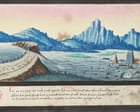
When you flip through the Book of Miracles, you are not looking at dry ecclesiastical scholarship. The accompanying German text is brief, almost caption-like, sitting neatly at the top or bottom of the page like a modern social media overlay. The real engine of the book is the visual spectacle. The artists used luminous pigments—azurite blues, vermilion reds, burnished golds, and toxic verdigris greens—to render hailstones the size of human heads, rivers overflowing with corpses, and terrifyingly vivid visions from the Book of Revelation.
It is visceral. It is relentless. And it was designed to be consumed sequentially, page after page, pulling the viewer deeper into a vortex of cosmic anxiety.
Why Our Brains Crave the Apocalypse
I have spent years studying how media technologies reshape human attention, and if there is one lesson that history hammers home with brutal consistency, it is that hardware changes far faster than wetware. Our skulls still house Paleolithic survival engines wired to prioritize threat over tranquility. In the ancestral savanna, ignoring a rustle in the tall grass meant death; ignoring a blooming flower meant nothing.
Psychologists call this negativity bias, and it explains why bad news travels faster than good news in every era. When I first examined high-resolution plates of the Book of Miracles, my immediate reaction was not scholarly detachment—it was a familiar, tightening knot in my stomach. Watching the sixteenth-century artist render a fiery cross hovering over a panicked crowd triggered the exact same low-grade dread I feel when refreshing a live news ticker during an international crisis.
Think of the Book of Miracles as a bespoke, analog newsfeed. Before daily newspapers existed, Europeans relied on Flugblätter—cheap, single-sheet illustrated broadsides sold by peddlers in town squares that reported sensational events: a monstrous birth in Saxony, a devastating flood in Rome, a strange aurora over Nuremberg. Someone in Augsburg—almost certainly a wealthy, educated patron with the resources to commission top-tier illuminators—decided that scattered pamphlets were not enough. They wanted an archive. They wanted the entire terrifying dataset bound together in one place.
Consider what happens next when you bind 123 disasters into a single volume.
Each isolated tragedy stops looking like an accident and starts looking like a pattern. A comet in 1527 becomes connected to a famine in 1529, which points inexorably toward the seven-headed beast of Revelation painted at the back of the book. The patron of the Book of Miracles was engaged in an early form of pattern-seeking—trying to decode the end of the world by staring intently at its fractures.
The Economics of Fear
There is a sharp, illuminating irony in the fact that this particular artifact is expected to fetch between £700,000 and £1 million at Sotheby’s in London. Today, doomscrolling is free at the point of entry; we pay for it with our attention, our sleep, and our mental equilibrium, while tech platforms monetize our eyeballs in the background. In 1550, chronic anxiety was a luxury good.
Only a member of Augsburg’s merchant aristocracy—families like the Fuggers or the Welsers, who financed emperors and tracked global trade routes—could afford to hire master illuminators to hand-paint over a hundred sheets of fine paper with expensive mineral pigments. Yet the underlying psychological transaction was identical. Whether you are a sixteenth-century banker paying a master painter in gold florins or a twenty-first-century office worker paying an app with four hours of fragmented REM sleep, you are buying the illusion of control.
Let us be honest about why we cannot look away when things go wrong. It is easy to mock the sixteenth-century citizen who thought a double rainbow or a bearded comet foretold the fall of kings. We have telescopes and Doppler radar; we know that atmospheric ice crystals refract sunlight into parhelia, or "sun dogs," and that comets are dirty snowballs orbiting the sun.
Yet knowing the science has not cured our compulsion. Why? Because the anxiety was never really about the comet. It was about vulnerability.
When a terrifying event happens outside our control—a pandemic, an economic shock, a geopolitical escalation—our brains desperately try to metabolize the helplessness by gathering information. We scan the horizon. We look for signs. In Augsburg, scanning the horizon meant looking up at the clouds for flaming swords and recording them in gouache. Today, scanning the horizon means refreshing a feed at midnight to read twenty-seven different takes on a crisis we cannot personally influence.
The medium is ink and rag paper versus OLED glass. The psychological loop is indistinguishable.
A Survivor’s Journey Through Five Centuries
What makes the Book of Miracles even more extraordinary is that it survived at all. Most ephemeral media—whether sixteenth-century broadsides or yesterday’s viral posts—vanishes into the shredder of history. The Book of Miracles escaped destruction largely because it was treated as a precious work of art, tucked away in private aristocratic libraries for centuries before resurfacing in the modern auction market. (A closely related sister manuscript, preserved in the collection of Mickey Cartin and published by Taschen in 2013, brought this visual universe to wider scholarly attention, revealing just how sophisticated the Augsburg workshop truly was.)
Look at the artistic execution on these pages, and you realize why curators speak of the manuscript with reverence. These are not crude, cartoonish doodles of monsters. The unknown masters of Augsburg brought the full force of the Northern Renaissance—the atmospheric perspective of Albrecht Altdorfer, the dramatic naturalism of Albrecht Dürer—to bear on the apocalypse.
In one plate, a colossal meteor streaks across a twilight sky rendered in delicate, graded washes of indigo and rose, casting an eerie light over a meticulously painted German town with stepped gables and quiet spires. In another, swarms of locusts descend like a living storm cloud, each insect rendered with obsessive, almost journalistic precision. The beauty of the craft creates a haunting tension with the horror of the subject matter. It seduces the eye even as it alarms the mind.
Sound familiar? Modern user-interface designers spend millions perfecting typography, haptic feedback, and fluid animations so that reading terrible news feels frictionless, even aesthetically pleasing. The Augsburg painters used lapis lazuli and gold leaf; modern designers use San Francisco font and pull-to-refresh physics. Both understood that if you want someone to stare into the abyss, you have to frame it beautifully.
The Invisible Stakes of the Scroll
Standing in front of a glass case displaying the Book of Miracles—or scrolling through its digitized plates on a laptop—forces a quiet reckoning. For years, commentators have warned that smartphones are rewiring the human brain, turning us into neurotic, hyper-vigilant creatures incapable of sustained peace. And to a degree, they are right: the speed and scale of modern information delivery have no historical precedent. A sixteenth-century merchant might hear about a disaster in Constantinople six weeks after it happened; we watch it livestreamed in 4K before the dust has settled.
Still, blaming the machine lets us off the hook too easily.
If you took away every smartphone on earth tomorrow, humans would still gather in town squares to trade rumors of catastrophe. They would still paint comets on vellum, print sensational pamphlets on wooden presses, and stay awake late into the night worrying about signs in the sky. The Book of Miracles is proof that the appetite for apocalyptic spectacle lives inside us, not inside our devices.
When Sotheby’s brings the hammer down on this manuscript in London, a private collector or a major museum will walk away with one of the rarest, most visually arresting artifacts of the German Renaissance. It will be celebrated as a triumph of sixteenth-century art, a window into the Reformation mind, and a staggering financial asset.
All of those things are true. Yet the real value of the Book of Miracles cannot be measured in pounds sterling. Its true value lies in the mirror it holds up across five hundred years.
We are not the first generation to feel as though the sky is falling, nor are we the first to confuse obsessively documenting the storm with finding shelter from it. Somewhere tonight, millions of people will lie awake in the dark, bathed in blue light, sliding a thumb across glass to see what new disaster has appeared on the horizon. Five centuries ago, in a quiet room in Augsburg, a man leaned over a glowing page of painted fire and turned to the next sheet, hoping the next omen would finally tell him what it all meant.
Neither of them found peace on the next page.