The desert does not care about geopolitics. Out in the vast, sun-bleached expanse of the Australian outback, the wind hums a low, eternal note against the scrub. For decades, this emptiness was the ultimate shield. Australia was an island continent, protected by thousands of miles of deep blue water and an unspoken assumption that any threat would have to cross the oceans first.
That assumption just evaporated in a flash of white-hot exhaust.
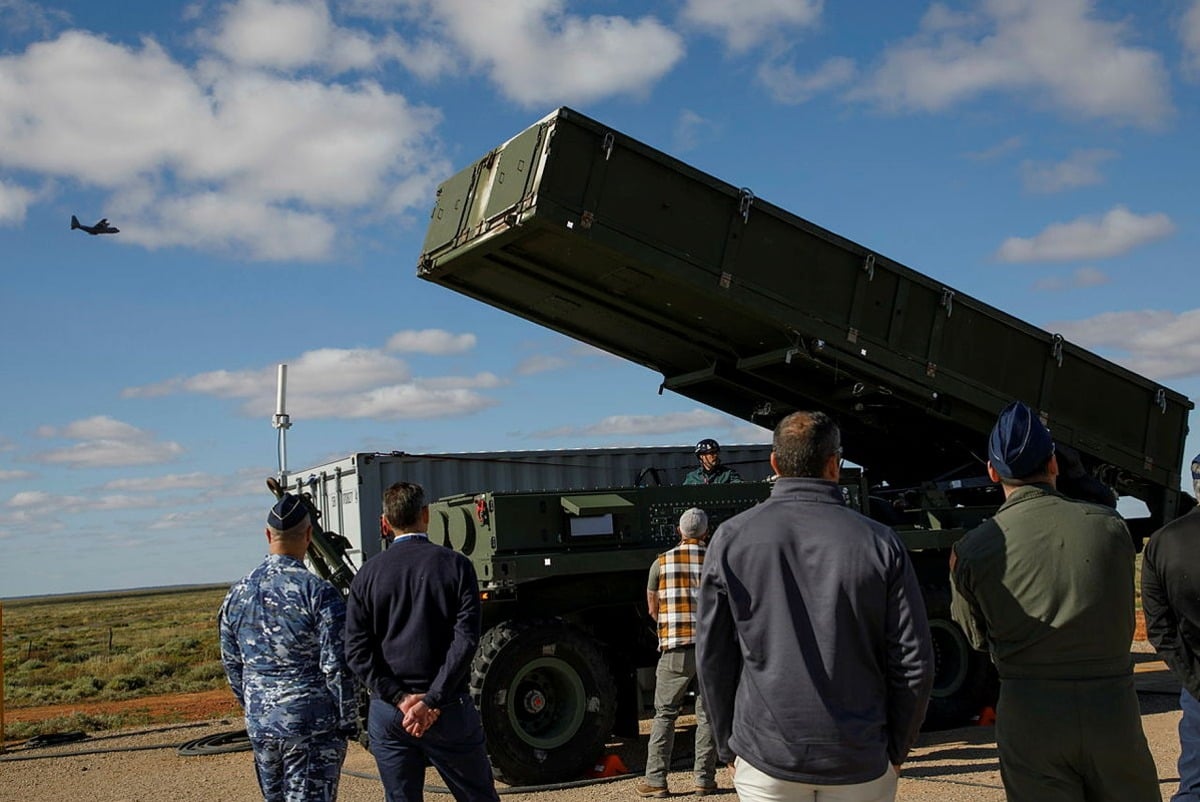
Imagine a team of engineers standing inside a reinforced concrete bunker, their eyes locked on a bank of monitors. Let’s call the lead test conductor Sarah. Her palms are damp, despite the fierce air conditioning fighting the desert heat outside. On the screen is a boxy, unglamorous metal trailer parked on the baked earth. It looks like something a farmer might use to haul equipment, but tucked inside its frame is a thirteen-foot pillar of solid rocket fuel and guidance electronics: the Standard Missile 2.
Until now, this weapon belonged exclusively to the sea. It lived in the vertical launching silos of multi-billion-dollar warships, designed to swat incoming threats out of the sky far from the coastline.
Sarah’s finger hovers. The countdown reaches zero.
Silence. Then, a shudder that vibrates through the soles of her boots before the sound even hits the bunker. The desert outside turns white. A roar like the tearing of physical fabric fills the air as the missile erupts from the dirt, carving a vertical line straight into the stratosphere.
This was not just a successful hardware test. It was the quiet burial of an old doctrine.
The Illusion of Distance
For generations, Australia’s defense strategy was dictated by geography. The oceans were a moat. If you wanted to project power or defend the mainland, you built a navy. You put your best technology on hulls that floated, floating fortresses meant to intercept trouble before it ever smelled the eucalyptus trees of the coast.
But modern warfare has shrunk the map.
Hypersonic threats, long-range cruise missiles, and fleets of cheap, mass-produced drones have turned the wide oceans into narrow corridors. A warship is a magnificent piece of engineering, but it can only be in one place at a time. It can be tracked from space. It can be targeted. Most importantly, it can be sunk.
When a nation realizes its moat is no longer wide enough, the psychological shift is profound. It forces a fundamental reassessment of what home security actually means. The decision to take a naval missile—a weapon refined over decades to operate in the spray of salt water—and bolt it to a ground launcher in the middle of the desert is an admission of this new reality.
It is an acknowledgment that the front line is no longer out at sea. The front line is everywhere.
The Problem with Salt and Soil
Taking a weapon out of its natural habitat is a nightmare for engineers like Sarah.
A ship provides a stable, predictable environment in many ways. It has massive generators pumping endless cooling water and electricity. It has a radar system the size of a house bolted to its superstructure, feeding the missile data through thick, heavily shielded internal cables. The ship’s computers know exactly where the vessel is, how it is rolling in the waves, and where the target is coming from.
Move that same missile to the back of a truck in the outback, and everything breaks down.
The heat is the first enemy. The red dust of Woomera gets into everything, acting like an abrasive paste that threatens to jam delicate hatches and ruin optical sensors. Then there is the power problem. A truck cannot carry a naval nuclear or gas-turbine generator. The missile must rely on compact, portable power units that have to spool up in seconds and deliver flawless, unfluctuating current.
Consider the digital challenge. Without the massive radar array of a destroyer, how does the missile know what to hit? It has to talk to distant sensors over the horizon, catching data packets passed through satellites or airborne early-warning aircraft. The missile must listen to a digital whisper from hundreds of miles away, trust that data implicitly, and steer itself into the path of an incoming threat traveling at multiples of the speed of sound.
During the test, as the missile tore through the upper atmosphere, it wasn't just testing its rocket motor. It was testing that invisible digital web. If the connection dropped for even a fraction of a second, the test would end in a catastrophic, multi-million-dollar firework display over the salt flats.
The telemetry screens stayed green. The missile found its imaginary target in the empty sky.
Shifting the Chessboard
To understand why this matters to someone who will never see a missile test, you have to look at the regional chessboard.
The Indo-Pacific region is currently experiencing the most rapid military buildup since the Second World War. Satellites track naval exercises constantly. Island chains are being fortified with concrete runways and missile batteries. In this environment, a navy is a highly visible, high-stakes hand of cards.
If an adversary knows you have five air-defense destroyers, they know exactly how many targets they need to overwhelm. They can count the vertical launch cells. They can calculate the reload times.
But a mobile, ground-based launcher changes the math entirely.
A truck can hide under a camo net in a grove of trees. It can park inside a commercial shipping container. It can move under the cover of a rainy night, shifting three hundred miles down a dirt highway while an overhead spy satellite is blocked by cloud cover.
Suddenly, an attacker cannot just look at the ocean and count hulls. They have to look at every valley, every highway turnout, every empty stretch of scrubland, and wonder if a lethal counter-punch is hiding in the shadows. This is the essence of deterrence. It is not about winning a war; it is about making the cost of starting one so absurdly high, so frustratingly unpredictable, that the match is never lit in the first place.
The Weight of the Concrete
When the roar finally subsided over the testing range, the dust began to settle back onto the scorched earth. The metal trailer, charred black around the launch tube, stood silent in the heat waves.
Inside the bunker, there were no high-fives or cinematic cheers. There was only the long, deep exhalation of a team that had spent months sweating over wiring diagrams and thermal calculations. Sarah looked at her monitors, saving the data logs that would be analyzed for the next six months.
The test was a success, but the feeling it leaves behind is complicated.
There is a distinct loss of innocence when a country begins to fortify its own soil. It means the vast, comforting emptiness of the interior is no longer just a beautiful landscape or a place for cattle stations. It is now a grid square on a tactical map. The defense of the nation has come ashore, stepping off the quarterdeck and planting its boots firmly in the dirt.
The sky above Woomera returned to its brilliant, empty blue. The wind picked up again, erasing the tire tracks left by the support vehicles and scattering the scent of burnt rocket propellant across the plains. The desert looked exactly as it had that morning, but everything had changed. The silence was heavier now, charged with the knowledge that the ground beneath it was no longer just earth. It was a shield, hardened and ready to strike.