The tarmac at Beijing Capital International Airport usually tastes like jet fuel and cold, thin air. But on that November afternoon, the air felt heavy with something else. Anticipation. A massive Boeing 747, painted in the unmistakable blue and white of Air Force One, taxied to a halt under a sky that had been scrubbed to a rare, brilliant blue.
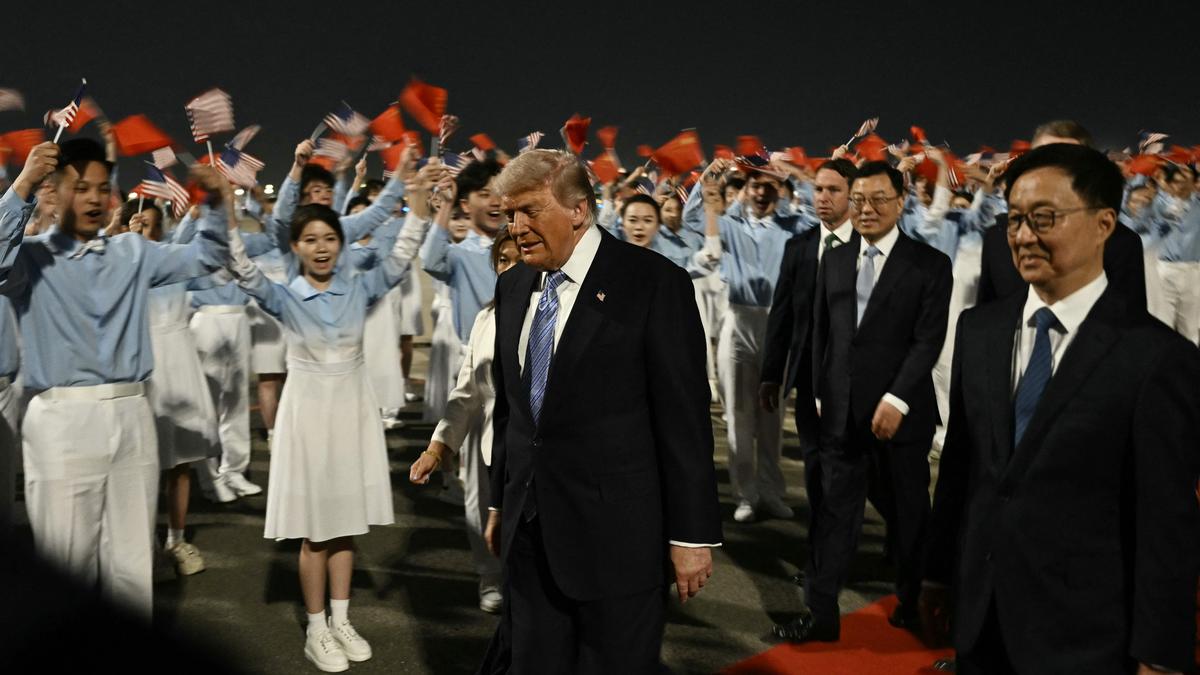
Donald Trump stepped into the frame. Beside him, Melania Trump wrapped her coat tighter against the November chill. Below them, a reception committee stood with military precision, flanked by a crowd of schoolchildren waving miniature American and Chinese flags. They jumped and cheered with a synchronized enthusiasm that only months of rehearsal can produce.
It was a display of chaoji huanying—the "super-welcome." Beijing had pulled out every stop, promising an experience that would surpass any previous state visit in the history of the People's Republic.
But stripped of the pageantry, this was a collision of two entirely different worlds.
On one side stood Trump, the brash Queens builder turned populist president, who had spent years viewing global relations through the lens of a zero-sum ledger. To him, America was losing, and China was the reason. On the other side stood Xi Jinping, the quiet, calculating architect of the "Chinese Dream," a leader who measured time not in election cycles, but in centuries.
The cameras captured the handshakes, the smiles, and the formal dinners. What they missed was the quiet panic rippling through the global economy. This was not a routine diplomatic tour. It was the opening gambit of a friction that would redefine the 21st century.
The Emperor’s Courtyard
To understand the stakes of that afternoon, you have to understand where Xi chose to take his guest first. He did not invite Trump to a sterile government building or a modern skyscraper. He took him to the Forbidden City.
For centuries, this vast complex of red walls and golden roofs was the literal center of the Chinese universe. It was the seat of emperors who viewed foreign dignitaries not as equals, but as suitors bringing tribute. By closing the ancient palace to the public for the day, Xi was making a profound statement about status, history, and continuity.
Imagine walking through those courtyard stones. They are worn smooth by the boots of imperial guards and the robes of dynasties that rose and fell while America was still a collection of colonies. Trump, a man whose aesthetic is defined by the glittering glass and gold leaf of Manhattan skyscrapers, looked genuinely fascinated as he toured the Hall of Supreme Harmony.
Over tea in the Baohe Hall, the two men exchanged pleasantries. Trump pulled out an iPad to show Xi a video of his granddaughter, Arabella Kushner, singing in Mandarin and reciting ancient Chinese poetry. Xi smiled, praising the performance as an "A-plus."
It was a masterclass in personal diplomacy. For an hour or two, the looming threat of economic warfare seemed to evaporate into the autumn air. The warmth felt real.
But outside those ancient walls, reality was waiting. The friendly banter could not obscure a stark math problem. The United States trade deficit with China had climbed to a staggering $347 billion the previous year. To Trump, that number was a direct theft of American wealth. To the factories in Shenzhen and Ohio, it was life or death.
The View from the Factory Floor
Let us look away from the emperors and the presidents for a moment to consider how this abstract trade math impacts a kitchen table in the American Midwest.
Think of a hypothetical factory manager in Ohio—let’s call him Robert. Robert runs a small plant that manufactures specialized auto parts. For a decade, his business has relied on a delicate equilibrium. He buys cheap, high-grade steel components from suppliers in Jiangsu province, assembles the final product in Ohio, and sells it to American automakers.
If Trump follows through on his campaign promises to slap massive tariffs on Chinese imports, Robert’s supply chain breaks. His costs skyrocket. He faces a brutal choice: raise prices and risk losing his domestic customers, or lay off ten guys on the assembly line who have worked for him since high school.
Now shift the lens across the Pacific to a factory in Dongguan. Meet a worker we will call Mei. She is 24, lives in a company dormitory, and sends half her paycheck back to her parents in rural Sichuan. Her entire livelihood depends on American consumers buying the electronic components she solders together for ten hours a day. If those consumers pull back because of a new tax at the US border, Mei’s factory cuts shifts. The fragile ladder her family is using to climb into the middle class suddenly loses its rungs.
This is the human face of macroeconomics. When two superpowers lock horns over trade balances, the impact does not hit the billionaires in Washington or Beijing first. It hits Robert and Mei.
Trump arrived in China carrying the grievances of thousands of Roberts. Xi met him holding the aspirations of millions of Meis.
The Art of the Deal Meets the Long Game
The core tension of the visit boiled down to a fundamental clash of philosophies.
Trump is a transactional leader. He believes in the immediate, tangible victory—the signed contract, the public announcement, the big number on a scoreboard. He wanted China to immediately buy more Boeing airplanes, more American soybeans, and more liquefied natural gas. He wanted to go home to his base with proof that his tough talk was yielding cash.
The Chinese government understood this perfectly. They prepared a massive cushion to soften his arrival: $253 billion in commercial deals and investment agreements. Companies like General Electric, Caterpillar, and Qualcomm signed lucrative memos of understanding. It was a staggering sum, designed to give Trump the grand theatrical victory he craved.
But beneath the surface, the structural issues remained untouched.
The American delegation was deeply divided on how to handle Beijing. On one side stood the pragmatists, like Treasury Secretary Steven Mnuchin, who favored stability and market access for US firms. On the other side stood the hawks, like Trade Representative Robert Lighthizer, who viewed China’s economic model as an existential threat to American technological supremacy. They weren't interested in China buying more soybeans; they wanted Beijing to stop forcing US companies to hand over their intellectual property as the price of doing business in China.
Consider the reality of how these trade deals work. A memorandum of understanding is not a legally binding contract. It is a statement of intent. It is a promise to think about buying something in the future.
The Chinese leadership is brilliant at using these non-binding agreements to buy time. They know that American presidents operate on a four-year clock. Xi Jinping, having recently cemented his grip on power at the 19th Party Congress, operates on a different horizon entirely. He was looking at China’s "Made in China 2025" plan, an ambitious blueprint to dominate global industries like artificial intelligence, electric vehicles, and robotics.
Xi was willing to buy as many American soybeans as it took to keep Trump happy in the short term, provided the United States did not interfere with China’s long-term climb up the technological ladder.
The Geopolitical Chessboard
Trade was only half the story. The air in Beijing was also thick with the scent of rocket fuel from North Korea.
Just months before Air Force One touched down, Pyongyang had conducted its sixth nuclear test and fired intercontinental ballistic missiles capable of reaching the American mainland. The rhetoric between Trump and Kim Jong Un had reached a fever pitch, with threats of "fire and fury" dominating the news cycle.
Trump needed Xi. China was, and remains, North Korea’s economic lifeline, accounting for over 90 percent of its foreign trade.
During their closed-door meetings in the Great Hall of the People, Trump pressed Xi to use his immense economic leverage to choke off oil supplies to Pyongyang and freeze its banking access. Xi nodded, agreed on the necessity of a denuclearized Korean peninsula, and promised to fully implement United Nations sanctions.
But the diplomacy here is like walking through a minefield in the dark.
Beijing fears a nuclear North Korea, but it fears a collapsed North Korea even more. If the Kim regime collapses, it creates a chaotic humanitarian crisis right on China’s northeastern border. Worse, it could lead to a unified Korea allied with the United States, bringing American troops right up to the Yalu River.
Xi had to perform a delicate balancing act: squeeze Pyongyang enough to satisfy Trump and prevent a war, but not so hard that the regime imploded. Trump seemed to sense this complexity, moderating his usual fiery rhetoric during his joint press statements with Xi. He praised the Chinese leader, stating, "I don't blame China. After all, who can blame a country for being able to take advantage of another country for the benefit of its citizens?"
It was a stunning rhetorical pivot. The man who had accused China of "raping" the American economy was now commending its leadership for looking out for their own people. The pageantry of Beijing had done its job.
When the Lights Go Out
The state dinner in the Great Hall of the People was a blur of shark fin soup alternative, traditional music, and toasts to eternal friendship. The two leaders smiled, raised their glasses, and spoke of a bright future for US-China relations.
But as the final convoy of black limousines drove away into the Beijing night, the temporary truce began to fracture.
The fundamental contradictions between a democratic, capitalist superpower and a state-directed, authoritarian economic giant could not be papered over by an expensive dinner or a tour of an ancient palace. The structural tectonic plates were shifting, and no amount of personal chemistry between Trump and Xi could stop the grinding gears of history.
Within months of this historic visit, the illusions of harmony shattered. The United States would launch a series of sweeping tariffs on billions of dollars of Chinese goods, triggering a retaliatory spiral that would disrupt global shipping, rattle stock markets, and alter supply chains from Vietnam to Mexico.
The "super-welcome" was not the start of a new era of cooperation. It was the final, elegant sunset of an old one.
The blue sky that Beijing had engineered for Trump’s arrival eventually faded back into the familiar, gray winter smog. Air Force One lifted off from the runway, climbing high above the yellow tiled roofs of the Forbidden City, leaving behind a relationship that was no longer defined by what the two nations could build together, but by how much they could endure from each other.