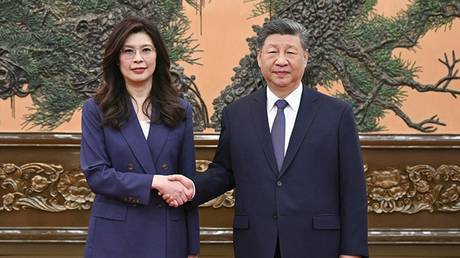
The air inside the Great Hall of the People has a specific weight. It is thick with the scent of floor wax, heavy drapes, and the silent, crushing pressure of a thousand years of history pressing against the present. When Xi Jinping stands at the end of a long, crimson rug, he isn't just a man in a suit. He is the personification of a multi-generational ambition.
Across from him stood Ma Ying-jeou. He is a man who once held the highest office in Taiwan, now traveling as a private citizen, yet carrying the psychic baggage of millions. This wasn't a meeting of two leaders. It was a meeting of ghosts and dreams.
The Geography of a Heartbeat
To understand the tension, you have to look past the maps. Don’t look at the 100 miles of water separating the mainland from the island. Look at the families.
Imagine a dinner table in Taipei. On one side sits a grandfather who remembers the chaotic retreat of 1949, the salt spray of the Taiwan Strait, and the bitter taste of a home left behind. On the other side sits his granddaughter, a digital artist who has never known a world where Taiwan wasn't a vibrant, self-governing democracy. To the grandfather, "reunification" sounds like a long-overdue homecoming. To the granddaughter, it sounds like the end of her world.
This is the "great rejuvenation" Xi talks about. It isn't just about GDP or military parades. It is a spiritual reclamation. Xi views the separation of Taiwan as a "wound" on the Chinese soul, a lingering scar from a century of humiliation by foreign powers. When he greeted Ma, he wasn't just shaking hands with a political veteran; he was reaching across that wound.
"External interference cannot stop the historic trend of reunion," Xi said. His voice was steady. Calm. The kind of calm that comes from a man who believes time is an ally, not an enemy.
The Architecture of the Meeting
The optics were curated with surgical precision. Every camera angle, every nod, every specific room choice was designed to broadcast a message: We are one family. They met in the East Hall. This is significant. Usually, foreign dignitaries are received in the North Hall. By choosing the East Hall, Beijing signaled that this was an internal affair, a domestic conversation between brothers who had simply had a long, painful disagreement.
Ma, for his part, played his role with a delicate balance. He spoke of peace. He spoke of shared ancestry. He invoked the "1992 Consensus"—that murky, linguistic tightrope where both sides agree there is only "one China" but can’t quite agree on what that means. It is a masterpiece of diplomatic ambiguity. It is the polite fiction that keeps the missiles in their silos.
But beneath the politeness, the stakes are visceral.
While the cameras flashed in Beijing, the people in Taiwan were looking at their phones, watching the news with a mix of exhaustion and anxiety. For them, these high-level summits feel like a game of chess being played over their heads. They are the pieces. They are the ones who would feel the heat if the "rejuvenation" turned from a handshake into a grip.
The Ghost in the Room
The current administration in Taipei was noticeably absent from this narrative. President Tsai Ing-wen and her successor, Lai Ching-te, represent a different path—one that views Taiwan not as a province in waiting, but as a nation already arrived.
Beijing calls them separatists. They call themselves realists.
This creates a strange, dual reality. In the Great Hall, you have the "Old Guard" talking about bloodlines and destiny. Out in the streets of Taipei, Taichung, and Kaohsiung, you have a society that has moved on. They have their own films, their own slang, their own way of breathing.
The tragedy of the "great rejuvenation" is that it requires two sides to want the same youth. Xi is looking backward to find his future. Taiwan’s youth are looking forward, terrified that the past is going to catch up with them.
The Price of a Dream
Logistics are often the enemy of poetry. To achieve this rejuvenation, the mainland has spent decades modernizing its military, encircling the island with "gray zone" tactics, and squeezing Taiwan’s international space.
Yet, during this visit, the tone was soft. Xi spoke of "mutual understanding." He offered a vision of prosperity. It was a charm offensive designed to show the Taiwanese people that the path to peace is paved with submission.
But peace is a fickle thing. If you buy it at the cost of your identity, is it still peace? Or is it just a very quiet surrender?
The visit was filled with historical sightseeing. Ma visited the Great Wall. He visited museums. He wept at the sight of ancient artifacts. These tears were real. They represent a genuine, deep-seated love for Chinese culture that many in Taiwan still feel. You can love the poetry of the Tang Dynasty and still want to vote for your own leaders. You can cherish the calligraphy of your ancestors and still want a passport that the rest of the world recognizes.
This is the nuance that gets lost in the headlines. The "opposition leader" isn't a traitor to his island, and he isn't a puppet for the mainland. He is a man caught in the gears of history, trying to find a third way in a world that only wants to offer two.
The Unspoken Echo
As the delegation moved through Beijing, the silence from the West was deafening. Washington watches these meetings with narrowed eyes. Every word Xi says about "rejuvenation" is translated by the Pentagon as "annexation." Every word Ma says about "peace" is parsed for signs of weakness.
The human element, however, isn't found in the policy papers. It’s found in the Strait itself.
There are sailors on both sides who look at each other through binoculars. They are young men, mostly. They have the same hair, the same eyes, and they likely play the same video games. If the "historic trend" Xi spoke of reaches its boiling point, these are the people who will be asked to kill each other for the sake of a map drawn in 1949.
Xi’s "great rejuvenation" is a grand, sweeping epic. It is a story of a superpower reclaiming its throne. It is a story of destiny. But stories of destiny rarely have room for the individual. They require the sacrifice of the small for the glory of the large.
When the meetings ended and the red carpets were rolled up, the fundamental reality remained unchanged. The water in the Strait is still cold. The politics are still frozen. And the people on the island are still waiting to see if their future will be written by them, or for them.
Xi and Ma shared a meal, toasted to the past, and spoke of a bright, unified tomorrow. But as the sun set over the Forbidden City, the shadows it cast reached all the way to Taipei, long and dark and full of questions that no amount of ceremony could answer.
The rejuvenation is coming, Xi says. The only question left is who will be left standing to see it.



