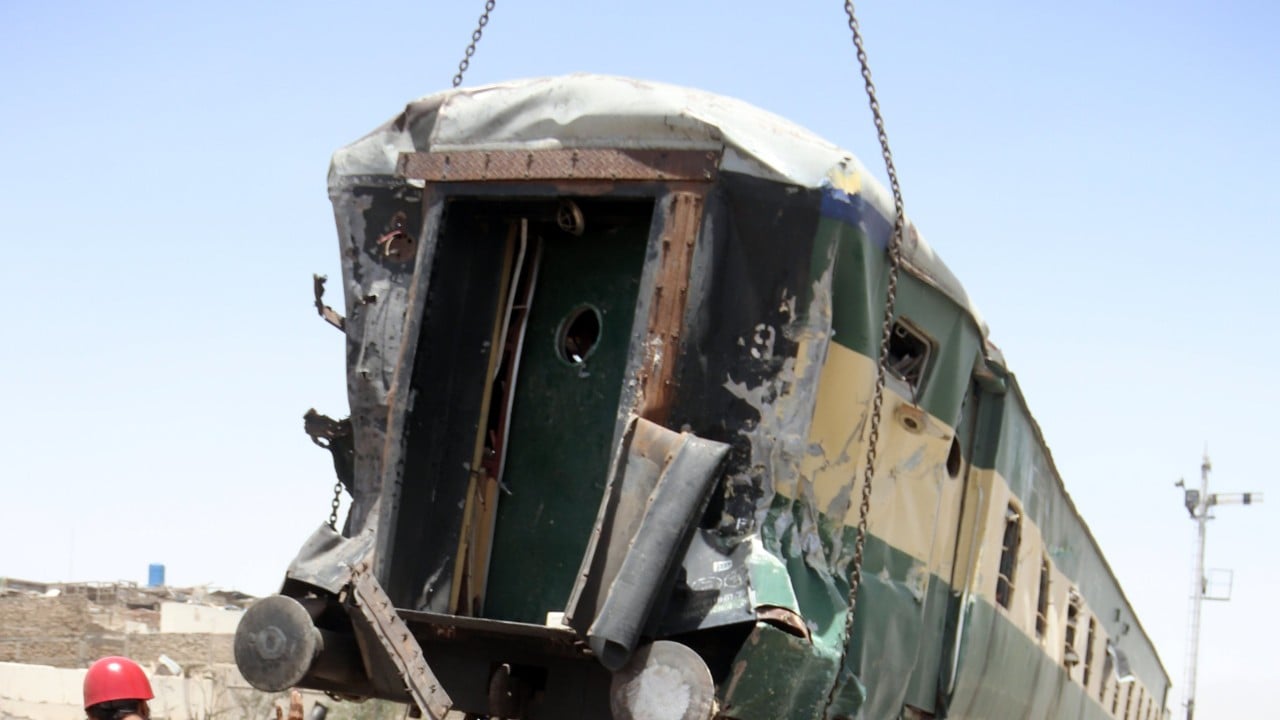
A devastating suicide car bomb attack on a passenger train in Quetta has killed at least 24 people and left more than 50 others wounded, marking a severe escalation in the conflict gripping Pakistan's southwestern Balochistan province. The blast targeted the Peshawar-bound Jaffar Express at the Chaman Phatak signal, where an explosive-laden vehicle struck a carriage carrying military personnel and their families traveling for the Eid holidays. The Balochistan Liberation Army claimed immediate responsibility for the carnage. This strike exposes a critical failure in the state's militarized security strategy, revealing that infrastructure networks have become completely indefensible against an insurgency that has shifted from remote guerrilla warfare to precise urban devastation.
The sheer mechanics of the attack demonstrate a sophisticated level of intelligence and execution. The insurgent vehicle intercepted the train at a vulnerable transit point outside the main station, piercing through multiple layers of regional security checkpoints. Carriages overturned, a fireball gutted the passenger compartments, and nearby civilian vehicles were reduced to charred frames.
While state officials immediately issued familiar condemnations promising to eliminate the threat, the reality on the ground tells a much more complicated story. This is no longer a low-intensity, peripheral conflict. It is a structural crisis.
The Strategy of Economic Strangulation
Railways in Balochistan are more than just transit lines. They represent the literal arteries of federal extraction and foreign investment in a region that remains the poorest in Pakistan despite its vast natural wealth.
By shifting targets from isolated security posts to central transport hubs and moving trains, ethnic secessionist groups are executing a deliberate strategy of economic isolation. They want to prove that the state cannot protect its own sovereign infrastructure, let alone the multi-billion-dollar foreign assets tied to the China-Pakistan Economic Corridor.
The security apparatus has responded by doubling down on kinetic force, deploying heavy troops, and launching sweeping regional operations. Yet, the persistence of these highly coordinated attacks proves that territorial control on paper does not translate to security in transit. A railway line stretching across hundreds of miles of rugged, hostile terrain offers infinite points of vulnerability. Guarding every mile is an operational impossibility.
The Human Cost of Policy Failures
The immediate aftermath in Quetta hospitals, where emergencies were declared and families searched through chaotic wards for survivors, highlights the severe human cost of this ongoing stalemate. Among the dead were soldiers heading home to their families, alongside ordinary civilians caught in the crossfire of a war that shows no signs of slowing down.
For decades, Islamabad has treated Balochistan primarily as a security problem to be managed through military deployment rather than a political crisis requiring genuine economic equity. Local grievances over the extraction of natural gas and mineral resources without local benefit have fueled recruitment for insurgent groups for generations.
Every heavy-handed crackdown by security forces tends to deepen local resentment, creating a self-perpetuating cycle of violence. The insurgents use this deep-seated anger to justify increasingly brutal tactics, shifting from symbolic sabotage to mass-casualty attacks designed to maximize political shockwaves.
The Limits of Ironclad Security
Relying entirely on armed checkpoints and intelligence operations has reached its visible limit. The state cannot simply garrison its way out of an insurgency rooted in deep structural alienation.
When a suicide car bomb can successfully strike a train carrying military personnel within the provincial capital, it reveals deep cracks in intelligence gathering and preventative security measures. Hardening stations with metal detectors and armed guards does little to safeguard trains once they leave the platform and navigate open country.
The federal government faces a harsh choice. Continuing with the current strategy guarantees a future of endless attrition, where infrastructure is perpetually rebuilt only to be torn apart again. True stability requires addressing the underlying economic disenfranchisement and governance failures that make the region a fertile ground for radicalization. Until the population sees a tangible stake in the federation's projects, the tracks leaving Quetta will remain some of the most dangerous miles of rail in the world.