Jannik Sinner did not just lose a tennis match on Court Philippe-Chatrier. He completely hit a wall. The world No. 1 and overwhelming tournament favorite was just one game away from a routine straight-sets victory against Argentina's Juan Manuel Cerúndolo. He was leading 6-3, 6-2, 5-1 under a punishing 32-degree Celsius Parisian sun when his body simply turned on him. Within an hour, a 30-match winning streak dissolved into a 3-6, 2-6, 7-5, 6-1, 6-1 second-round defeat. While superficial post-match analysis will point to a simple bad day or standard heat exhaustion, the reality of Sinner’s physical collapse exposes a much deeper, more systemic problem facing modern tennis players.
The sport has reached a point where the physical demands of baseline attrition have outpaced human biology. Sinner’s defeat was not a failure of talent or tactical execution, but an inevitable consequence of an unyielding calendar and a style of play that treats the human body like an expendable machine.
The Illusion of Invincibility
Sinner came into Roland-Garros looking entirely untouchable. He had spent the spring collecting ATP Masters 1000 titles in Indian Wells, Miami, Monte Carlo, Madrid, and Rome. With defending champion Carlos Alcaraz out of the tournament due to injury, the path to a maiden French Open title and a career Grand Slam seemed entirely clear. For the first two sets against Cerúndolo, the narrative held perfectly true. Sinner struck the ball with terrifying purity, dictating play and leaving the world No. 56 searching for answers.
Then came the middle of the third set.
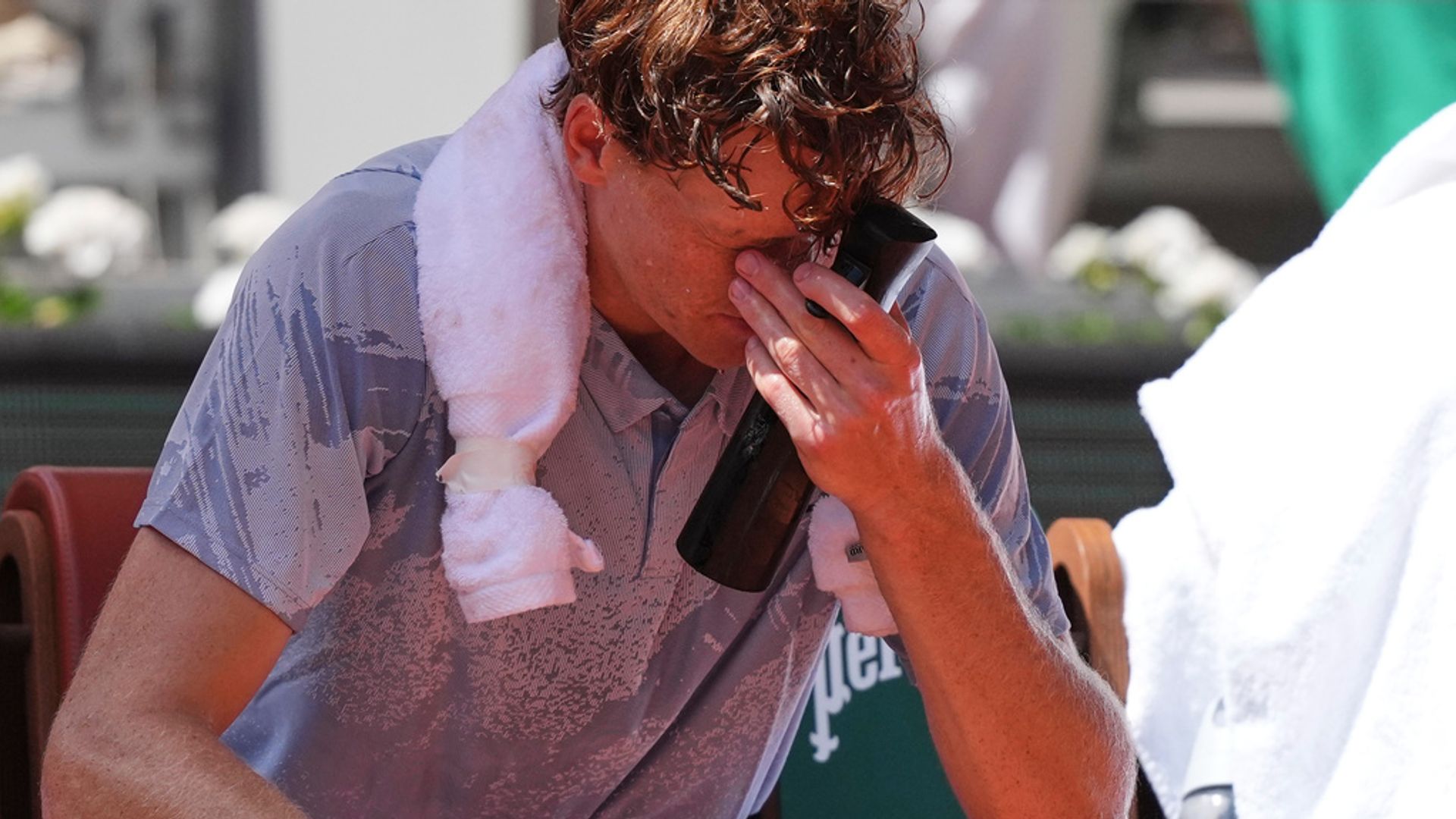
Sinner woke up on Thursday morning feeling unwell, suffering from poor sleep and low energy. In the early stages of the match, he managed to mask his condition by keeping rallies exceptionally short. But as the heat intensified and the match crossed the two-hour mark, his internal reserve ran entirely dry.
Suddenly, the top seed began doubling over between points. He grew visibly dizzy and nauseous. Serving for the match at 5-4, his legs refused to drive into the court. He requested a medical timeout, leaving the court to seek relief from the extreme heat with ice packs and mineral supplements. It did no good. Sinner lost 18 consecutive points during that crucial stretch, a statistical anomaly for a player of his caliber that signaled a complete systemic shutdown.
When the Modern Style Meets Extreme Heat
To understand why Sinner collapsed so spectacularly, one must look at how the modern game is played on clay. The contemporary baseline style requires absolute kinetic violence on every single shot. Players do not just slide and hit; they explode out of corners, absorbing massive amounts of torque through their hips, knees, and ankles.
On a sweltering afternoon in Paris, this style turns the tennis court into a furnace. When a player is already compromised by illness or lack of sleep, the body's ability to thermoregulate fails entirely.
"I struggled, starting to feel very dizzy," Sinner said in his post-match press conference. "Very low of energy. Fourth set, I let it go a little bit trying to have a bit more energy in the fifth... then it went a bit downwards. I don't remember the last time I felt this weak."
By electing to effectively tank the fourth set to save himself for a fifth, Sinner made a calculated gamble. But on clay, momentum is a heavy object to stop. Cerúndolo, sensing the physical distress across the net, did exactly what a smart clay-courter should do. He extended the rallies, hit heavy ball after heavy ball into the corners, and forced Sinner to move. The tactical shift was brutal. The Italian could no longer chase routine balls, let alone mount a counter-attack.
The Cost of Domination
This is not the first time Sinner has experienced physical fragility on the grandest stages. Similar issues arose during a grueling match at the Australian Open against Eliot Spizzirri. The underlying truth that the tennis world prefers to ignore is that Sinner’s relentless schedule over the past three months caught up with him at the worst possible moment.
Over the last 90 days, Sinner averaged a competitive singles match every 2.5 days. He won nearly all of them, but winning takes a profound toll. The human body requires periods of deep recovery to handle the demands of a five-set Grand Slam match in peak summer conditions. When a player wins everything, they lose their windows for rest.
The defeat makes Cerúndolo the lowest-ranked player to beat a men's top seed at Roland-Garros before the third round since 2000. It also leaves the men's draw completely wide open, devoid of its two primary heavyweights. For Sinner, the defeat means a painful wait to secure the Coupe des Mousquetaires. More importantly, it serves as a stark warning about the physical boundaries of the modern game. If the sport's finest athlete can be reduced to helplessness by a combination of a bad night's sleep and a hot afternoon, the current schedule is simply unsustainable.