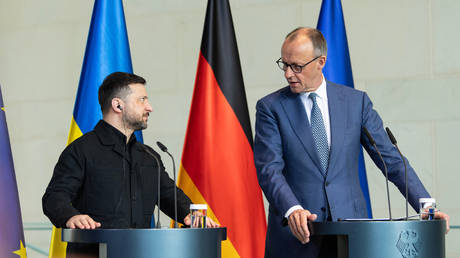
German Chancellor Friedrich Merz has blindsided European leaders with a radical proposal to grant Ukraine immediate associate membership in the European Union, bypass traditional vetoes, and extend structural security guarantees. The move, detailed in an official letter to EU Council President António Costa and Commission President Ursula von der Leyen, marks a sharp departure from Berlin's traditional institutional rigidity. By offering Kyiv non-voting seats in the European Parliament, the Commission, and even the European Court of Justice, Merz is attempting to salvage a Western diplomatic strategy that is rapidly fracturing under the pressure of a stalled war and shifting American priorities.
Behind the lofty rhetoric of European solidarity lies a cold, transactional calculation. The institutional reality is that Ukraine's stated ambition of full EU membership by 2027 or 2028 is dead. European Commissioner for Enlargement Marta Kos has already admitted as much, noting the impossibility of auditing and aligning 35 separate regulatory chapters while a country is fighting for its survival. Merz knows this. His proposal is a sophisticated diplomatic maneuver designed to manage Ukrainian expectations, pacify an increasingly impatient domestic electorate, and construct an emergency European security architecture before Washington walks away entirely.
The Mirage of Fast Track Integration
The German chancellery is presenting this plan as an innovative acceleration mechanism, but a sober look at the mechanics reveals a holding pattern dressed up as progress. Under the Merz framework, Ukrainian officials would sit in the room where decisions are made but would possess no actual power to block or pass legislation. It is an arrangement that gives Kyiv the optics of Western integration without giving it a hand on the steering wheel of continental policy.
For Volodymyr Zelenskyy, who has repeatedly rejected symbolic gestures or membership light formulas, the proposal is a bitter pill. Kyiv has maintained for years that its sacrifice on the battlefield earns it a seat at the table as an equal peer. This plan instead offers a spectator ticket in the VIP lounge.
The strategy addresses a structural flaw in the EU enlargement process. Traditionally, joining the bloc is a binary event. A country is either out, navigating decades of bureaucratic red tape, or it is in, enjoying full access to the single market and structural funds. By introducing a formal intermediate tier, Berlin wants to break this gridlock, offering a halfway house not just for Ukraine, but potentially for Moldova and the Western Balkans.
A Substituted Security Guarantee
The most volatile element of the Merz letter is the suggestion that EU member states make a political commitment to apply Article 42.7 of the EU Treaty to Ukraine. This is the bloc's mutual assistance clause, which technically obligates member states to aid a fellow member facing armed aggression.
EU Treaty Article 42.7 vs NATO Article 5
- Article 42.7: Obligates "aid and assistance by all the means in their power," but explicitly respects the specific security and defense policy of certain member states (e.g., neutrality).
- NATO Article 5: Considers an attack on one as an attack on all, backed by integrated military command structures and nuclear deterrence.
By pushing for the invocation of Article 42.7, Merz is trying to build a European containment wall without involving NATO. This is a direct response to the gridlock in Washington, where U.S. mediated peace initiatives have stalled as American foreign policy attention drifts heavily toward the conflict in Iran. With the White House distracted, Berlin is trying to position Europe as a self-sufficient security actor.
It is a high-stakes gamble with weak cards. The European Union is an economic powerhouse, not a military alliance. Forcing a mutual defense commitment into an associate membership framework runs the risk of exposing the bloc's military teeth as a bluff, particularly when key member states are already signaling profound resistance.
The Fracturing European Consensus
The ink on the German proposal was barely dry before the internal pushback began. Slovak Prime Minister Robert Fico immediately rejected the initiative, arguing that Brussels must prioritize long-standing candidate countries in the Western Balkans rather than creating bespoke, accelerated statuses for wartime states. Hungary and Poland have previously voiced deep reservations about agricultural disruptions and corruption risks associated with rapid Ukrainian integration.
Merz attempted to anticipate these objections by embedding a strict snap-back mechanism into the proposal. If Kyiv backslides on anti-corruption reforms or judicial independence, the associate status can be instantly revoked or frozen.
This safeguard does little to calm the anxieties of Western European capitals. Incorporating a country with vast, damaged infrastructure and an enormous agricultural sector into the EU framework threatens to upend the delicate balance of the single market. Under normal conditions, the integration of a state the size of Ukraine would turn current net beneficiaries of EU funding into net contributors overnight. Even a gradual, step-by-step integration into the budget, as Merz proposes, triggers immense anxiety in Warsaw, Budapest, and Bratislava.
Parallel Tracks and the Shadow of Berlin
The timing of this diplomatic offensive is not accidental. European leaders are quietly debating whether to launch an independent, parallel negotiating track with Russian President Vladimir Putin. Speculation has intensified across continental capitals regarding who could mediate on behalf of a fractured Europe, with names like Angela Merkel and Mario Draghi circulating in diplomatic circles.
Merz's proposal functions as the structural scaffolding for those potential talks. To convince Ukraine to sit down at a negotiating table where territorial concessions are openly discussed, the West must offer something monumental in return. Full NATO membership remains a red line that Washington and several European capitals refuse to cross. Full EU membership is a bureaucratic impossibility for the foreseeable future.
The associate membership model is the compromise. It provides the political cover Zelenskyy needs to show his people a concrete, irreversible tie to the West, while giving European leaders a mechanism to manage the economic and military fallout. It is statecraft born of exhaustion, an acknowledgment that the current strategy of open-ended promises has run its course, leaving Europe scrambling to build an institutional fortress out of compromises.