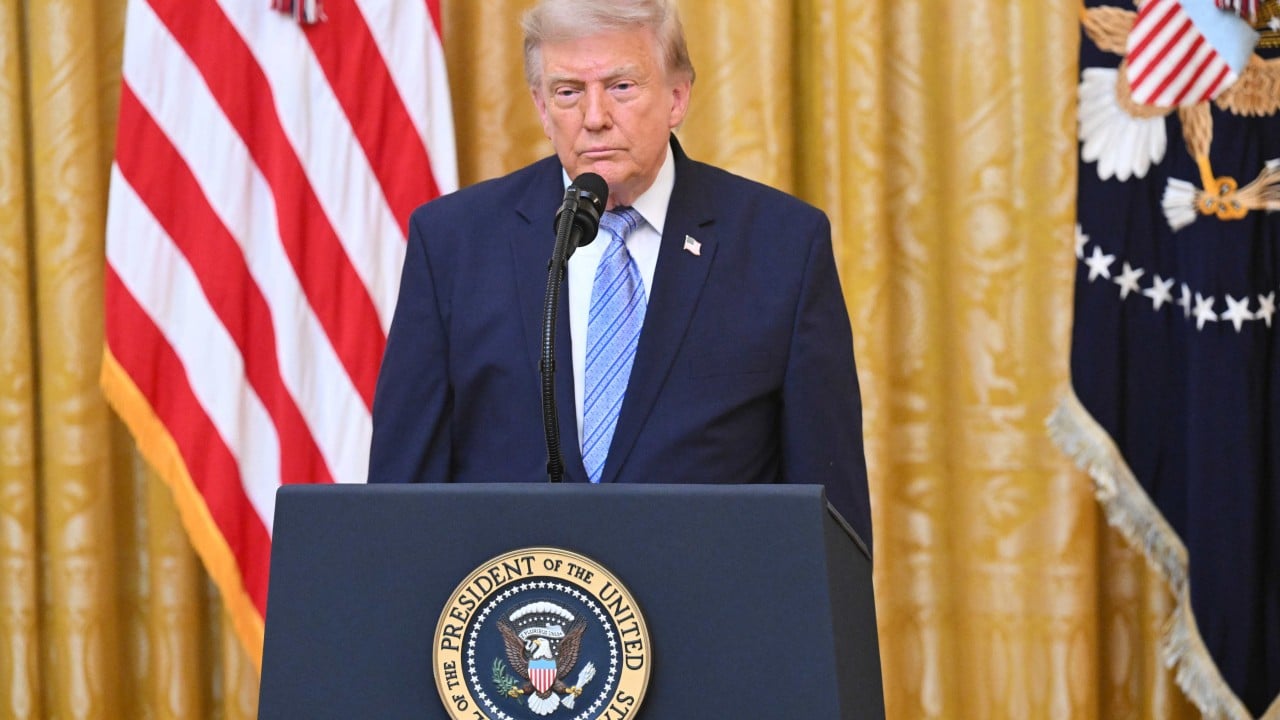
When Donald Trump took to prime-time television to declare that Beijing weaponized 220 million stolen voter files to sway the 2020 American election, the reaction across Chinese digital platforms was not panic or outrage. It was amusement. The viral phrase dominating Weibo and WeChat was a dry, three-word shrug: "Let them fight." This collective mockery reveals a fundamental shift in how the Chinese public views Washington. For years, state media carefully curated anti-American sentiment, but today, Chinese citizens do not even need a push from government censors to view American democratic processes as an entertaining, self-destructive theater.
Behind the dismissive memes lies a calculated geopolitical reality. By framing American political infighting as a spectator sport, both the Chinese public and the state apparatus achieve a shared objective. They neutralize Washington’s moral authority while systematically ignoring the actual substance of the security allegations.
The Anatomy of the Two Hundred Million File Accusation
The core of the recent friction stems from newly declassified documents that the White House claims offer definitive proof of foreign espionage. According to the administration, Chinese actors illicitly acquired massive troves of American voter data containing names, addresses, and registration details. To an outside observer, this sounds like the blueprint for a sweeping covert operation. To those familiar with the mechanics of political campaigns, the reality is far more mundane.
American voter files are not highly guarded state secrets. Political consultancies, marketing firms, and advocacy groups purchase these identical lists every election cycle to target advertisements. National intelligence assessments have long established that Chinese security agencies harvest public and semi-private information globally. They do this to build predictive models, map out political structures, and understand foreign populations. Gathering data is an act of routine espionage, not an act of electoral sabotage.
The distinction matters because it exposes the gap between political rhetoric and intelligence realities. The declassified CIA documents themselves explicitly noted that while Beijing holds the capability to interfere, it lacked the intent to directly alter vote counts or manipulate the technical infrastructure of the election. When a political leader translates routine, systemic intelligence-gathering into an ongoing act of war, it provides the perfect ammunition for foreign adversaries looking to discredit the entire system.
The Popcorn Eating Mentality as a Tool of Statecraft
In Chinese internet culture, the concept of eating popcorn while watching a crisis unfold is an established coping mechanism and political stance. When American institutions clash, Chinese netizens view it through the lens of historical karma. The state-run media does not need to manufacture fake news when the raw footage of American political polarization provides a more compelling narrative than any propaganda script could manage.
This passivity is highly functional for the ruling party in Beijing. In the past, Chinese authorities had to work hard to convince their citizens that Western-style democracy was unsuited for the country. Now, the American political system does the heavy lifting for them. Every contested election, every congressional deadlock, and every allegation of a deep-state conspiracy serves as a living advertisement for the stability of authoritarian governance.
The online commentators cheering on the chaos are not necessarily blind state loyalists either. Many are highly educated, middle-class professionals who simply look across the Pacific and see a system that appears increasingly unstable. They compare the predictable, long-term infrastructure planning of their own government with the wild policy swings of alternating American administrations. The conclusion they reach is pragmatic rather than ideological. They prefer the predictable flaws of their own system over the unpredictable volatility of a fractured democracy.
The Limits of the Non Interference Doctrine
Beijing official policy has maintained a strict public line for decades. The Foreign Ministry regularly states that China never has and never will interfere in the internal affairs of other nations. Following the latest accusations, spokespeople immediately dismissed the claims as groundless fabrications designed to score domestic political points.
"China has no interest in the US election and has never interfered in it."
— Lin Jian, Chinese Foreign Ministry Spokesperson
This diplomatic shield allows Beijing to take the high road on the world stage while its domestic internet lampoons the West. Yet, the claim of total non-interference is a convenient fiction. While Chinese hackers may not be changing individual votes in digital voting machines, their influence operations are well-documented. The strategy is not to favor one candidate over another, but to widen the existing cracks in American society.
Instead of creating fake narratives from scratch, foreign influence campaigns amplify the arguments that Americans are already having with each other. They boost racial tensions, exacerbate economic anxieties, and share conspiratorial content from both sides of the political aisle. The goal is simple. A superpower consumed by internal culture wars and institutional distrust is a superpower that cannot effectively project power abroad or mount a coherent defense of its geopolitical interests.
The Economic Calculations Behind the Digital Snark
While social media users laugh at the political friction, Chinese economic policymakers are watching with a distinct sense of unease. The humor on the surface masks a deeper anxiety about the future of global trade. Washington may be divided internally, but hostility toward Beijing remains one of the few issues that commands absolute bipartisan consensus.
====================================================================
               AMYGDALA VS. WALLET: THE TWO FACES OF CHINA
--------------------------------------------------------------------
Online Consumer Sentiment       | Celebrates American division; enjoys
                                | the spectacle of political chaos.
--------------------------------------------------------------------
Corporate Executive Reality      | Fears unpredictable tariff spikes;
                                | struggles with supply chain shifts.
====================================================================
For Chinese manufacturers and technology firms, the constant invocation of a Chinese threat in American political speeches translates directly into economic pain. It means sudden export restrictions, unpredictable tariff increases, and heightened scrutiny on international investments. The domestic audience might enjoy the spectacle of an American president arguing with his own intelligence agencies, but the business community knows that a volatile Washington is fundamentally bad for the bottom line.
This creates a paradox within Chinese society. The public celebrates the perceived decline of American power, yet the country’s economic health remains deeply intertwined with the stability of the American consumer market. If the political system in Washington truly fractured to the point of structural failure, the resulting global economic shockwave would hit Chinese factories and supply chains instantly.
The Long Road to Disillusionment
To understand how Chinese public opinion arrived at this point of deep cynicism, one must look back several decades. In the late twentieth century, the American model held a powerful allure for younger, urban Chinese citizens. The economic freedom, cultural exports, and technological dominance of the West were viewed as benchmarks to emulate.
That admiration eroded over time. The turning point was not a single event, but a steady accumulation of global missteps. The financial crisis of 2008 severely damaged the reputation of Western economic stewardship. Subsequent military interventions abroad and deepening polarization at home further dismantled the image of Washington as a competent global leader.
By the time the global pandemic arrived, the shift in perspective was complete. The domestic audience saw an American government unable to coordinate a basic public health response, followed by a highly contested transition of power that culminated in political violence. The old respect vanished, replaced by the amused detachment visible on social media platforms today.
The current accusations regarding voter data are simply the latest episode in a long-running television series that the Chinese public has been watching for years. They do not look at the declassified documents and see a grave threat to international norms. They look at the situation and see a political establishment that needs an external scapegoat to explain its own internal vulnerabilities.
The ultimate danger for Washington is not that China is actively sabotaging its democratic processes. The danger is that those processes are losing their legitimacy entirely in the eyes of the rest of the world. When an adversary no longer fears your power, but instead views your internal governance as a form of comic relief, the traditional tools of deterrence lose their edge. The political shouting matches in Washington may win short-term domestic votes, but they are costing the country its long-term credibility on the global stage.
The real victory for Beijing does not require a single modified ballot. It is achieved every time an American citizen loses faith in the integrity of their own vote, and every time a foreign observer sits back, opens a social media app, and tells the world to just let them fight.
Trump Speech on Election Security This video provides the full context of the prime-time address that triggered the wave of mockery on Chinese social media platforms.