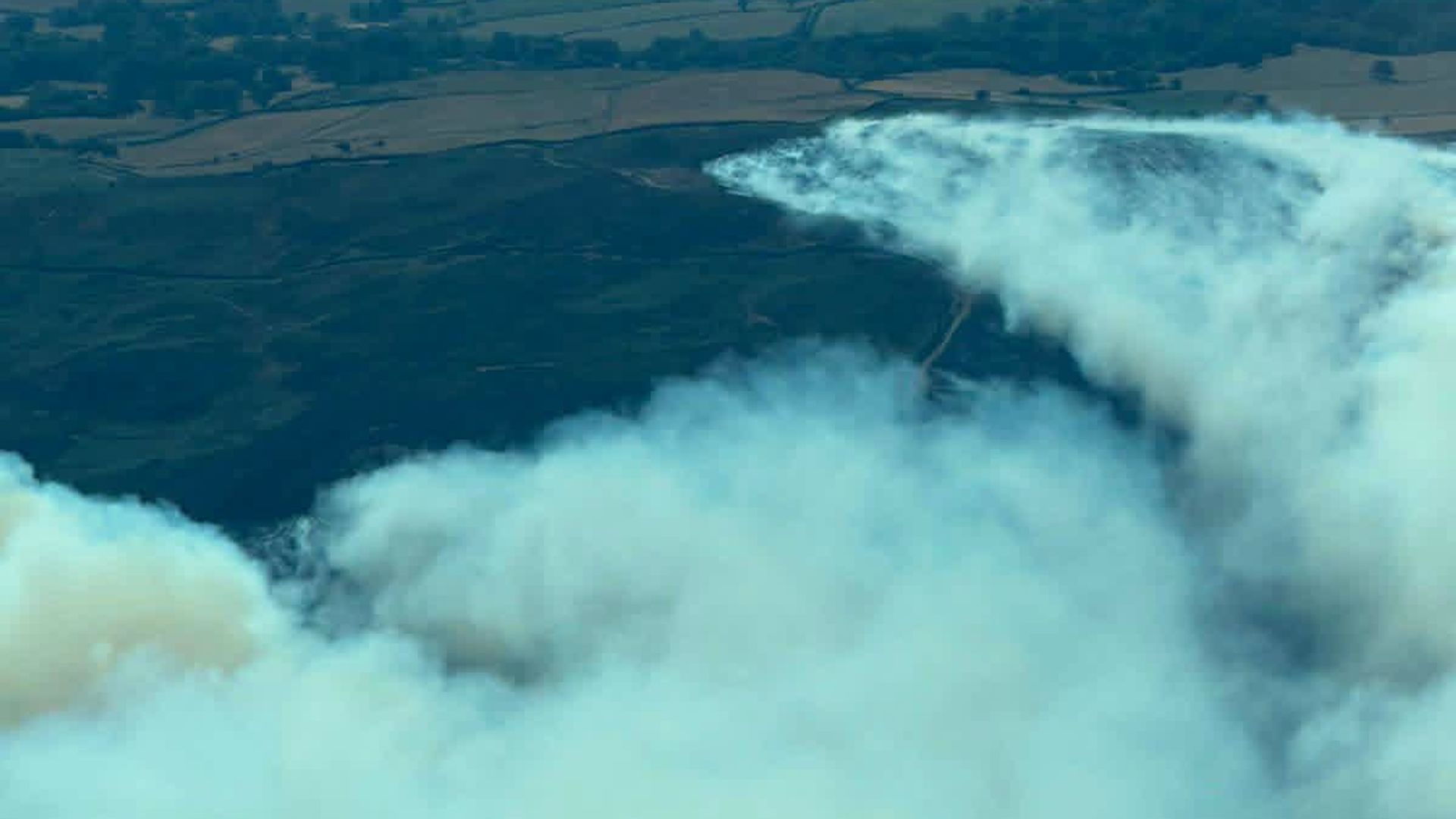
When emergency services declared a major incident over the wildfire tearing through Conwy Mountain in North Wales, the official response followed a familiar, well-rehearsed script. Evacuation orders were issued, residents were told to seal their windows, and the public was urged to stay away from the smoke-choked Sychnant Pass.
But beneath the standard emergency bulletins lies a terrifying reality that authorities are desperate to downplay. The United Kingdom is completely unprepared for the reality of extreme wildfires, treating structural, climate-driven disasters as isolated summer anomalies. As heatwaves regularly push temperatures past 30 degrees Celsius, the country is facing a systemic ecological breakdown that our emergency infrastructure was never designed to handle. For a closer look into this area, we recommend: this related article.
The fire in North Wales is not a freak accident. It is the predictable outcome of an emergency response framework that remains stubbornly reactive, underfunded, and intellectually blind to the changing nature of British weather.
The Myth of the Green and Pleasant Land
For generations, the British public has viewed wildfires as something that happens elsewhere. We watch news footage of burning hillsides in southern Europe, California, or Australia, convinced that our damp, temperate climate protects us. That protection no longer exists. For additional context on the matter, detailed reporting can be read at Reuters.
The data paints an undeniable picture of escalation. The preceding calendar year broke every historical metric, registering as the worst wildfire season in British history. Over 47,000 hectares of land burned across the nation, obliterating the previous records set just a few years prior. This is no longer an occasional bad summer. It is a fundamental shift in the baseline of British environmental risk.
The core of the problem rests in the soil and the vegetation. When sustained heatwaves hit the British Isles, the moisture levels in gorse, bracken, and peat drop to critical levels. The ground turns into a massive tinderbox. When an ignition event occurs—whether through a discarded disposable barbecue, a spark from a rail line, or deliberate arson—the resulting blaze behaves with an intensity that leaves traditional firefighting tactics useless.
Fire crews on Conwy Mountain found themselves fighting a mountain blaze in topography that mimics alpine or Mediterranean fire zones, yet they are equipped largely with tools designed for urban house fires and localized grass fires. The gap between the threat we face and the tools we possess is widening every year.
The Extinction of Funding and the Rise of Risk
To understand why these blazes are getting out of hand, one must look at the balance sheets of regional fire and rescue services over the last two decades. Investigative analysis of service budgets reveals a grim trajectory of austerity. Frontline firefighter numbers have been cut systematically, stations have closed, and specialized wildfire training has been relegated to an afterthought in all but a few counties.
A Fragmented Defense Against a Borderless Threat
The British emergency services framework is fundamentally localized. Each county or region operates its own fire service, managing its own budget and equipment procurement. While mutual aid agreements exist, a large-scale wildfire does not respect administrative borders.
Consider what happens when a major incident is declared. Resources are pulled from surrounding towns, leaving urban areas vulnerable. Firefighters trained primarily to extract casualties from car crashes or extinguish kitchen fires are suddenly dropped onto a steep, smoke-blinded hillside with hand tools, trying to beat back a fire front moving at the speed of the wind.
- Equipment Deficits: Most UK fire services lack heavy-duty off-road tankers capable of carrying significant water loads across rough terrain.
- Air Support Deficiencies: Unlike Spain, France, or Greece, the UK has no dedicated national fleet of water-bombing aircraft or heavy helicopters. We rely on private contractors or ad-hoc arrangements that take hours, sometimes days, to mobilize.
- Tactical Training Gaps: Specialized wildfire units exist only in small pockets, leaving the vast majority of personnel to learn on the job during active crises.
This structural fragmentation means that when a fire like the one at Sychnant Pass breaks out, the response is chaotic by default. It relies on the raw bravery of undermanned crews rather than a coordinated, technologically superior strategy.
The Peatland Time Bomb
The conversation around wildfires frequently focuses on the destruction of property and the immediate threat to human life. This focus misses the true ecological catastrophe occurring beneath the surface.
The UK holds a significant portion of the world's blanket peat bogs, particularly across Scotland, Northern Ireland, and the uplands of England and Wales. These peatlands are massive carbon sinks. When healthy and wet, they store more carbon than all the forests of the UK and France combined. When they dry out and catch fire, they transform from carbon sinks into massive carbon bombs.
The historic Dava Moor fire in Scotland demonstrated the terrifying mechanics of this transformation, where a single megafire released the equivalent of a year's worth of regional fire emissions in a matter of days.
Peatland Wildfire Cycle:
[Sustained Heat/Drought] -> [Peat Dries Out] -> [Surface Ignition] -> [Deep Subterranean Burn] -> [Massive CO2 & Black Carbon Release]
When a fire gets into the peat, it does not just burn the surface vegetation. It eats its way underground. A subterranean peat fire can smolder for weeks, surviving rainstorms and surface dampness, only to flare up again yards away when the wind shifts. Extinguishing a deep peat fire requires millions of gallons of water poured directly into the ground, a logistical impossibility on remote, roadless hillsides.
The black carbon and soot kicked up by these fires travel thousands of miles, actively accelerating global warming and degrading air quality for millions of citizens long after the visible flames have been doused.
The Failure of Regulation and Public Ignorance
If the structural response is broken, the preventative framework is practically nonexistent. Walk into any major supermarket during a British summer wave, and you will find stacks of cheap, disposable barbecues prominently displayed near the entrance. These single-use foil trays are responsible for an overwhelming percentage of our most destructive upland fires.
While some local authorities have attempted to introduce public space protection orders to ban these items in high-risk zones, enforcement is a farce. A handful of underpaid park rangers cannot patrol thousands of acres of open moorland and mountain trails.
Furthermore, the legal penalties for starting a wildfire through negligence remain laughably minor. Unless deliberate arson can be proven beyond a reasonable doubt—a notoriously difficult task in rural areas—those responsible for destroying hundreds of hectares of pristine habitat walk away with little more than a mild reprimand.
The government has continually resisted a nationwide ban on the sale of disposable barbecues, bowing to retail lobbying and a political reluctance to be seen as interfering with the British public's right to enjoy the countryside. This political cowardice carries a direct cost, measured in scorched earth, dead livestock, and millions of pounds of taxpayer money spent extinguishing preventable blazes.
Rebuilding the Frontline From the Ground Up
Fixing this crisis requires a complete rejection of the current localized, reactive model. We cannot keep relying on local fire chiefs to declare major incidents when they run out of trucks.
A dedicated National Wildfire Agency must be established, operating outside the constraints of local council budgets. This agency needs its own fleet of all-terrain vehicles, specialized heavy equipment, and a permanent contract for aerial firefighting support throughout the peak high-risk months.
More importantly, land management practices must be revolutionized. For decades, the debate over upland management has been dominated by commercial interests, particularly grouse moor estates that utilize rotational burning to encourage new heather growth. The science is increasingly clear that this practice dries out the underlying peat, making the land vastly more susceptible to catastrophic, uncontrollable wildfires during periods of extreme heat.
Rewilding efforts, blocking drainage ditches to re-wet the peatlands, and restoring natural deciduous woodlands can create natural firebreaks across the British countryside. These interventions require long-term funding and a willingness to confront powerful rural landowning lobbies.
The smoke rising from Conwy Mountain is a warning sign written across the sky. The climate has changed, the terrain has changed, and the fires have changed. The only thing that remains frozen in the past is our strategy for fighting them. If we do not fundamentally alter our approach to land management and emergency funding immediately, the green pastures that define the British identity will spend every subsequent summer turning to ash.