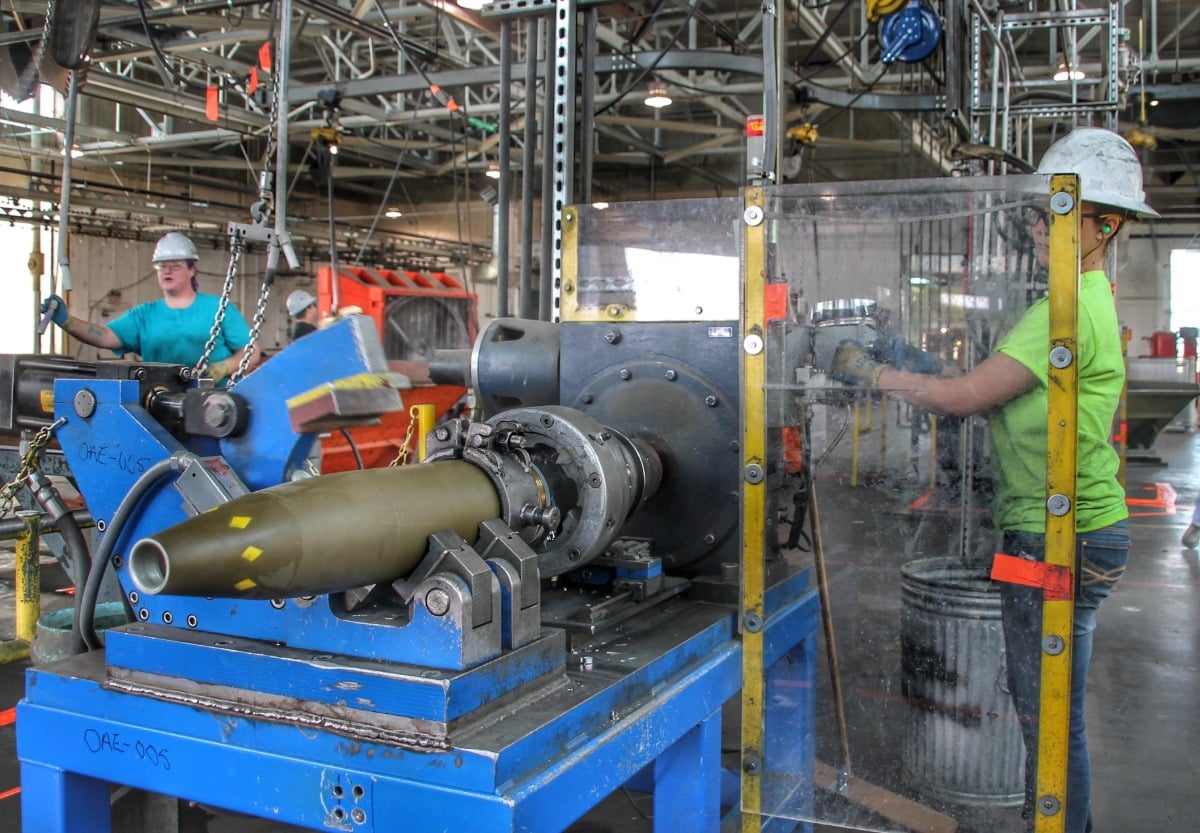
The U.S. Army just quietly locked down a $2.3 billion, 20-year contract with Day & Zimmermann to manage, maintain, and modernize the Hawthorne Army Depot in Nevada. On its face, the defense press treated the announcement as standard Pentagon business. A legacy contractor keeping the keys to a vital logistics hub until 2046.
But looking at this massive deal as just another routine operations contract misses the entire structural crisis currently facing America's defense industrial base.
Hawthorne is not just a collection of storage lockers in the desert. It is the largest ammunition depot on earth, spanning nearly 150,000 acres and crammed with more than 2,000 hardened bunkers. It acts as the ultimate shock absorber for America's conventional military power. When global shipping lanes freeze or major conflicts erupt, Hawthorne is the reservoir the military relies on to maintain a continuous flow of munitions.
The decision to award a 20-year firm-fixed-price contract to a single operator reveals a deeper reality. The Pentagon is actively scrambling to rebuild a crumbling, century-old network of government-owned, contractor-operated facilities. This massive infrastructure is currently buckling under the dual pressures of intense global supply demands and decades of systemic neglect.
The Fragile Illusion of the Contractor Operated Depot
The American military relies on a unique structural hybrid known as the Organic Industrial Base. The government owns the land, the buildings, and the raw explosive materials. Private defense corporations, however, run the actual operations. At Hawthorne, Day & Zimmermann handles everything from physical security and fire protection to the highly sensitive work of munitions demilitarization and logistics.
This dynamic creates a profound structural tension.
+-----------------------------------------------------------------+
|               THE GOCO STRUCTURAL TENSION                       |
+-----------------------------------------------------------------+
|  PENTAGON MOTIVATIONS             |  CONTRACTOR MOTIVATIONS      |
|  - Surge capacity on demand       |  - Predictable profit margins|
|  - Extreme safety compliance      |  - Low fixed overhead        |
|  - Long-term infrastructure care  |  - Short-term labor efficiency|
+-----------------------------------------------------------------+
Private contractors operate on thin margins and short-term horizons, while the facilities they manage require multi-decade, capital-intensive investments. When the Army requests sudden, massive industrial surges to supply foreign partners or restock domestic reserves, these private entities are forced to rapidly scale up operations inside facilities that frequently feature aging production tech and deteriorating infrastructure.
By locking Day & Zimmermann into an agreement that runs through 2046, the Army Contracting Command is attempting to force stability onto an unstable system. The firm-fixed-price structure means the contractor bears the financial risk of cost overruns. Yet, if inflation spikes or the labor market in rural Nevada tightens significantly, the contract could quickly become a financial burden, leading to deferred maintenance and operational friction.
The Logistics Crisis Hiding in the High Desert
The strategic reality of modern warfare is that the military with the most resilient supply chain wins. For decades, the Pentagon prioritized efficiency over redundancy. It optimized its logistics networks for low-intensity, predictable conflicts.
The immediate result was a lean, brittle pipeline.
Hawthorne's primary mission is to store conventional munitions and manage the safe disposal of obsolete ordnance. But you cannot easily modernize a site that handles millions of pounds of high explosives. Upgrading its infrastructure requires specialized tools, specialized talent, and slow, deliberate engineering processes.
Consider a hypothetical example of modernizing an explosive storage bunker. In a typical commercial warehouse, integrating autonomous inventory tracking and climate sensors takes a few weeks. At a facility like Hawthorne, a single static spark can cause a catastrophic detonation. Every sensor must be intrinsically safe, every network line heavily shielded, and every construction worker vetted through rigorous federal security clearances.
The $2.3 billion price tag is not just paying for labor to move crates. It is paying for the immense, slow overhead of executing 14 distinct performance work statements, covering everything from environmental remediation to specialized cyber security for industrial control systems.
Why Four Bids Signal a Consolidated Market
The Army noted that it received four bids for the Hawthorne contract. In the world of high-stakes defense procurement, four bids is actually considered a competitive showing. It highlights the dangerously small pool of industrial players capable of executing a contract of this scale.
Running a 150,000-acre ammunition depot requires deep, institutional experience that cannot be spun up by a standard commercial logistics firm. The pool of qualified operators is limited to a handful of massive defense conglomerates, including Day & Zimmermann, BAE Systems, and General Dynamics.
This extreme consolidation presents a persistent strategic risk for the military.
- Zero Failure Tolerance: If a primary contractor experiences systemic financial distress or operational failure, the Army has no viable backup option to step in and run the facility.
- Reduced Pricing Leverage: Limited competition over multi-decade contracts reduces the Pentagon’s ability to negotiate down long-term costs.
- Stagnant Innovation: Dominant incumbents face minimal pressure to introduce commercial logistics technologies into highly regulated military environments.
The Army's decision to stick with an incumbent like Day & Zimmermann reflects a clear preference for predictability over the uncertainty of transitioning to a new operator.
The Demilitarization Bottleneck
The public often focuses entirely on the production and distribution of military ordnance. But the back end of the ammunition lifecycle, known as demilitarization, is where the defense industrial base faces its most severe operational logjam.
Thousands of tons of conventional munitions reach their expiration date every single year. If left untended, degrading propellants become highly unstable and dangerous to store. Hawthorne is the only government-owned, contractor-operated facility in the country with a dedicated, large-scale demilitarization capability.
This means the depot must constantly balance two opposing missions. It has to act as an active, high-velocity distribution hub shipping fresh munitions out to global units, while simultaneously operating a massive, high-security recycling and destruction plant for expired ordnance.
       +---------------------------------------------------+
       |            HAWTHORNE'S DUAL MISSION               |
       +---------------------------------------------------+
       |  INBOUND: Expired Ordnance & Stable Base Storage  |
       +---------------------------------------------------+
                                |
         +----------------------+----------------------+
         |                                             |
         v                                             v
+-------------------------------+             +-------------------------------+
|    SUPPLY DEPOT OPERATIONS    |             |   MUNITIONS DEMILITARIZATION  |
| - Rapid deployment logistics  |             | - Safe explosive extraction   |
| - Global distribution links   |             | - Environmental processing    |
| - Active readiness support    |             | - Controlled destruction      |
+-------------------------------+             +-------------------------------+
This dual mandate creates a complex operational puzzle. The contractor has to allocate limited labor and security resources between processing volatile, obsolete explosives and packing modern, high-tech tactical systems for immediate deployment. If demilitarization backlogs grow too large, valuable bunker space is compromised, which directly limits the military's total storage capacity for active, combat-ready stockpiles.
Modernization Cannot Be Bought on a Fixed Price
The underlying flaw in the Pentagon's approach to this contract lies in the tension between modernization and firm-fixed-price contracting. The Army wants to transition Hawthorne into a highly automated, digitally integrated logistics node. At the same time, it wants the budgetary certainty of a capped, multi-decade financial agreement.
True industrial modernization is an open-ended process. It requires adapting to new technological developments, shifting geopolitical threats, and evolving safety mandates. When a contractor is bound to a fixed-price framework over 20 years, every unexpected infrastructure hurdle or supply chain disruption triggers a protracted round of legal and financial negotiations.
If the Army genuinely wants to modernize its largest ammunition depot, it cannot simply hand over a check and look away for two decades. It will have to actively co-invest in the underlying physical infrastructure, taking on a share of the financial risk to ensure Hawthorne can meet the demands of a volatile global landscape.