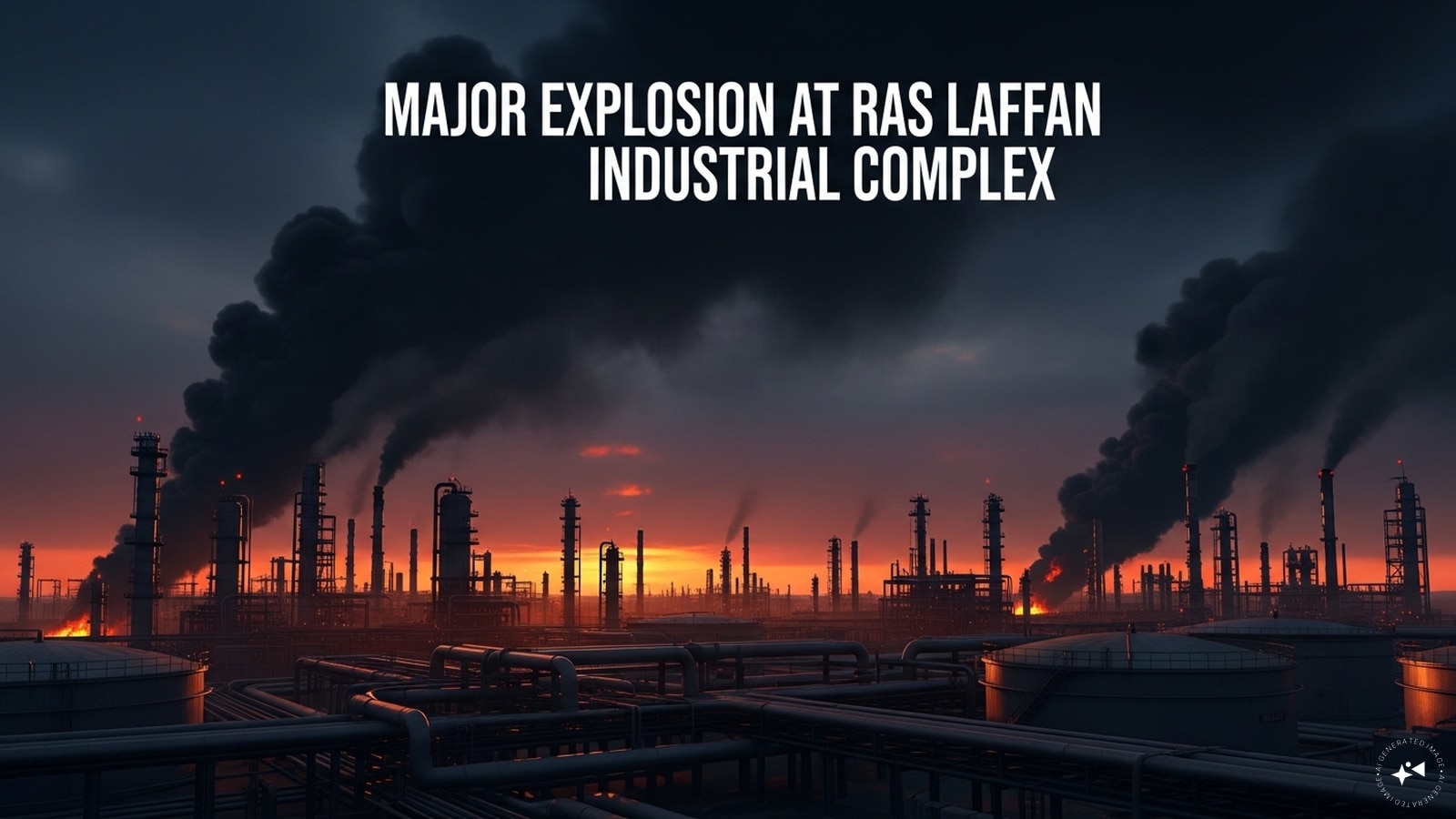
The media collective just collective-shat its pants over Qatar's Ras Laffan industrial complex.
"Major explosion." "Supply chain crisis." "Global energy panic."
The headlines write themselves because fear sells clicks to anxious traders who don't know the difference between an upstream manifold and a downstream cracker. They see a plume of smoke on a smartphone video and immediately project a winter of cold European homes and soaring LNG prices.
QatarEnergy called it an "operational incident." The press mocked the phrasing as corporate doublespeak designed to hide a catastrophe.
The press is wrong.
Calling a localized thermal event an operational incident isn't a cover-up. It is a precise engineering definition. In high-pressure, world-scale petrochemical infrastructure, systems are literally designed to fail safely, vent aggressively, and isolate instantly. What looked like a terrifying disaster to an outsider was actually the physical manifestation of billions of dollars of redundant safety systems working exactly as intended.
Stop looking at the smoke. Look at the data.
The Myth of the Fragile Energy Hub
The lazy consensus states that global energy infrastructure is a fragile house of cards, where one spark can bring down the global economy.
I have spent two decades auditing asset integrity for major energy infrastructure projects across the Middle East and the North Sea. I have seen what happens when things actually go wrong. When a system genuinely fails, you don't get a controlled shutdown and a brief press release. You get weeks of force majeure declarations and infrastructure melt.
Ras Laffan is the beating heart of global LNG, processing production from the massive North Field. If the facility were as brittle as the doom-mongers claim, the global market would have convulsed instantly. Instead, the cargo loading schedules barely blinked.
Why? Because modern mega-complexes are built on a philosophy of absolute decoupling.
Anatomy of an Engineered Failure
When an anomaly occurs in a high-pressure environment, the objective is never to keep the machine running at all costs. The objective is to kill the section, isolate the hydrocarbons, and dump the pressure.
- Emergency Depressurization (EDP): Automated systems blow down the affected lines in seconds, routing gas to the flare stacks or designated containment areas. This looks like a massive fire. To the untrained eye, it looks like the plant is burning down. To an engineer, it means the pressure is leaving the vessel before the vessel leaves the structural foundations.
- Segmented Isolation: Ras Laffan operates on a modular train system. Train 1 doesn't care if Train 2 has an issue. They are physically and operationally segregated by automated isolation valves that slam shut faster than a human can blink.
- Redundancy Depths: Critical systems have $N+1$ or even $N+2$ redundancy. If a primary processing element suffers a thermal excursion, the load transfers.
The market panics because it assumes an explosion equals a total system failure. The reality is that the explosion is often the safety valve preventing a systemic collapse.
Dismantling the Panic
Let us address the questions flooding the financial terminals, using a dose of operational reality to correct the flawed premises.
Will this incident cause a global LNG supply shortage?
No. The assumption that a single localized incident halts an entire export hub betrays a fundamental ignorance of how LNG liquefaction works. Ras Laffan’s total capacity spans multiple massive production trains. Unless there is a catastrophic failure of the common marine export berths—which did not happen—liquefied gas keeps moving from storage to hull. The global supply chain has built-in buffers, namely floating storage and regasification units (FSRUs) and linepack, specifically to absorb minor operational hiccups without skipping a beat.
Why do energy companies minimize explosions as "operational incidents"?
Because accuracy matters more than optics. To the public, "explosion" implies an uncontrolled, destructive event that threatens the viability of the entire asset. To an industrial operator, an unexpected ignition within a confined or vented space is a specific risk factor managed by safety layers. Calling it an explosion creates macroeconomic panic; calling it an operational incident correctly categorizes it as a localized deviation from normal operations that the facility's internal response teams are equipped to handle.
The Trillion-Dollar Illusion of Absolute Safety
Here is the uncomfortable truth that ESG consultants and corporate public relations teams refuse to admit: Zero risk is a lie.
If you process hundreds of millions of standard cubic feet of gas per day at pressures exceeding 100 bar and temperatures below -160 degrees Celsius, physics will occasionally fight back. The goal of a world-class operator is not to achieve an impossible state of perpetual perfection. The goal is to build an architecture where minor failures cannot cascade into systemic disasters.
Consider the baseline math of asset reliability. We use the formula for reliability over time:
$$R(t) = e^{-\lambda t}$$
Where $\lambda$ represents the failure rate. In a facility with millions of components, $\lambda$ is never zero. Components will degrade. Seals will weep. Sensors will glitch.
The contrarian perspective isn't that we should tolerate sloppy operations. It is that we must judge an organization by its resilience, not its luck. QatarEnergy has spent the last three decades investing in automated safety instrumented systems (SIS) conforming to Safety Integrity Level 3 (SIL 3) standards. That investment paid off. The incident was contained, the personnel were protected, and the infrastructure remained intact.
Stop Fixing the Wrong Variable
Corporate boards routinely make the mistake of over-correcting after a highly visible, low-impact incident. They add layers of bureaucratic oversight, mandate endless safety stand-downs, and drown their engineers in paperwork.
This creates a false sense of security while actually increasing risk.
When you overload an operational team with administrative compliance, you distract them from the physical reality of the plant. They spend more time filling out risk assessment matrices than looking at vibration analysis data or checking ultrasonic thickness measurements on piping.
The lesson of Ras Laffan isn't that Qatar needs tighter regulations or more oversight. The lesson is that their engineering standards worked. The physical barriers held. The automation succeeded.
If you run an industrial enterprise, stop trying to engineer a world where nothing ever sparks. Build a world that can take a hit to the jaw and keep walking. Treat the noise of the media as the irrelevant static it is, look at your containment metrics, and let your engineers do their jobs.