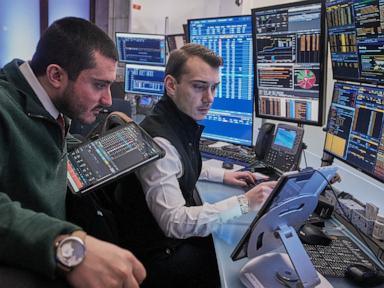
At 8:58 AM in Tokyo, the fluorescent lights of a trading floor hum at a frequency you only notice when everyone stops talking.
Kenji—a composite character built from the dozens of mid-tier institutional traders working the desks between Marunouchi and Central—is staring at three monitors. His coffee has gone cold. Outside his window, rain beads against the glass, blurring the neon signs of Shinjuku into smears of bruised purple and amber. On his primary screen, the Nikkei 225 flickers green, then red, then a flat, indecisive gray. Across the East China Sea, the Hang Seng is dragging its feet, weighed down by tech conglomerates that were supposed to be invincible six months ago. In Seoul, the KOSPI is twitching every time a rumor crosses the wire about memory chip margins.
If you read the standard wire reports this morning, they will tell you that Asian trading is mixed as worries about artificial intelligence grow.
That sentence is technically accurate. It is also completely bloodless. It reduces a profound crisis of faith—a massive, tectonic grinding of capital, human ambition, and quiet terror—into a weather report for people who don't care if it rains.
To understand why screens across Tokyo, Hong Kong, Seoul, and Taipei are flashing with such erratic, nervous energy right now, you have to look past the ticker symbols. You have to look at the ghost in the machine, and the very real bill that has finally arrived at the table.
The Architecture of a Mirage
Three years ago, the narrative was intoxicating. Silicon Valley built the brain, and Asia built the body.
If you wanted the silicon wafers etched at scales smaller than a virus, you went to Hsinchu in Taiwan. If you wanted the high-bandwidth memory stacked like microscopic skyscrapers to feed those processors, you went to Icheon in South Korea. If you wanted the precision optics, the chemical resists, the robotic assembly lines, and the server racks that turned abstract code into physical reality, you went to Japan and southern China. For months, Asian equity markets rode a tidal wave of certainty. Every earnings call was a victory lap. Every capital expenditure announcement from an American tech giant sent shockwaves of euphoria straight through the Pacific supply chain.
I remember sitting in a cramped, smoke-stained izakaya in Shinbashi two winters ago, listening to a supply chain analyst explain how the math worked. He drew a diagram on a wet paper napkin. At the top were the hyperscalers—companies with cash reserves larger than the GDP of mid-sized European nations—pouring tens of billions of dollars into data centers. At the bottom were the Asian manufacturers, collecting a guaranteed toll on every single chip, capacitor, and cooling pipe required to build the future.
"It's the California Gold Rush," he told me, tapping the soggy napkin with a chopstick. "We don't care who finds gold. We own every shovel factory on earth."
It was a seductive analogy. It made sense. Until you stopped to ask a simple, uncomfortable question: what happens if the miners dig for three years, spend every dime they have on shovels, and only find dirt?
That question is what kept Kenji awake until three in the morning. It is what is driving the erratic, split-screen personality of Asian markets today.
The Bill Comes Due
To grasp the tension gripping financial centers from Singapore to Shanghai, consider a hypothetical scenario involving a mid-sized logistics company in Osaka—let's call it Kanto Freight.
Last year, Kanto Freight spent four million dollars integrating a suite of generative AI tools into its dispatch and customs clearance operations. The pitch was irresistible: automated route optimization, instant translation of shipping manifests, predictive maintenance for their fleet. Six months in, the chief financial officer sat down to audit the return on that investment. The software worked well enough. It summarized emails nicely. It drafted polite responses to angry clients. Yet when she looked at the bottom line, shipping margins hadn't moved by a single basis point. Meanwhile, the annual licensing fees for the software—and the cloud computing costs required to run it—had quietly doubled.
Multiply Kanto Freight by fifty thousand enterprises across Asia, North America, and Europe, and you begin to see the jagged crack running right down the middle of the global economy.
Investors are waking up to a brutal asymmetry. On one side of the ledger sits the infrastructure build-out: hundreds of billions of dollars spent on data centers, power grids, and advanced semiconductors. On the other side sits actual, verifiable revenue generated by end-users paying for AI products. The gap between those two numbers isn't just wide; it is a canyon.
In the financial world, this is known as a digestion phase, a polite euphemism for a hangover. When the market realizes that the return on invested capital might take a decade instead of three quarters, capital doesn't flee all at once. It fractures. It becomes schizophrenic.
Watch how that fracture plays out across a single trading session in Asia. In Taiwan, a semiconductor foundry posts record monthly sales because orders for next-generation AI accelerators are still locked in through the end of the year. The stock ticks up. Two hours later, a major Japanese conglomerate heavily exposed to enterprise software and automation cuts its forward guidance, citing slower-than-expected corporate adoption. Its shares plunge four percent, dragging down the broader index. Meanwhile, in Hong Kong, investors wrestle with a entirely different set of shadows: tightening export controls, regulatory scrutiny, and the nagging fear that domestic tech giants are trapped in an expensive arms race they cannot monetize fast enough.
Mixed. That's the word the wire services use.
Mixed is what happens when half the room is betting on the future and the other half is quietly checking where the fire exits are.
The Invisible Weights on the Scale
If this were merely a story about corporate balance sheets and overvalued tech stocks, it would be easy enough to navigate. Markets overbuild, markets correct, life goes on. We saw it with the transcontinental railroads in the 1870s. We saw it with fiber-optic cables in 1999. The infrastructure gets built, the early investors lose their shirts, and society eventually enjoys cheap bandwidth or cheap freight.
But the anxiety pulsing through Asian trading desks right now carries heavier, darker undercurrents. There are invisible weights resting on the scale, and every trader in the region feels them even when they don't show up in a quarterly earnings report.
First, there is the sheer physicality of the bottleneck.
For years, we treated digital technology as weightless, something floating effortlessly in "the cloud." Anyone who has walked through a modern AI data center in Johor Bahru or outside Tokyo knows how absurd that metaphor is. These facilities are roaring, heat-belching industrial behemoths. They consume electricity on the scale of mid-sized cities and drink millions of gallons of water just to keep their silicon brains from melting into slag. Across Asia, utility stocks have quietly turned into proxy bets on artificial intelligence, yet the physical grid is groaning under the strain. Permitting delays, transformer shortages, and soaring energy costs are turning into hard physical ceilings on how fast this revolution can actually grow. You cannot write an algorithm to conjure a high-voltage substation out of thin air.
Second, there is the geopolitical tripwire.
Asia is not a monolith; it is a tightly wound watch where every gear depends on its neighbor, even when those neighbors are locked in fierce strategic rivalry. A chip designed in California might be etched in Taiwan, packaged in Malaysia, paired with memory from South Korea, and assembled into a server in Shenzhen. Every step of that journey now passes through a minefield of tariffs, export restrictions, and national security reviews. When a rumor circulates in Washington about new limits on high-bandwidth memory exports, the tremor hits Seoul within seconds. When Beijing hints at retaliatory restrictions on rare earth minerals like gallium or germanium—elements essential for advanced semiconductors—supply chain managers from Nagoya to Hsinchu reach for their antacids.
Try pricing that risk into a discounted cash flow model. You can't. It isn't math; it's poker played in the dark.
Third—and perhaps most unsettling—is the creeping realization that the technology itself might be hitting a wall of diminishing returns.
For the past few years, the prevailing dogma in AI research was simple: scale solves everything. Feed the model more data, give it more computing power, build a bigger cluster of chips, and intelligence will emerge automatically. That assumption fueled the greatest capital expenditure boom in modern history. Yet whispers are growing louder in engineering circles that throwing ten times more compute at a model no longer yields a tenfold leap in capability. Instead, you get marginally better poetry, slightly fewer hallucinations, and an astronomical electricity bill. If the brute-force era of AI scaling is slowing down, the entire economic justification for buying millions of hyper-expensive chips suddenly looks fragile.
Living Inside the Volatility
I won't pretend to know whether we are standing at the edge of a 2000-style dot-com collapse or simply catching our breath before the next leg up. Anyone who speaks with absolute certainty about where tech equities go from here is either selling you a fund or lying to themselves.
What I do know is what it feels like to sit inside this kind of uncertainty. It is exhausting.
In normal markets, bad news is bad news and good news is good news. When a central bank cuts interest rates, stocks rise. When inflation spikes, stocks fall. There is a rhythm to it, a comforting predictability that allows ordinary people—pension fund managers, retail investors saving for a child's university tuition, small business owners hedging currency risk—to make rational plans.
In an AI-dominated market, logic turns inside out. A company announces it is spending twenty billion dollars on new servers, and its stock drops because investors think it's burning cash. Another company announces layoffs to fund its AI transition, and its stock surges, until six months later when customers realize there is nobody left to answer the phone. Good earnings are punished because they aren't miraculous enough; mediocre earnings are rewarded because everyone braced for a catastrophe.
Look back at Kenji at his desk in Tokyo. By 11:30 AM, the morning session closes for lunch. The Nikkei is down 0.4 percent. The Hang Seng is up 0.2 percent. The KOSPI is flat. To an outsider glancing at a financial summary over breakfast in London or New York, nothing happened in Asia today. Just another quiet, sideways session.
They won't see the millions of shares that changed hands in frantic, algorithmic bursts during the opening twenty minutes. They won't see the portfolio managers quietly trimming their exposure to high-flying chipmakers and rotating into boring, unglamorous banks, railways, and consumer staples—companies that sell soy sauce, train tickets, and life insurance, things human beings actually need regardless of whether a machine can pass the bar exam.
The Shift Toward What Is Real
There is a quiet wisdom in that rotation, a kind of collective survival instinct asserting itself beneath the surface noise.
Whenever a society falls in love with a transformative technology, it temporarily forgets the difference between a tool and a miracle. Steam engines didn't eliminate the need for tracks, bridges, and timetables. The internet didn't make warehouses, delivery trucks, or human trust obsolete; in fact, it made them more valuable than ever, because once everyone has a website, the company that actually delivers the package on time wins.
We are entering that painful, necessary sobering-up period with artificial intelligence. The easy money—the phase where simply uttering the letters "A" and "I" on an earnings call added ten percent to a company's market cap—is dead. What comes next is harder, slower, and far less glamorous. It is the work of proving actual utility. It is the grind of integrating messy software into messy legacy businesses, training skeptical workers, navigating copyright battles, and figuring out how to charge a customer ten dollars for a service that costs nine dollars in electricity to run.
For the companies across Asia that supply the physical backbone of the modern world, this transition isn't an ending, though the daily stock charts might make it feel like one. Even if the wildest fantasies of Silicon Valley take twice as long to materialize, the world still needs faster memory, cleaner energy, smarter robotics, and more resilient supply chains. The factories in Hsinchu, Icheon, and Osaka aren't going dark. They are simply being forced to separate real, sustainable demand from speculative froth.
At 2:55 PM in Tokyo, five minutes before the closing bell, the rain outside Kenji's window finally stops. A thin shaft of late-afternoon sunlight breaks through the clouds, catching the wet concrete of the expressway below and turning it into a ribbon of blinding silver.
On his screen, a small green tick appears next to a mid-sized Japanese industrial manufacturer—a company that makes unglamorous, heavy-duty valves for power plants. Nobody has written a breathless magazine profile about it. It doesn't have a chatbot. It just builds things that hold pressure when the heat goes up.
Kenji clicks his mouse, locks in a modest order, and finally reaches for his cold cup of coffee.