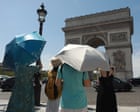
The afternoon sun hits a sixth-floor apartment in Milan, Rome, or Madrid, and something strange happens to the air. It stops moving. Outside, the street looks almost festive—café awnings striped in cream and terracotta, scooters buzzing past plane trees, tourists holding gelato cones like trophies. Inside, behind shuttered windows and plaster walls thick enough to hold a grudge, the temperature climbs past thirty-five degrees Celsius and refuses to pack its bags at dusk.
Silence. That is often how it begins when summer turns lethal in a European city. Meanwhile, you can explore similar stories here: Why Telling Mothers About Lead Paint in Ivory Coast Fails.
Scientists warn that heat killed a staggering 50,000 people across Europe’s cities over a single summer. Fifty thousand. Say the number slowly enough to hear the weight of it—not as a spreadsheet row or a chart bar in a climate report, but as fifty thousand chairs left empty at breakfast tables from Lisbon to Warsaw. Fifty thousand lives ended by an invisible pressure that rarely leaves a dramatic bruise, rarely triggers a siren, and almost never makes the front page the way a flood or a wildfire does.
We are terrible at mourning slow weather. When a river bursts its banks, we see the mud on the sofa and the water line on the wallpaper. We understand water. It has edges. It has sound. Heat has neither. It enters through the pores, thickens the blood, taxes a tired heart, clouds the judgment of an older adult who forgets to drink water until dizziness hits, and slips out of the room without a slam of the door. To understand the bigger picture, check out the detailed article by Everyday Health.
To understand why urban summers have become this dangerous, I have to step back from the headline and look at what happens inside real bodies and real streets. I have spent years reporting on extreme weather and living in cities where summer used to mean long, golden evenings that cooled down around nine o'clock when the breeze came off the river or the hills. I still remember the smell of hot asphalt cooling after a brief August shower, that sharp mineral tang rising off the pavement. Over the last decade, that evening relief has grown shorter, thinner, and sometimes nonexistent. Nights stay warm. Concrete stays hot. A body that cannot cool down at night starts the next morning already in debt.
Let’s introduce a hypothetical character to trace how this debt adds up. Let’s call her Elena, seventy-eight, living alone on the top floor of a brick building built in the 1960s without central air conditioning. Elena is not a statistic; she is a woman who still irons her linen napkins and waters a pot of rosemary on her balcony at dawn. (To be clear, Elena is a hypothetical composite created to illustrate documented physiological and urban patterns, not a specific real person.)
On day one of a July heatwave, Elena feels fine, just a little tired. By day three, the night temperature outside barely drops below twenty-six degrees. Her apartment holds onto the heat like a brick oven. Her body works overtime to cool itself: blood vessels near the skin dilate, her heart beats faster to circulate blood toward the surface, and she sweats. Sweating sounds simple, almost trivial, until you realize that cooling by evaporation requires fluids, salts, and a cardiovascular system with spare capacity. If Elena takes blood pressure medication or a diuretic, or if she simply doesn't feel thirsty because aging dulls the thirst signal, her blood volume drops slightly. Her heart has to pump harder with less fluid to move.
Think of the human body like an old car climbing a steep mountain pass in July. If the radiator is slightly clogged and the coolant is low, the engine doesn't explode immediately. First, the temperature gauge creeps toward the red. The fan whirs loudly. If you pull over in the shade and let it idle with the hood up, it recovers. If you keep pushing up the grade hour after hour without letting it cool, something gives out—a gasket, a hose, the engine block itself. That metaphor is imperfect because humans aren't machines and can't just pop the hood, yet it captures the quiet mechanics of heat strain: cumulative stress wearing down a system that was already working near its limit.
Why did this happen to 50,000 people across Europe’s cities in one summer? Because cities are heat traps built for a climate that no longer exists.
How Stone and Asphalt Turn Cities Into Ovens
Walk down any dense European street on a cloudless afternoon and you are walking through an engineered thermal battery. Asphalt is black; it drinks solar radiation. Concrete, brick, and stone store that heat for hours, releasing it slowly long after the sun drops below the rooftops. Narrow streets can block cooling breezes, while wide avenues paved without shade turn into radiating corridors. Urban planners and meteorologists call this the urban heat island effect, though "effect" makes it sound like a minor quirk rather than a daily physical reality for tens of millions of city dwellers.
Consider what happens next: a heatwave settles over a region not for twenty-four hours, but for ten days or two weeks. High pressure stalls over the continent, pushing warm air down and trapping it. During the day, the sun bakes the roofs and walls. At night, instead of radiating heat freely into a cool sky, dense buildings bounce warmth back and forth. A city can easily run several degrees warmer than the surrounding countryside at night, turning what should be a recovery window into another shift on the assembly line of exhaustion.
I sometimes doubt whether those of us who can afford air conditioning, shaded courtyards, or weekend trips to the coast truly grasp what it feels like to be trapped in a hot room without options. Even writing about it from a comfortable room with a fan humming softly makes me pause and check my own blind spots. It is easy to treat climate data as settled, clinical, and distant—until you picture someone sitting on the edge of a mattress at midnight, shirt sticking to their back, listening to traffic outside and waiting for a breeze that never comes.
Historical memory plays a trick on us here, too. For generations, European homes were designed to keep warmth in, not push it out. Thick walls, small windows in older housing stock, limited mechanical cooling—all of that made complete sense when summers were milder and winters were the main enemy of survival. We don't remodel entire cities overnight, and retrofitting millions of apartments takes money, permits, time, and political will. Meanwhile, the atmosphere has changed faster than our building codes.
The Invisible Stakes Behind a Staggering Toll
When researchers report roughly 50,000 heat-related deaths in European cities over a single summer, people naturally ask how scientists count deaths from heat when most death certificates don't say "died of hot weather."
That question goes straight to the heart of why heat is so often underestimated. Only a fraction of heat deaths involve classic heatstroke, where core body temperature soars above forty degrees Celsius and organ failure sets in rapidly. Most of the time, heat acts as the final straw on a fragile chain. A person with underlying heart disease, respiratory trouble, kidney strain, or diabetes is pushed over the edge when extreme heat forces the heart and lungs to work harder. A stroke happens. A heart attack occurs. A fall happens after a dizzy spell in a stifling hallway.
Epidemiologists use statistical modeling to see what standard death certificates miss. They compare the number of deaths that actually occur during hot spells against the expected baseline for that time of year, accounting for seasonal trends and other factors. When mortality spikes in lockstep with soaring temperatures across dozens of cities, the excess deaths tell a story that individual paperwork often blurs. It is detective work with numbers, and while models always carry margins of uncertainty, the pattern across repeated hot summers has become unmistakable.
Who pays the highest price? Not everyone equally.
Older adults sit right in the crosshairs because aging reduces the body's ability to regulate temperature efficiently and often comes with chronic health conditions and daily medications. People living alone—like our hypothetical Elena—face an extra hazard because nobody notices early warning signs like confusion, slurred speech, or unusual lethargy until hours pass. Low-income residents in top-floor flats or poorly insulated buildings often lack both financial resources and cooling infrastructure. Outdoor workers, delivery riders, and construction crews face direct exposure under brutal sun, sometimes pushing through symptoms because stopping means losing pay or falling behind schedule.
Even healthy, younger people aren't immune when exertion meets high heat and humidity. Sweat can't evaporate easily when the air is already saturated with moisture, robbing the body of its main cooling mechanism. Push hard enough in those conditions—playing a midday match, working on a roof, running without hydration—and heat exhaustion can spiral fast.
Why Familiar Habits Fail in Extreme Heat
Part of what makes modern summers disorienting is that our instincts were calibrated for a gentler world.
Take the classic impulse to throw open the windows as soon as the sun goes down or when a hot breeze blows through. If the air outside is hotter than the air inside, or if walls are scorching hot, opening windows at the wrong time can actually let more heat in or pull warm air across cool surfaces. Knowing when to open windows—early morning when outside air dips below indoor air, then closing shutters and curtains before the sun hits the glass—sounds small, yet many of us learn it by trial and error.
Then there is the myth that only drinking water matters, or that waiting until you feel thirsty is good enough. By the time thirst kicks in, mild dehydration is already underway. And heavy alcohol intake or sugary drinks during a heatwave can work against hydration, leaving people sluggish and more vulnerable as the afternoon wears on.
We also tend to think of heat danger as a story about Southern Europe alone—Spain, Italy, Greece, southern France. Yet cities further north and central are increasingly feeling the squeeze, precisely because their buildings, habits, and public health systems were built around the assumption that blistering, multi-day heatwaves were rare anomalies rather than recurring summer fixtures. When a city isn't used to extreme heat, even moderate-by-southern-standards temperatures can cause sharp spikes in illness and death.
Cooling Down Without Losing Ourselves
If the problem were purely about weather, there would be nothing to do but sigh and buy another portable fan. Fortunately, cities and communities are not helpless, even if no single fix is a magic wand.
Let's bring Elena back for a moment—again, purely as a hypothetical illustration of how layered solutions work together. Suppose her neighborhood association and city council roll out a practical summer plan before July hits. Nothing flashy. Just things that work.
First, shade and greenery return to the street level. Planting mature trees along sidewalks and in pocket parks isn't merely decorative; tree canopies block sunlight before it hits pavement and release moisture through transpiration, cooling the immediate air. Adding cool or reflective coatings to flat roofs reduces how much heat buildings absorb and pass down to top-floor apartments. Where space allows, opening public cooling centers—air-conditioned libraries, community halls, museums, or designated neighborhood rooms—gives people like Elena a place to sit comfortably during the hottest hours of the day without worrying about a sky-high electricity bill.
Second, human connection matters just as much as architecture. Check-in networks—neighbors knocking on doors, local volunteers calling older residents during heat alerts, community health workers keeping tabs on vulnerable households—catch trouble early. Sometimes saving a life during a heatwave doesn't require high technology. It requires someone asking, "How is it feeling up here today?" and bringing a jug of cold water or helping someone get to a cool room.
Third, early warning systems need teeth, not just alerts on a phone screen that people swipe away. Effective heat action plans pair weather forecasts with concrete triggers: extending pool hours, adjusting outdoor work schedules during peak heat, deploying misting stations, and giving clear, plain-spoken advice on cooling the body—like cool showers, damp cloths on the neck and wrists, staying out of direct sun at peak hours, and watching for warning signs such as dizziness, headache, nausea, rapid pulse, or confusion.
Critics sometimes argue that pushing air conditioning everywhere creates a vicious cycle: more AC units dump more waste heat into streets and strain power grids, while running on fossil fuels adds more greenhouse gases over time. That tension is real. Air conditioning can be a literal lifesaver for high-risk individuals during extreme heatwaves, yet relying on AC alone—especially powered by dirty grids—treats the symptom while feeding the root cause. Smart cooling pairs targeted mechanical relief and clean electricity with passive design: insulation, external shading, light-colored surfaces, urban greenery, and wind corridors.
When a city combines physical cooling with social care, the mood shifts. Tension eases. Instead of treating summer heat like an unavoidable tax paid in human lives, communities start treating it as a solvable design and care challenge.
What We Choose to Notice Next
Fifty thousand deaths in a single summer across Europe’s cities is not a background detail. It is a warning flare rising above rooftops, boulevards, and quiet apartment stairwells. Heat doesn't roar like thunder. It hums inside walls, presses against window glass, tests fragile hearts, and asks whether our cities—and our habits of looking out for one another—are ready for the summers arriving now.
Look out the window the next time the afternoon sun turns the pavement white and the evening air stays heavy long after dark. Think about the top floor across the street, the older neighbor down the hall, the person working outside at two in the afternoon, and the quiet rooms where heat lingers long after the sun goes down.