Silence.
That is the first thing you notice when a newsroom dies, long before the ink dries on the final press run or the servers are unplugged in the basement. It is not the dramatic, cinematic silence of a Hollywood thriller, where reporters dramatically pack cardboard boxes while rain lashes against the windowpanes. No, it is a much heavier, thicker quiet—the sound of a hundred pairs of fingers hovering millimeters above mechanical keyboards, frozen by a sudden, suffocating math problem that no journalist should ever have to solve.
If I type this word, how many years in a penal colony does it cost my editor?
In the spring of 2022, that exact equation stopped the presses at Novaya Gazeta, Russia’s most respected independent newspaper. For nearly three decades, the publication had been a stubborn, ink-stained anomaly in a country steadily sliding back into authoritarianism. Founded in 1993 using money from Mikhail Gorbachev’s Nobel Peace Prize—a fact that sounds almost mythological today—it had survived financial collapse, cyberattacks, state-sponsored smear campaigns, and the targeted murders of six of its journalists, including the fearless investigative reporter Anna Politkovskaya.
Then came the warnings from Roskomnadzor, Russia’s state communications regulator. Two official notices, delivered with bureaucratic coldness. Under Russian law, receiving two warnings within a single year gives the state the legal mechanism to strip a media outlet of its license permanently. Faced with the immediate imprisonment of its staff under sweeping new censorship laws that criminalized calling the invasion of Ukraine a "war," the newspaper announced it was suspending all print and online operations until the conflict ended.
The headlines around the world were crisp, factual, and entirely inadequate. They told you what happened. They missed the seismic shift of why it matters to anyone sitting thousands of miles away, sipping morning coffee in a democracy they assume is permanent.
The Architecture of Erasure
To understand what happened inside that Moscow newsroom, you have to understand how modern censorship actually works. Forget the dusty history books. Forget images of soldiers marching into printing houses with sledgehammers, smashing lead type and burning stacks of broadsheets in the public square. That kind of brute-force suppression is messy. It creates martyrs. It draws cameras.
Modern authoritarianism prefers the scalpel to the sledgehammer. It uses bureaucracy, tax audits, regulatory tripwires, and vaguely worded legislation designed to make self-preservation indistinguishable from obedience.
Consider a hypothetical scenario to see how this trap snaps shut. Imagine you are a chef running a beloved neighborhood bistro. The local health inspector doesn't padlock your doors or arrest you for serving bad food. Instead, the city council passes a sudden ordinance declaring that salt is now classified as a dangerous toxin, and anyone caught using the word "salt" on a menu faces fifteen years in prison. You can stay open, of course. Nobody is stopping you from cooking. You just have to pretend that the fundamental ingredient holding your entire craft together does not exist.
That is precisely what the Russian authorities did to Novaya Gazeta. The Kremlin passed legislation punishing the spread of "false information" about the Russian military with up to fifteen years behind bars. What constituted "false information"? Anything that deviated from the official briefings of the Ministry of Defense. Using the word "war" instead of "special military operation." Reporting on civilian casualties. Documenting the destruction of Ukrainian cities.
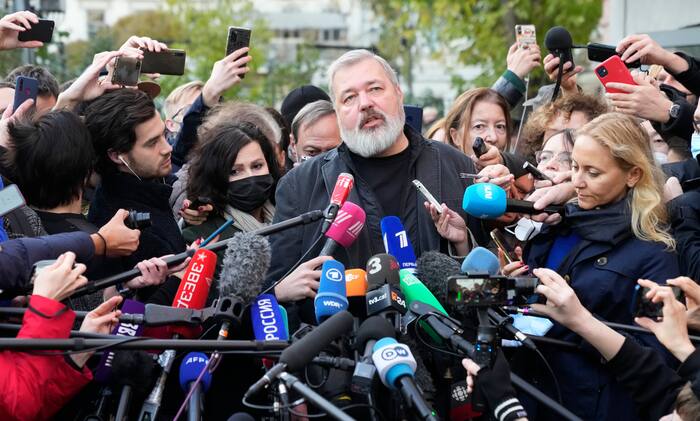
Dmitry Muratov, the newspaper’s longtime editor-in-chief—who had stood on a stage in Oslo just months earlier to accept the 2021 Nobel Peace Prize for his defense of freedom of expression—suddenly found himself presiding over an impossible choice. Continue publishing the truth, and watch his young reporters disappear into the Russian prison system. Or comply with the censorship laws, hollow out the soul of the paper, and become just another state-approved echo chamber.
He chose a third option. He turned off the lights.
The Ghost in the Newsroom
I remember the specific smell of old-school newsrooms before everything migrated to sterile cloud servers—a dense, comforting fog of burnt espresso, cheap paper dust, static electricity, and urgent human sweat. There is a kinetic energy to a place where people argue loudly about comma placement because they genuinely believe that getting the facts right might save a stranger's life.
At Novaya Gazeta, that belief was not a romantic cliché. It was a literal survival metric.
For twenty-nine years, the paper operated as a living archive of everything the Russian state wanted forgotten. When Russian forces leveled Grozny during the Chechen wars, Novaya Gazeta was there, counting the bodies the Kremlin denied existed. When the nuclear submarine Kursk sank in the Barents Sea in 2000, leaving 118 sailors trapped on the ocean floor while officials lied about rescue efforts, it was Novaya Gazeta that exposed the cover-up. They investigated high-level corruption in the Kremlin’s inner circle, documented state-sanctioned torture in Chechnya, and tracked the mercenaries of the Wagner Group long before the rest of the world knew their name.
The price was paid in blood. Igor Domnikov. Yuri Shchekochikhin. Anna Politkovskaya, shot dead in the elevator of her Moscow apartment building on Vladimir Putin’s birthday. Stanislav Markelov and Anastasia Baburova, gunned down in broad daylight steps from the Kremlin. Natalia Estemirova, abducted and executed in the North Caucasus.
Their portraits hung on the walls of the editorial office, staring down at the desks of the living. You cannot walk past those faces every morning on your way to get a cup of tea and treat journalism like a corporate content gig. Every story published in those pages carried an implicit covenant with the dead: We are still here, so your silence was not in vain.
When the second warning from Roskomnadzor arrived, that covenant collided head-on with a new reality. For decades, the unspoken rule for independent journalists in Russia had been brutal but clear: if you cross certain red lines, you might be beaten, poisoned, or killed. It was a terrifying gamble, yet individual reporters could choose to take that risk upon themselves.
The laws introduced in March 2022 changed the calculus entirely. They criminalized the institution itself. They threatened prison not just for the writer, but for the copy editor, the website administrator, the layout designer, and the driver delivering the bundles to the kiosks. Heroism is one thing when you are gambling with your own life; it becomes recklessness when you are gambling with the freedom of a twenty-two-year-old fact-checker who just started last month.
Why a Closed Paper in Moscow Matters to You
It is tempting, especially when reading international news from the comfort of a stable democracy, to file the closure of Novaya Gazeta under a familiar, fatalistic mental folder: Russia being Russia. It feels distant, tragic, and fundamentally foreign.
That instinct is dangerous.
To understand why, we have to look at what happens to a society the moment its independent press goes dark. Information does not exist in a vacuum; it functions much like oxygen in a sealed room. You never notice it while it is circulating freely. You complain about the noise, the bias, the sensationalism, the endless arguments over competing headlines. You take for granted that if someone in power steals public money, or lies about a war, or covers up a toxic spill, someone with a press pass and a stubborn streak will eventually dig up the receipts.
Remove the oxygen, and the room does not explode. People simply grow drowsy. Their vision narrows. Eventually, they stop remembering what fresh air even felt like.
In the weeks following the shutdown of Novaya Gazeta—alongside the forced closures of other independent outlets like TV Rain and Ekho Moskvy—a profound psychological shift settled over millions of Russian households. Without independent reporting to provide a counterweight, state television became the sole architect of reality.
Think about what that does to a family dinner table. Imagine a mother in a small Russian town watching evening broadcasts that show heroic soldiers liberating grateful civilians, while her twenty-year-old son, stationed across the border in Ukraine, calls her on a smuggled phone to tell her his unit is being slaughtered in a muddy trench with expired rations. Without a trusted, independent newspaper to validate the son's reality, the mother is forced into an agonizing cognitive dissonance. Whom does she believe? The sleek, authoritative news anchor backed by the entire apparatus of the state, or her own trembling child?
More often than not, across history, propaganda wins that battle inside the human mind. Not because people are stupid, but because believing a comforting lie sanctioned by the majority is infinitely less painful than accepting a terrifying truth that isolates you from everyone you love.
The Myth of the Indestructible Democracy
We often tell ourselves that censorship requires a dictatorship, that it could never take root where free speech is written into the constitution. Yet look closely at the mechanics of how Novaya Gazeta was dismantled, and the pattern becomes unsettlingly recognizable.
Notice that the Russian Constitution explicitly guarantees freedom of thought and speech. Article 29 states clearly that the freedom of mass information shall be guaranteed, and censorship shall be prohibited. On paper, Russia had the legal protections of a modern European state.
In practice, those protections meant nothing once the public grew too exhausted, too cynical, or too distracted to defend them.
Authoritarian creep rarely announces itself with a coup. It advances through small, seemingly reasonable compromises. First, independent outlets are labeled "foreign agents," forcing them to stamp a humiliating legal disclaimer at the top of every article, scaring away advertisers and starving them of revenue. People shrug; they probably do take foreign money, after all. Next, tax authorities launch endless investigations into minor accounting discrepancies. People look away; nobody likes tax cheats. Then, protesters supporting the journalists are fined, fired from their jobs, or denied university spots. The crowds shrink. By the time the regulator finally issues that second formal warning and pulls the plug, the public has already been conditioned to accept the silence as inevitable.
I have watched variations of this exhaustion play out in newsrooms across three continents. The weapons change—sometimes it is predatory lawsuits filed by billionaires, sometimes it is algorithmic suppression on social media platforms, sometimes it is state regulators wielding national security laws—but the psychological goal is always identical: make telling the truth so expensive, so exhausting, and so legally perilous that the truth-tellers simply decide to pack up and go home.
What Survives the Dark
When Novaya Gazeta suspended operations, it did not surrender entirely. Within weeks, a group of its exiled journalists launched Novaya Gazeta Europe from Riga, Latvia, determined to keep reporting from beyond the reach of Moscow’s censors. Back in Russia, Dmitry Muratov auctioned off his Nobel Peace Prize medal—raising over $103 million to help Ukrainian child refugees—and stayed behind in Moscow, walking the quiet halls of an empty newsroom, refusing to flee the country he had spent his life trying to save.
Still, a website operated from exile is not the same thing as a physical newspaper printed in the heart of the capital, dropped onto the desks of ministers, read on the morning metro by ordinary commuters who might otherwise never seek out a dissenting view. An exiled voice speaks mostly to those already looking for it; a domestic newspaper forces the entire nation to confront what it prefers to ignore.
That is the invisible loss that statistics cannot capture. You can count the closed bureaus. You can tally the blocked websites, the jailed reporters, the exiled editors. What you cannot measure are the stories that will never be written because the tipster was too afraid to make the phone call. You cannot count the corruption schemes that will flourish unchecked because no one is auditing the contracts, or the mothers who will never learn what truly happened to their sons because the official ledger says missing in action and nobody is left to ask where.
Think back to that silent newsroom in Moscow on the day the suspension was announced.
Before turning off the lights, the staff did what journalists have always done when the world around them stops making sense. They documented it. They published a brief, stark statement explaining that they were halting work until the war in Ukraine was over, sparing their colleagues from prison while refusing to print a single word of state-approved fiction.
In the corner of the empty editorial office sat the massive, heavy printing press plates from their final edition—cold slabs of aluminum etched with the last uncensored words allowed to exist on Russian soil. Outside, the Moscow traffic kept moving, the metro trains kept running, and the evening news came on right on schedule, bright and loud and entirely unbothered by the truth.