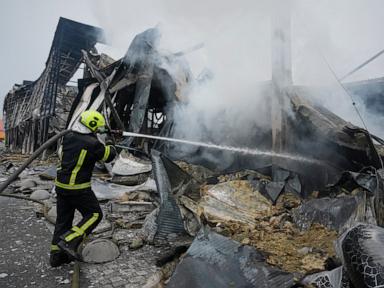
Ink barely dries on a diplomatic table before the sky remembers how to scream.
You read the headline over morning coffee. Russia pounds Ukraine with missiles and drones, hours after agreeing to peace talks. You skim the numbers—dozens of projectiles, waves of unmanned aircraft, power substations knocked dark, sirens wailing from Kharkiv to Lviv—and feel a familiar, hollow knot tighten in your chest. Another contradiction. Another broken word. Another day where diplomatic language sounds like a cruel joke told over burning glass. Recently making headlines in related news: Why the Standard Narrative on Middle East Border Raids Misses the Real Strategic Calculus.
Wait.
Before we reduce this moment to mere hypocrisy or cynical theater, look closer at the clock. A few hours is not a lifetime, yet in modern warfare it is an eternity of logistics, inertia, and calculation. When a massive military machine agrees in principle to sit down at a table, it does not slam on its brakes like a hatchback on a neighborhood street. It is a freight train moving at eighty miles an hour with three miles of stopping distance. Additional insights on this are detailed by The Washington Post.
To understand why missiles and drones still rain down hours after peace talks are announced, we have to step out of the sterile world of press releases and into the cold, damp air of a stairwell at three in the morning.
The Hypothetical Night in Dnipro
The following scene is a hypothetical composite built from documented accounts of civilians living under missile and drone barrages across Ukraine.
Call her Olena. She is thirty-four, a pediatric physical therapist who keeps a canvas tote bag packed beside the front door of her eighth-floor apartment. Inside are two wool blankets, a power bank, her son's inhaler, a bottle of water, and a laminated copy of his birth certificate. Not a grand survival kit. Just the things you grab when the ceiling starts to hum.
At 1:40 a.m., her phone buzzes twice—an alert app and a civil defense notification—followed a heartbeat later by the low, rising wail of the city siren outside. She does not wake her seven-year-old, Maksym, with panic. Years of practice have taught her a quiet choreography. She slips her bare feet into sneakers, pulls a fleece over her pajamas, and lifts him gently enough that his eyelids barely flutter.
"Little trip, buddy," she whispers against his ear. "Just to see the neighbors."
By 1:52 a.m., they are sitting on overturned plastic crates in a windowless interior corridor two floors down, surrounded by three other families. Someone has brought a thermos of lukewarm tea. Someone else is scrolling endlessly through local channels, trying to figure out whether the incoming threat is slow-drifting loitering munitions—the buzzsaw drones that drone overhead for agonizing minutes—or ballistic missiles that leave almost no warning after the radar ping.
At 2:15 a.m., three hours after envoys and officials across borders signaled willingness to talk about peace, the building shudders.
It is not a movie explosion. It is a heavy, dull thud that travels straight through the soles of your shoes into your teeth, followed by the chime of distant car alarms and the faint crackle of a transformer failing somewhere miles away. Dust drifts down from the ceiling joint like gray snow. Maksym presses his face into Olena's ribs. His small fingers hook into the fabric of her sweater.
"Did the peace start yet, Mom?" he asks.
How do you answer a seven-year-old when the diplomats are speaking one dialect and the air defense batteries are speaking another?
Why Peace Talks and Barrages Happen on the Same Clock
To someone watching from thousands of miles away, agreeing to peace talks and launching missiles hours later looks like a flat contradiction. Either you want peace, or you want war.
Diplomatic history tells a messier story. Negotiations rarely begin with a sudden outbreak of goodwill; they begin when leverage is being tested, repositioned, or squeezed for every last ounce of advantage. Think of two chess players agreeing to sit down for a match while one of them tries to slip one final piece onto the board before the clock starts. That analogy is imperfect—chess has no screaming children or shattered boilers—yet it captures the cold strategic logic behind the timing.
When leaders consent to talks, commanders in the field often operate under orders issued days earlier. A missile crew on a launch platform or a drone operator miles from the front is executing a pre-planned strike package aimed at air defenses, energy nodes, or command hubs. Halting a multi-axis barrage mid-flight or mid-prep requires chain-of-command decisions that military planners treat as concessions of momentum. Worse, from a ruthless tactical standpoint, striking right before or right after an agreement signals resolve: We are talking, yes, but we are not defeated, and our capacity to hurt you remains intact.
There is also a darker arithmetic at work. Pressure on infrastructure—heating plants, substations, rail junctions—shapes what a side believes it can demand once formal bargaining begins. Exhaustion is a bargaining chip in brutal conflicts. When winter air creeps into unheated apartments, every megawatt lost becomes leverage in a room far from the cold.
I have stood in rooms where people tried to parse geopolitical statements while the lights flickered and died, watching exhaustion turn smart, capable adults into people who could barely remember what day of the week it was. Sleep deprivation does something subtle to human judgment. After weeks of interrupted nights, fear stops feeling like a spike and starts feeling like gravity. You stop asking grand philosophical questions about international law and start asking very small, very immediate questions: Will the radiator get warm before noon? Will the water pressure hold?
The Cost of Treating Headlines Like Weather
We have become dangerously fluent in consuming war as weather.
A barrage happens. A diplomatic headline drops. We scroll, we sigh, we feel a flash of anger or helplessness, and ten minutes later we are answering an email or picking up groceries. That emotional whiplash is understandable. None of us can carry the full weight of every tragedy on earth every hour of every day without breaking.
Still, there is a hidden cost when we treat hours-apart peace pledges and missile strikes as mere noise.
First, it blurs accountability. When headlines frame violence immediately following talks as an inexplicable glitch, we risk treating atrocities and infrastructure strikes as inevitable side effects rather than deliberate choices made by human beings pulling triggers and signing orders. A drone does not launch itself. A cruise missile does not pick a neighborhood substation on its own.
Second, it distorts how we judge diplomacy itself. If we assume that any agreement to talk must immediately stop every rocket, we either swing to naive optimism the moment a statement is released or swing to total nihilism the moment a strike hits. Both extremes make us poor observers. Real ceasefires—the kind that hold rather than merely pause for cameras—require verification, buffer zones, clear enforcement mechanisms, and political will that survives domestic pressure. A willingness to talk is a door cracking open an inch; it is not a roof over anyone's head.
Consider what happens next when a peace initiative collides with a fresh wave of strikes: trust, already thinner than ice on a spring pond, cracks even further. Every missile that lands hours after a diplomatic signal makes the next round of talks harder to sell to a battered public. How do you ask a mother in a damp hallway to believe in negotiations when her window frames just blew inward?
What People Usually Ask When the Sky Lights Up
When a story like this breaks, the same questions ripple across living rooms and group chats almost immediately.
Does agreeing to peace talks legally require an immediate halt to attacks?
Not automatically. Unless a formal ceasefire, armistice, or interim pause has been explicitly agreed upon and scheduled to take effect at a specific time, parties can—and frequently do—continue military operations right up until a binding truce begins. Talking about peace is not the same thing as signing a cessation of hostilities.
Why target energy and civilian-adjacent infrastructure right around diplomatic moves?
Because modern grid and heating systems are dual-use lifelines. Knocking out transformers, substations, or generation plants disrupts logistics, factories, and command centers, while simultaneously imposing severe strain on everyday life. In cold months, heating and power are inseparable from survival, making them high-impact targets whenever leverage is contested.
Are "peace talks" always genuine when strikes continue?
Not always. Sometimes talks reflect real constraints—economic strain, manpower limits, equipment wear, or pressure from allies. Other times they serve to stall momentum, divide external partners, test an opponent's bottom line, or project a reasonable image while pursuing maximalist goals on the ground. Separating genuine openings from stalling tactics takes patience, verified facts on the ground, and a clear eye for what changes—or fails to change—over days and weeks rather than hours.
Looking Past the Noise Without Looking Away
If you feel cynical reading these headlines, you are not alone. I have felt that heavy, sour skepticism myself—the urge to close the tab because every promised breakthrough seems followed by another siren. Cynicism feels safe because it protects you from being fooled.
Yet pure cynicism has a flaw: it flattens everything into the same gray smear. It cannot tell the difference between a cynical stalling tactic and a painful, fragile opening that nearly dies in its first hours. It cannot hear the difference between a leader using talks as cover and a family downstairs praying that the next alert is a false alarm.
We do not need to pretend that a statement from a capital city equals safety in a basement. We do not need to fall for every diplomatic headline. What we owe the truth—and the people living inside those headlines—is clearer sight. Watch the details, not just the announcements. Notice who shows up to negotiate, what terms are actually on the table, and whether actions over coming days match words spoken today.
Back in that hypothetical stairwell in Dnipro, the sirens finally begin to fade as the sky slowly turns the color of a bruise before dawn. Maksym is asleep again against Olena's shoulder, his breath warm and steady against her collar. Upstairs, the apartment is colder than it was at midnight, and the morning news will likely call the night's barrage a setback to peace.
For Olena, peace is not a headline in another city. Peace is a quiet ceiling that stays quiet.