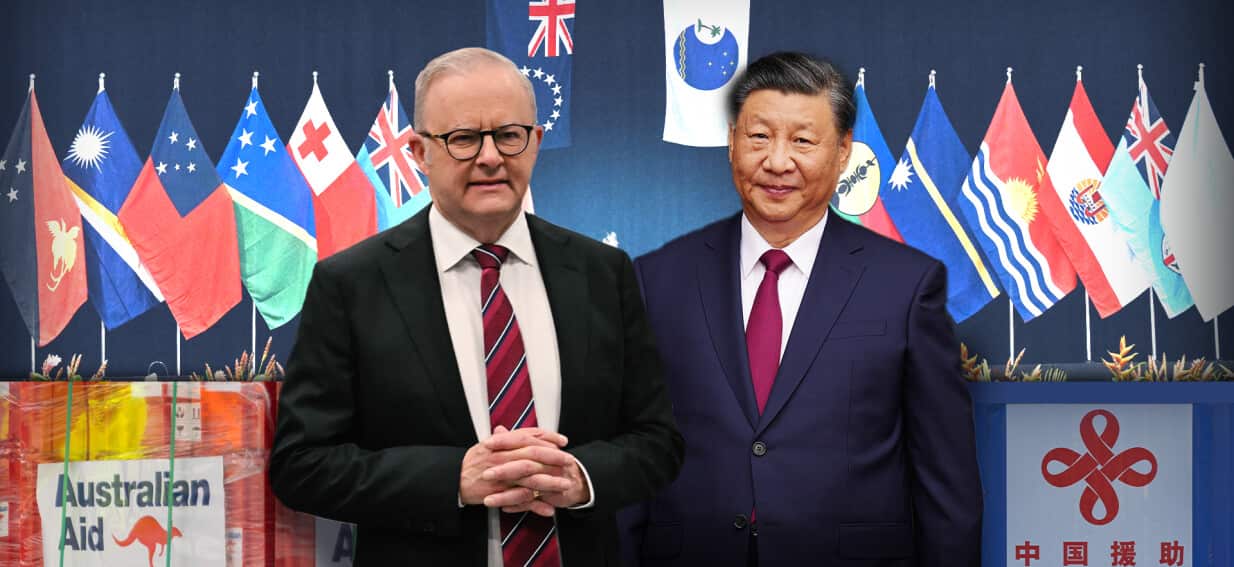
The air inside a diplomatic dispatch room always smells faintly of stale coffee and hot electronics. I remember standing in one such room years ago, watching a young analyst trace a red line across a map of the South Pacific with a yellow highlighter. To her, it was an exercise in geography. To the governments pouring billions of dollars into island chains thousands of miles away, it was a chessboard.
Right now, a six-billion-dollar race is unfolding across the blue expanse of our nearest neighbors. Australia finds itself tangled in this quiet struggle, not because it chose to be, but because geography is an unyielding master.
Look at the maps published in financial columns and think tanks. They show neat arrows, economic zones, and port facilities. They talk about influence as if it were a commodity traded on an exchange floor. But influence does not live on a balance sheet. It lives in the quiet conversations under corrugated tin roofs, in the hum of diesel generators keeping a regional hospital running, and in the rusted hulls of fishing boats bobbing in turquoise lagoons.
Strategy has changed. The old playbook relied on grand pronouncements, diplomatic handshakes, and checkbook aid dropped from the belly of a transport plane. Beijing realized long ago that manifests and memorandums of understanding do not win loyalty. Concrete does. Scholarships win loyalty. Access to international markets wins loyalty. When a coastal village in Solomon Islands needs a wharf built so their tuna can reach markets before spoiling, they do not ask about geopolitical alignment. They ask who brought the cement.
Australia is waking up to this reality, though the awakening is often clumsy. Canberra’s leaders peer across the water and see a security dilemma. The policymakers in Beijing see an economic frontier and an ideological horizon. The island nations themselves see something else entirely: a chance to bargain for their own survival in a warming, fractured world.
To understand what is happening, consider a hypothetical morning in the life of a civil servant in Port Vila or Suva.
She walks into her office, carrying a ledger filled with infrastructural deficits. Her nation needs a new seawall to stop the rising tide from swallowing the family cemetery. It needs a resilient undersea internet cable so children can download textbooks instead of waiting days for physical shipments. She has two phone numbers on her desk. One rings in a Western capital, tied up in environmental impact assessments, procurement committee reviews, and multi-year auditing cycles. The other rings in an Eastern capital, where a delegation arrived last Tuesday with a ready-to-sign contract, an engineering crew already waiting at the port, and no questions asked about domestic governance reforms.
Speed is a weapon. Bureaucracy is a vulnerability.
This is where the $6 billion figure stops being an abstraction and starts looking like a desperate scramble for relevance. Australia has realized that writing checks from afar is no longer enough. The Pacific Step-up, as Canberra officially terms its regional engagement strategy, was born from a sudden, cold panic. The panic of realizing that security pacts can be signed overnight while trust takes generations to build.
Yet, throwing money at an ocean does not automatically secure friends.
I have sat across from leaders in these island states who express a quiet exhaustion. They are courted by everyone and trusted by few. They watch superpowers posture about sovereignty while their own coastlines quietly erode beneath their feet. For them, the great power competition is an atmospheric pressure. It dictates the weather, but it rarely fills their stomachs.
When Australia responds with naval vessels, police training programs, and budget support, it operates from a framework of defense. When China responds with telecommunications networks, agricultural tech centers, and infrastructure loans, it operates from a framework of integration.
One model asks: Are you safe?
The other asks: Do you grow?
Nations do not choose security over prosperity when prosperity feels like the only shield against literal drowning. The existential threat of climate change remains the silent partner in every diplomatic negotiation across the Pacific. When sea levels rise, the country that offers elevated causeways and engineered shorelines wins a level of allegiance that no aircraft carrier can buy.
Australia’s challenge is not merely matching funds. It is reimagining partnership. For decades, the relationship was paternalistic, marked by the arrogance of the wealthy neighbor dictating terms to the aid recipient. That era is dying, even if some diplomats refuse to attend the funeral. The Pacific nations know their worth. They are sovereign entities with agency, playing the great powers against one another to secure the best possible deal for their people.
To call this a game is to misunderstand the stakes. If a miscalculation happens here, entire cultures face displacement, and regional stability fractures into a mosaic of competing security blocs.
The strategy shift in Beijing is subtle. It has moved away from grand, headline-grabbing debt traps—which generated fierce local pushback and international alarm—toward targeted, institutional, and digital footprints. Police cooperation agreements, localized media training, and digital surveillance infrastructure now take precedence over massive, empty port terminals. It is an integration of influence that weaves itself into the everyday administration of the state.
Australia’s counter-strategy must match this quiet permanence. It cannot be episodic. It cannot depend on which political party holds power in Canberra or whether the domestic budget is tight.
Consider the alternative. A fragmented Pacific, where regional architecture breaks down under the weight of competing intelligence apparatuses and militarized ports. Trade routes disrupted. Families divided by new invisible walls of alignment.
The red line the analyst drew on the map years ago was never just about shipping lanes or military containment. It was about people. Fishermen, teachers, nurses, and leaders who want to decide their own future without being treated as pawns on someone else's board.
As the sun sets over the coral sea, casting long shadows across atolls that have weathered millennia of storms, the modern empire builders sit in air-conditioned boardrooms drafting their next moves. But out on the water, the tide keeps coming in, indifferent to the billions changing hands, waiting only to see who is standing on the shore when the water finally reaches the doorstep.