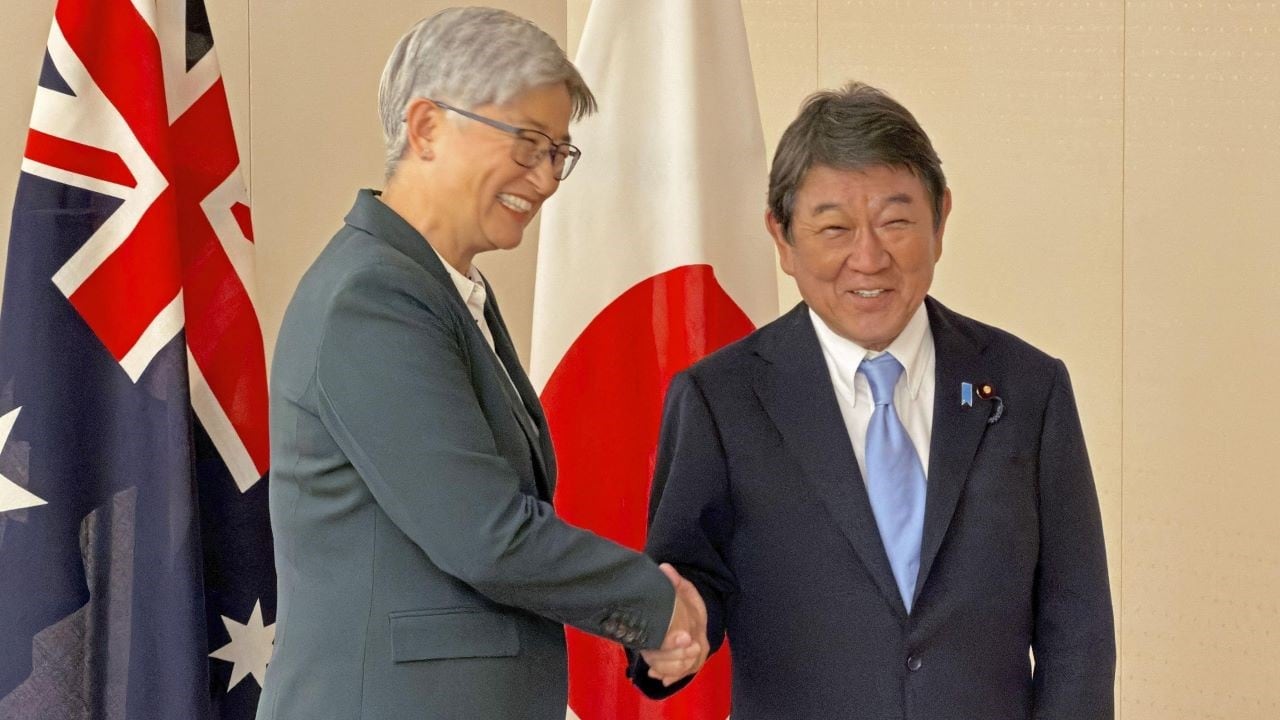
Diplomats love photo opportunities. They love them because handshakes and vague communiqués mask a uncomfortable truth: very little is actually happening. As the foreign ministers of Japan and Australia land in New Delhi for the latest Quadrilateral Security Dialogue meeting, the mainstream press is already churning out the predictable narrative. They will talk about "a free and open Indo-Pacific." They will hint at a united front against Chinese expansionism. They will make it sound like a nascent Asian NATO is being forged right before our eyes.
It is a comforting fantasy. It is also entirely wrong.
The lazy consensus among foreign policy pundits is that the Quad is a tightening military noose around Beijing. This view completely misunderstands the geometry of Asian geopolitics, the stubborn realities of geography, and the explicit strategic doctrine of New Delhi. India is not looking for a security umbrella, nor is it willing to act as one for Western allies. If you are expecting this ministerial meeting to yield a breakthrough mutual defense pact or a coordinated military strategy, you are watching the wrong channel.
The Quad is a diplomatic talk-shop masquerading as a security architecture. And that is exactly how India wants to keep it.
The Myth of the Asian NATO
To understand why the Quad will never become a formal military alliance, look at the structural design of NATO compared to the realities of the Indo-Pacific. NATO relies on article 5: an attack on one is an attack on all. It works because the North Atlantic is a contiguous geopolitical theater with a single, clear adversary during its formulation.
The Indo-Pacific is different. The four members of the Quad—the United States, Japan, Australia, and India—have vastly different vulnerabilities, economic dependencies, and strategic priorities.
Let’s look at the actual defense commitments on paper. The United States has formal, treaty-bound bilateral defense obligations with both Japan and Australia. If either country is attacked, Washington is legally obligated to step in. India has no such treaties with the West. It proudly maintains its strategic autonomy, a legacy of its non-alignment era that has been updated for the 21st century, not abandoned.
Consider the economic asymmetry. Australia’s largest trading partner is China. Japan’s largest trading partner is China. India, meanwhile, shares a heavily militarized, disputed 2,100-mile land border with China in the Himalayas. When tensions flare along the Line of Actual Control (LAC) in Ladakh, American aircraft carriers in the South China Sea do not deter Chinese infantry. Australian frigates cannot patrol the heights of the Galwan Valley.
India understands a brutal truth that Western analysts routinely ignore: in a shooting war with China, India fights alone.
Dismantling the Premise of "People Also Ask"
Look at the standard questions ordinary people—and uninformed analysts—ask about this partnership:
- Is the Quad a military alliance? No. It explicitly lacks a mutual defense treaty, a joint command structure, or integrated military forces.
- Will India sign a defense pact with the US against China? Never. Doing so would turn India into a junior partner in a superpower rivalry, compromising its sovereignty.
- Does the Quad deter Chinese aggression? Only rhetorically. Beijing is deterred by raw, hard power at the point of conflict, not by joint statements issued from air-conditioned rooms in New Delhi.
The premise of these questions is flawed because they assume India wants to be integrated into a Western security bloc. I have spent years tracking defense acquisitions and bilateral border negotiations in New Delhi. The view from South Block—the seat of India’s Ministry of External Affairs—is radically different from the view from the Pentagon or Canberra.
New Delhi views alliances as liabilities. An alliance means you inherit other people's enemies. India has enough of its own.
The Strategy of Multi-Alignment
What the mainstream media misses is the concept of multi-alignment. While Western commentators try to force India into a binary choice—either with the West or against it—India is busy playing a completely different game.
India is a member of the Quad. It is also a founding member of BRICS (alongside China and Russia) and the Shanghai Cooperation Organisation (SCO). To a Western mind, this looks like hypocrisy or indecision. To an Indian strategist, it is a masterclass in hedging risks.
       India's Multi-Alignment Web
     /              |             \
  The Quad        BRICS           SCO
(US, JP, AU)   (CN, RU, etc.)  (CN, RU, Central Asia)
By sitting in every room, India ensures that no single bloc can make decisions that harm its national interests. When the Japanese and Australian foreign ministers sit down with India's External Affairs Minister, they are not meeting an ally. They are meeting a sovereign actor that will cooperate on supply chain resilience, maritime domain awareness, and humanitarian assistance—but will politely decline any invitation to join a military coalition.
Follow the Money, Not the Communiqués
If you want to know what the Quad actually is, look at its working groups. They do not focus on joint submarine warfare or coordinated missile defense. They focus on:
- Critical and emerging technologies
- Climate change and clean energy supply chains
- Infrastructure and connectivity
- Counter-terrorism and cybersecurity
This is a bureaucracy designed for economic decoupling and soft-power projection, not warfighting. It is an agreement to build factories and secure microchips outside of China's sphere of influence. That is valuable work, but it is a far cry from the military containment strategy that hawk commentators in Washington like to boast about.
When India buys weapons, it does not buy them to integrate with the US military. It buys them to defend its own borders. India continues to import vast amounts of Russian military hardware, including the S-400 missile defense system, despite fierce pressure from Washington. It does this because Indian defense planners prioritize strategic flexibility over interoperability with Western forces. They want weapons that work for India, not weapons that talk to American satellites.
The Risk of Miscalculation
There is a genuine downside to India’s contrarian approach, and honesty demands we acknowledge it. By refusing to commit to a formal alliance, India risks finding itself isolated if a localized border conflict with China escalates into a full-scale war. If Beijing decides to test New Delhi’s resolve, India cannot trigger an Article 5 equivalent. It cannot demand that American troops deploy to the Himalayas.
But New Delhi has calculated that the alternative—becoming a frontline state in an American-led cold war against China—is far more dangerous. It would permanently alienate a powerful neighbor and lock India into a conflict dynamic that serves Washington’s global hegemony rather than India’s regional development.
Stop Looking for an Alliance
Do not read the upcoming joint statements expecting a shift in the regional balance of power. Do not get excited by phrases like "shared democratic values" or "deepening security cooperation." These are the standard diplomatic currencies used to buy headlines.
The Quad will remain a flexible, non-binding forum. It will continue to hold naval exercises like Malabar, but those exercises are symbolic gestures of goodwill, not dress rehearsals for a combined campaign.
India will continue to welcome the foreign ministers of Japan and Australia with full honors. It will sign deals on solar panels, trade routes, and student exchanges. But the moment the conversation turns toward building a collective military wall against Beijing, India will quietly, firmly, step back.
New Delhi is not looking for a savior, and it has no intention of being yours.